Hear From Our Clients
You’re not just getting new shingles. You’re getting a roof system engineered for Suffolk County’s coastal conditions—the kind that holds up when the next big storm rolls through.
That means hurricane-rated materials designed for winds over 110 mph. Ice and water shield in the valleys and eaves where leaks start. Proper ventilation so your attic doesn’t turn into a moisture trap. And flashing that won’t corrode from salt air in three years.
Most roof replacements in Islip run between $8,000 and $15,000 depending on size and material. That’s a real number, not a bait-and-switch estimate that doubles once we’re on your roof. You’ll know what you’re paying before we touch a shingle, and you’ll know exactly what you’re getting for it—a roof that protects your home and your family when Long Island weather does what it does.
Home Team Construction has spent over a decade replacing roofs across Suffolk County. We’re not a national franchise or a crew that shows up from three states over after a storm. We’re local roofers who live in the same communities we serve.
That matters because we know what Islip roofs go through. We’ve seen what happens when contractors cut corners on coastal installs—shingles that blow off in the first nor’easter, flashing that rusts out in two years, ventilation that creates ice dams every winter. We’ve fixed enough of those mistakes to know how to avoid them.
Every crew member is licensed and insured. Every job gets a workmanship warranty and manufacturer material coverage. And if a storm hits and you need emergency tarping while your insurance claim processes, we’re available—because storm damage doesn’t wait for business hours.
It starts with an inspection. We come out, get on your roof, and look at what’s actually going on—not what we can see from the driveway. If there’s storm damage and you’re filing an insurance claim, we’ll document everything and work directly with your insurance company to make sure you’re getting the coverage you’re entitled to.
Once we agree on scope and price, we pull permits and schedule the work. Most roof replacements take one to three days depending on size and complexity. We show up when we say we will, work efficiently, and clean up completely at the end of each day. You’ll get photo updates as we go so you can see the progress without climbing a ladder.
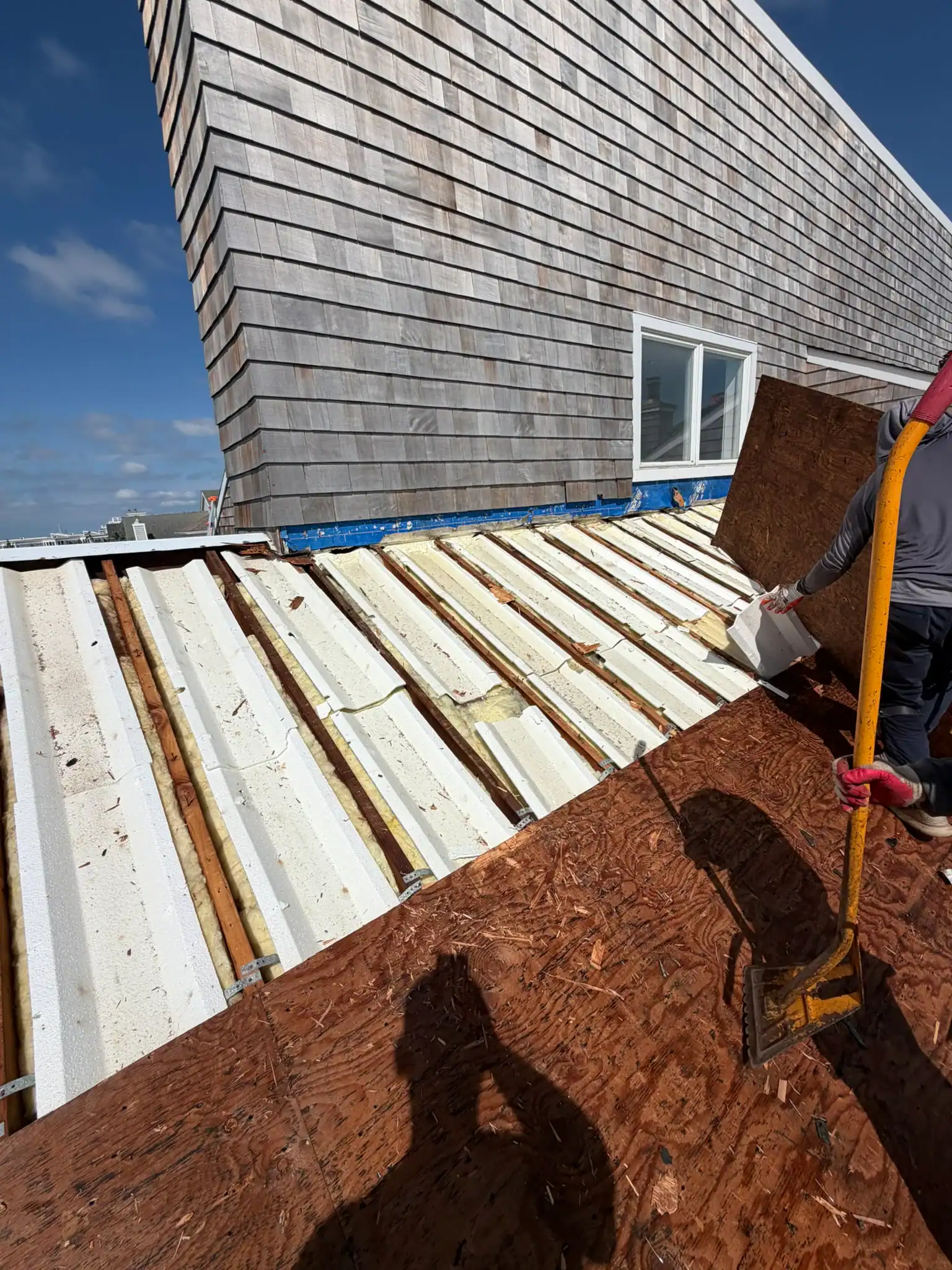
The actual replacement means tearing off the old roof down to the decking, inspecting for any rot or damage, then building it back up with the right materials in the right order. Underlayment goes down first. Then ice and water shield in critical areas. Then your shingles, installed to manufacturer specs so your warranty actually means something. Finally, new flashing, ridge vents, and a full site cleanup. When we’re done, your property looks better than when we started—and your roof is ready for whatever Long Island throws at it next.
Ready to get started?
Every roof replacement includes complete tear-off and disposal of your old roof. We don’t layer new shingles over old ones—that’s a shortcut that hides problems and voids warranties. You’re getting a fresh start from the decking up.
We handle all types of residential roofing: pitched roofs, flat roofs, garage roof replacement, additions, dormers. For pitched roofs, we typically install architectural asphalt shingles rated for high winds—they’re the best balance of performance, longevity, and cost for Long Island’s climate. For flat roofs, we use TPO or EPDM rubber roofing systems designed for proper drainage and UV resistance.
In Islip and across Suffolk County, coastal conditions mean extra attention to details that matter. We install premium underlayment as a secondary water barrier. Ice and water shield goes in valleys, around chimneys, along eaves—anywhere water can back up or penetrate. Ventilation gets sized correctly for your attic space to prevent moisture buildup and ice dams. And all flashing is installed to handle salt air corrosion, not just pass inspection.
You’ll also get help with the permit process and direct coordination with your insurance company if storm damage is involved. We’ve worked with every major insurer and know how to document damage so your claim gets approved. If you’re paying out of pocket, you’ll get transparent pricing up front—no surprises, no change orders unless we find structural damage that genuinely needs addressing.
Most residential roof replacements take one to three days from start to finish. A typical single-family home with straightforward access usually gets done in a day and a half. Larger homes, complex roof lines, or multiple dormers and valleys can push that to two or three days.
Weather affects the timeline. We don’t install roofing in rain or high winds—it’s not safe and it compromises the installation. If the forecast looks bad, we’ll reschedule rather than rush through a job that won’t hold up. Long Island weather can be unpredictable, especially during spring and fall, so we build some flexibility into the schedule.
If we find rot or structural damage during tear-off, that adds time. We won’t know what’s under your shingles until we remove them. Most roofs don’t have major issues, but if yours does, we’ll show you exactly what needs fixing and give you a price before proceeding. You’re never locked into repairs you didn’t agree to.
Most homeowners in Islip pay between $8,000 and $15,000 for a complete roof replacement with quality architectural shingles. That’s for a typical single-family home ranging from 1,500 to 2,500 square feet of roof area. Larger homes, steeper pitches, or premium materials will cost more.
The price includes everything: tear-off and disposal, new underlayment, ice and water shield, shingles, flashing, ridge vents, permits, and cleanup. You’re not paying for materials separately or getting hit with disposal fees at the end. One price covers the complete job.
If you’re replacing a flat roof or garage roof, pricing works a bit differently because the materials and installation process aren’t the same. Flat roofs typically run $5 to $10 per square foot installed depending on the membrane type. We’ll give you an exact quote after seeing your specific roof—pitch, access, condition, and any special requirements all factor into the final number.
It depends on your policy and the type of damage. Most homeowners insurance covers sudden storm damage—wind that rips off shingles, hail that dents or cracks them, falling trees or branches. What insurance typically won’t cover is gradual wear and tear or a roof that’s just reached the end of its lifespan.
The key is documentation. After a storm, we’ll inspect your roof and document any damage with photos and detailed notes. If there’s a valid claim, we’ll work directly with your insurance adjuster to make sure they see what we see. Insurance companies sometimes lowball damage or miss things during their initial inspection. Having a local roofing contractor who knows what to look for helps you get the coverage you’re entitled to.
Even if your claim gets approved, you’ll likely pay a deductible—usually between $500 and $2,500 depending on your policy. The insurance company pays the rest. We can work with you on timing so you’re not fronting the entire cost while waiting for the claim to process. And if you need emergency tarping to prevent further damage, we handle that immediately, then include it in the claim.
Architectural asphalt shingles rated for high winds are your best option for Long Island’s coastal conditions. They’re thicker and heavier than basic 3-tab shingles, which means they hold up better against nor’easters and hurricane-force winds. Look for shingles rated to at least 110 mph—preferably 130 mph if you’re close to the water.
Brands like GAF, Owens Corning, and CertainTeed all make quality architectural shingles with strong wind ratings and solid warranties. The specific product matters less than proper installation. Even the best shingles will fail if they’re not installed to manufacturer specs with the right underlayment, starter strips, and fastener placement. That’s where working with experienced local roofers makes a difference.
Metal roofing is another option if you want maximum durability and wind resistance. It costs more up front—typically double what architectural shingles run—but it lasts 40 to 50 years with minimal maintenance. Metal also sheds snow and ice better than asphalt, which matters during harsh Long Island winters. The tradeoff is cost and aesthetics. Not every neighborhood or HOA allows metal roofs, and not every homeowner wants that look.
Yes. Any roof replacement in Islip requires a building permit from the Town of Islip Building Department. The permit ensures the work meets current building codes and gets inspected for safety and quality. Skipping the permit might save a few hundred dollars up front, but it creates major problems if you ever sell your home or file an insurance claim.
We handle the permit process as part of every roof replacement. That means pulling the permit, scheduling inspections, and making sure everything passes. You don’t have to deal with the Building Department or worry about whether the work meets code. It’s all included in the job.
The permit cost varies depending on the size and scope of work, but it typically runs a few hundred dollars. That’s a small price for peace of mind and legal compliance. Some contractors skip permits to cut costs or avoid inspections—that’s a red flag. Any legitimate roof replacement company will pull permits automatically because it protects you and ensures the work is done right.
If your roof is over 20 years old and you’re seeing multiple issues—curling shingles, granule loss, leaks in different areas—you probably need a full replacement. Repairs make sense for isolated damage on a newer roof. They don’t make sense when you’re patching problems every year on a roof that’s near the end of its lifespan.
The math is straightforward. If repair costs are approaching 30% to 40% of what a full replacement would cost, just replace it. You’ll spend the money either way, but with a replacement you get a roof that’s good for another 25 to 30 years instead of limping along for two or three more.
We’ll give you an honest assessment after inspecting your roof. If repairs will genuinely solve your problem and buy you several more years, we’ll tell you that. If your roof is done and you’re throwing money at a losing battle, we’ll tell you that too. You’ll get a straight answer either way—not a sales pitch designed to maximize our invoice.
Other Services we provide in Islip