

Hear From Our Clients

When a roof replacement is done properly on a post-WWII Cape Cod or ranch home in North Lindenhurst, you stop chasing problems. No more water stains spreading across the ceiling after a nor’easter rolls through. No more wondering if this is the winter your attic finally lets go. You get a system that was installed for where you actually live not a generic install that treats your North Lindenhurst home like it’s somewhere in the midwest.
The low-pitch roofs that define so much of North Lindenhurst’s housing stock are particularly vulnerable to ice dams. When heat escapes through an under-ventilated attic which is common in homes built in this era it melts snow on the roof, and that water refreezes at the cold eaves and backs up under your shingles. A proper replacement addresses that at the source: the right underlayment, ice and water shield at every eave and valley, and a ventilation setup that actually works with your home’s design.
Beyond the structural side, there’s the financial one. A roof in poor condition affects your homeowner’s insurance, your ability to sell, and your peace of mind every time a storm warning pops up on your phone. Getting ahead of it before it becomes an emergency is almost always cheaper and far less stressful than waiting until water is coming in.
We’re a family-owned exterior contractor that has been serving North Lindenhurst and the broader Suffolk County area for over a decade. Every job is documented with photos and video including what’s found under the old shingles so you’re never left guessing about what was done or why. That level of transparency isn’t standard in this industry. Here, it’s just how things are done.
Alban, our owner, is the person customers talk to from estimate through completion. Reviewers have named him specifically not just the company because he shows up, explains what he’s looking at, and doesn’t disappear after the contract is signed. For homeowners in North Lindenhurst who’ve dealt with contractors that send a crew and vanish, that difference is significant.
From the post-WWII ranches off Wellwood Avenue to the split-levels closer to the Farmingdale border, we’ve worked on the kind of homes that define North Lindenhurst. The Town of Babylon’s permit requirements, the South Shore’s storm profile, the housing stock’s specific vulnerabilities none of that is new territory for our crew.

It starts with an inspection and a written, itemized estimate. Not a lump sum with fine print a line-by-line breakdown that covers tear-off, disposal, deck inspection, underlayment, ice and water shield, flashing, ventilation, shingles, and cleanup. That way, if we open up the roof and find deteriorated decking underneath which happens more than you’d think on homes built in the 1940s and 50s you already know how that gets handled. No surprises mid-job.
Before any work begins, we pull the required building permit through the Town of Babylon’s Building Division over at Town Hall on Sunrise Highway in Lindenhurst. That permit triggers a final inspection once the job is complete, which gives you documented proof that your new roof meets local building code. Skipping that step might save a contractor a few days, but it creates real problems for you at resale or when filing an insurance claim.
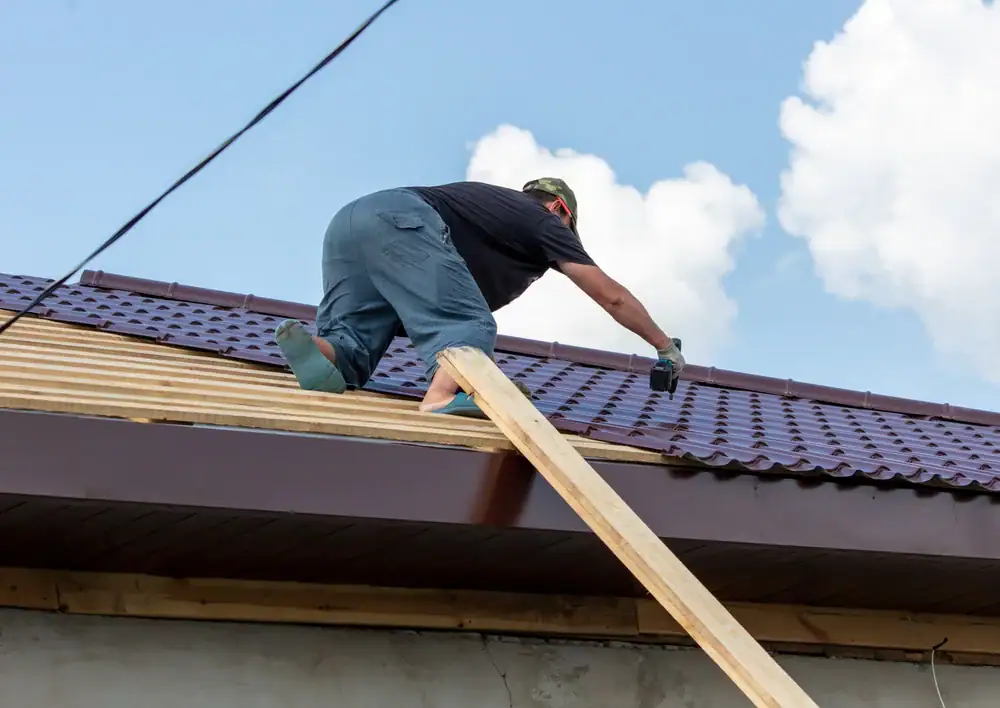
On installation day, the old roof comes off completely no overlay, no shortcuts. Every layer of the new system goes down in the right order, and the entire job is photographed and filmed as it progresses. When our crew leaves, the site is cleaned, a magnet sweep is run for nails, and you receive the documentation of everything that was done. That’s the whole job, start to finish.

Ready to get started?
Every roof replacement through our company is a full tear-off and reinstall not a layer-over. That matters because overlays trap moisture, add weight to a deck that may already be compromised, and hide problems that only get worse. On a home that’s been standing since the 1950s, what’s under those shingles deserves a real look before anything new goes on top.
The materials we install are selected for where you live. North Lindenhurst sits in the Town of Babylon on Long Island’s South Shore, where nor’easters come through multiple times a year and coastal humidity accelerates shingle wear. The 3-tab shingles that were standard when many of these homes were last re-roofed offer around 60 to 70 mph wind resistance. That’s not enough for this area. Architectural shingles rated for 110 to 130 mph winds are the baseline here not an upgrade, just the appropriate choice for the South Shore’s storm exposure.
If financing is what’s been holding things back, we offer 18 months interest-free, which removes the need to delay a replacement you already know you need. The average full replacement in North Lindenhurst runs between $8,000 and $15,000 depending on roof size and condition and acting before a leak forces your hand almost always keeps that number closer to the lower end.
Yes roof replacement in North Lindenhurst requires a building permit through the Town of Babylon’s Building Division. The application is processed at Babylon Town Hall on Sunrise Highway in Lindenhurst, and it requires your contractor’s New York State Home Improvement Contractor license number, a property survey, and a completed application. Permit fees typically run between $150 and $350, and processing takes around five to ten business days in most cases.
Once the job is complete, a final inspection is required. That inspection creates an official record that your new roof was installed to code which matters when you go to sell your home, file a homeowner’s insurance claim, or simply want confirmation that the work was done correctly. Contractors who skip permits save themselves the paperwork and leave you with the liability. We handle the entire permit process as part of every job in North Lindenhurst, so you don’t have to manage it yourself.
For a standard asphalt shingle replacement on a typical North Lindenhurst home, you’re generally looking at somewhere between $8,000 and $15,000, with around $11,500 being a reasonable midpoint for an average-sized house. That range moves based on the size of your roof, the pitch, how many layers need to come off, and what the deck looks like once the old shingles are removed.
The post-WWII homes that make up most of North Lindenhurst’s housing stock the Cape Cods, ranches, and split-levels built in the 1940s through the 1960s sometimes have original or early-replacement decking that’s deteriorated beneath the surface. If that’s the case, deck repairs add to the total. That’s exactly why itemized estimates matter: you should know before the job starts how deck repairs are priced and handled, not find out when the old shingles are already in the dumpster. Our estimates break all of that down in writing before any work begins.
The honest answer is that it depends on what’s actually going on up there and you can’t always tell from the ground. Missing shingles, visible granule loss in your gutters, and curling or cupping at the edges are signs that the roof is aging out. But the more telling indicators are often less visible: water stains on your ceiling or attic sheathing, daylight showing through in the attic, or soft spots on the deck when walked.
For North Lindenhurst homes built in the 1940s and 50s, age alone is a serious factor. Asphalt shingles in Long Island’s coastal climate typically last 15 to 20 years shorter than the 25 to 30 years you’d see in a milder inland climate, because the South Shore’s humidity, salt air, and storm frequency wear materials down faster. If your roof is approaching or past that window, a repair might buy you a season or two, but it’s rarely the smarter financial move. A proper inspection will tell you which situation you’re actually in.
An overlay means new shingles go directly on top of the old ones. It’s faster and cheaper upfront, but it creates real problems down the line. Layering new shingles over old ones traps moisture between the layers, adds significant weight to a roof deck that may already be weakened, and makes it impossible to inspect the deck for rot, soft spots, or structural damage before the new material goes down.
On a home built in the 1940s or 50s in North Lindenhurst, that hidden deck condition is not a minor concern it’s a genuine unknown until the old shingles come off. An overlay buries that unknown under another layer of material and calls it done. A full tear-off removes everything, exposes the deck for inspection, addresses any damage found, and gives the new roofing system a clean, solid foundation. We only do full tear-offs. It’s not a policy for the sake of it it’s the only approach that actually makes sense on housing stock this age.
For most homes in North Lindenhurst, architectural asphalt shingles are the right call. They’re durable, cost-effective, and when you choose the right product rated for the kind of wind exposure the South Shore actually sees. The key word there is rated. Standard 3-tab shingles carry a wind resistance of around 60 to 70 mph. Nor’easters that track up the Atlantic coast regularly exceed that, and the Town of Babylon’s position on Great South Bay means coastal storms hit with real force in North Lindenhurst.
Architectural shingles rated for 110 to 130 mph winds are the appropriate baseline for this area not an upgrade tier, just the minimum that makes sense given the local storm profile. Beyond the shingles themselves, the full system matters: synthetic underlayment, ice and water shield at all eaves and valleys to protect against the ice dams common on North Lindenhurst’s low-pitch roofs, properly installed flashings at every penetration, and a ventilation setup that works with your attic. The shingle is just the top layer what’s underneath it determines how the whole system performs.
It can and usually in a positive direction. Insurance carriers look at roof age and condition when determining your premium and coverage terms. An aging roof on a home in the Town of Babylon, where storm frequency is real and coastal exposure is a documented risk factor, can result in higher premiums or coverage limitations. After Hurricane Sandy, homeowners across the broader Babylon area saw insurance rates climb, and carriers became more attentive to roof condition as part of underwriting.
Replacing an aging roof with a properly permitted, code-compliant installation can make you eligible for lower premiums, especially if the new roof includes impact-resistant shingles. It also removes a common reason carriers reduce payouts on storm damage claims if your roof was already near end of life when damage occurred, the claim settlement often reflects that. A new, documented installation with a passing Town of Babylon final inspection gives you a clean record to present to your insurer, which is a meaningful asset the next time a nor’easter comes through and you need to file.
Other Services we provide in North Lindenhurst