Hear From Our Clients
The obvious part is the leak stops. But the part most homeowners in Farmingville don’t think about until it’s too late is what a failing roof does to everything underneath it insulation, framing, ceilings, and the long-term value of a home worth over $650,000 in today’s Farmingville market. A properly replaced roof protects all of that, not just the surface.
Here’s what’s specific to Farmingville: homes sit on the Ronkonkoma Moraine, which means elevated terrain, steeper pitches on a lot of older homes, and wind exposure that flat-terrain towns like Holbrook or Holtsville simply don’t deal with the same way. That matters when it comes to how a roof is installed shingle selection, fastener placement, flashing at the ridgeline. These details aren’t optional here.
About 67–70% of Farmingville’s housing stock was built between 1950 and 1979. If your home falls in that range and the roof hasn’t been replaced since the early-to-mid 2000s, you’re at or past the typical 15–20 year lifespan for asphalt shingles in coastal Suffolk County. The freeze-thaw cycle alone temperatures swinging above and below freezing repeatedly every winter accelerates wear in ways that don’t show up until water already has a path in. Getting ahead of it is almost always cheaper than reacting to it.
Home Team Construction is based in Mastic, right along Horseblock Road the same County Route 16 corridor that runs directly through Farmingville. That’s not a coincidence. We’ve been working in Brookhaven Town for over a decade, pulling permits from the same Building Division that sits at Town Hall on Independence Hill, right here in Farmingville.
Owner Alban runs the operation personally. His name shows up in reviews because he’s actually on the jobs not routing your project through a subcontractor network while someone in a call center handles your questions. When we say we’re local, it means something specific: same jurisdiction, same permit process, same roads, same neighbors.
We handle roof replacement alongside gutters, siding, chimneys, skylights, and decks which matters in a community where a lot of homes are hitting multiple systems reaching end-of-life at the same time. One contractor, one standard of work, one point of contact.
It starts with a free inspection photos included. We get on the roof, document what we find, and give you a straight answer: replacement, repair, or nothing yet. If replacement is the right call, you get a fully itemized estimate. Not a single number, but a line-by-line breakdown of tear-off, disposal, deck inspection, underlayment, ice and water shield, flashing, ventilation, shingles, and cleanup. You’ll know exactly what you’re paying for before anything is signed.
Once you move forward, we handle the Brookhaven Town building permit. That’s not something to skip unpermitted roofing work in Brookhaven creates real problems at resale, and since Town Hall is right here in Farmingville, local buyers and their attorneys know what to look for. We pull the permit, we follow the process, and your completed roof has the documentation to back it up.
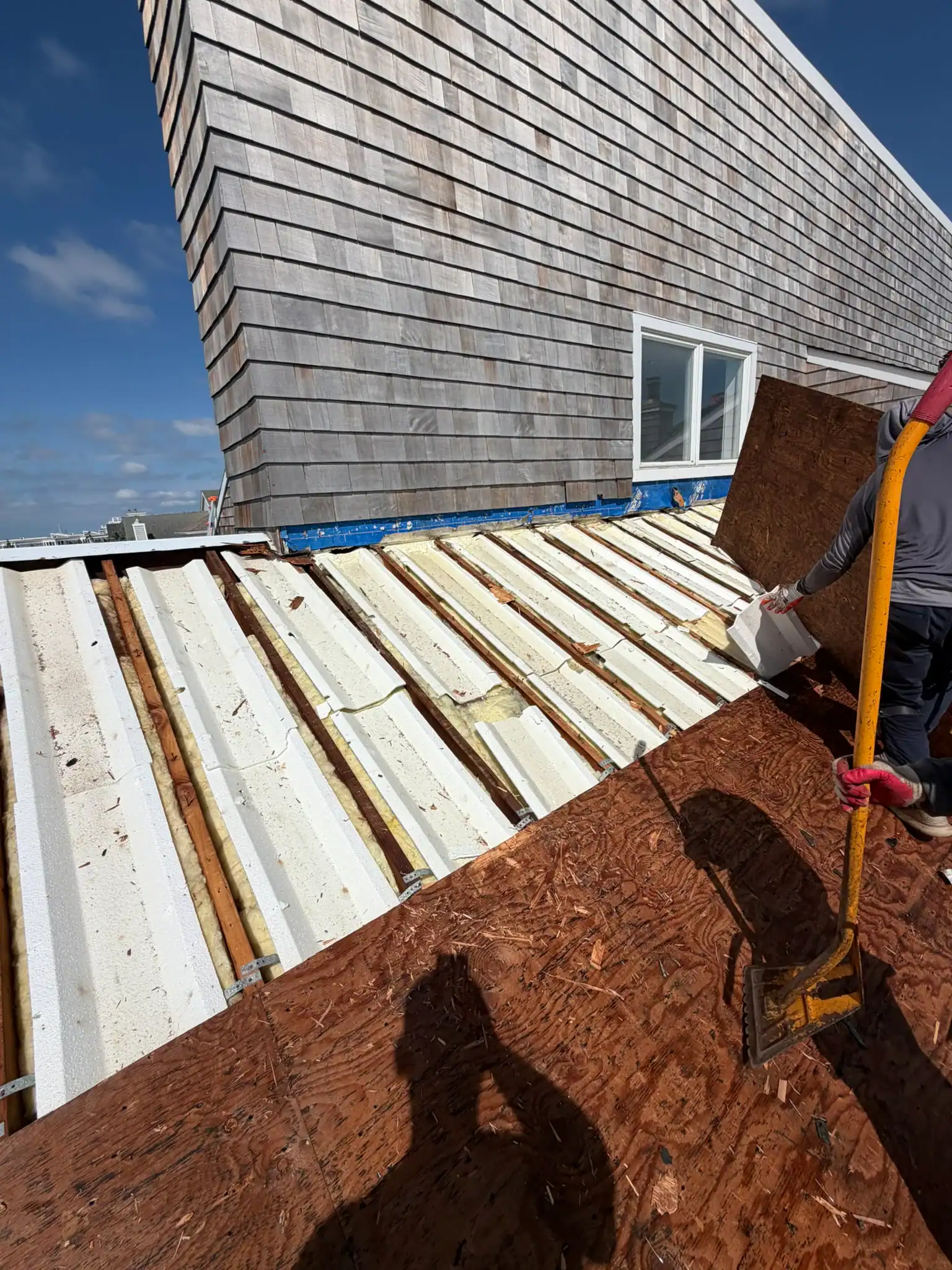
On installation day, we tear off the old system, inspect the decking, and address any rotted or damaged boards before anything goes back on. If we find something unexpected under the surface and on homes built in the 1960s and 70s, that happens we show you documentation and talk through options before any additional work is done. After the job, you get photos and video of the completed work: the deck, the underlayment, the flashings, the full system. That record is yours to keep.
Ready to get started?
Farmingville’s climate demands more than a basic shingle swap. Standard 3-tab shingles carry a 60–70 mph wind rating that’s not enough for a community on the Ronkonkoma Moraine that sees nor’easters with near-hurricane-force winds every few years. We install architectural (dimensional) shingles rated for 110–130 mph winds as the baseline, with proper fastening patterns and flashing details that hold up when the weather actually tests them.
Ice and water shield at the eaves and valleys isn’t an upgrade here it’s a requirement. Many of Farmingville’s older homes were built before modern ventilation standards existed, which means heat escapes through the roof deck, melts snow at the ridge, and refreezes at the eaves. That’s how ice dams form and force water back under the shingles. We address ventilation as part of every replacement, not as an afterthought.
Every job we complete includes full tear-off of the existing system, deck inspection and repair as needed, proper underlayment, all flashing at penetrations and transitions, and complete post-job cleanup including nail sweeping. The finished project comes with a written workmanship warranty and photo documentation of the completed system. We offer financing for qualifying projects 18 months interest-free which makes it easier to address a failing roof now rather than letting water damage compound the cost while you wait.
Yes Brookhaven Town requires a building permit for roof replacement, and since Brookhaven Town Hall is physically located in Farmingville at 1 Independence Hill, this isn’t a gray area. The permit process requires a completed application, the contractor’s Suffolk County Home Improvement Contractor (HIC) license, and proof of general liability and workers’ compensation insurance. Skipping the permit might not seem like a big deal until you go to sell or refinance at which point unpermitted work surfaces during title review, and you may be required to retroactively permit or remediate it.
We pull the Brookhaven building permit as a standard part of every roof replacement we do. You don’t have to chase it down or figure out the process yourself. When the job is done, your roof is fully permitted and documented which protects you now and at every future transaction.
For a typical single-family home in Farmingville, a full asphalt shingle roof replacement generally runs between $8,500 and $20,000+, depending on the size of the home, the pitch and complexity of the roof, the condition of the existing deck, and the materials selected. Homes on or near Bald Hill with steeper pitches or multiple roof planes will typically land toward the higher end of that range due to the additional labor and material requirements.
Material costs have risen significantly roughly 6–10% in 2025 alone, following a near-30% run-up since 2022 so estimates from a few years ago are no longer reliable benchmarks. The best way to get an accurate number for your specific Farmingville home is a free on-site inspection with a written, itemized estimate. That way you’re comparing real line items, not a single number that leaves you guessing about what’s actually included.
The honest answer is that it depends on what’s actually happening with your specific roof and you shouldn’t have to guess. A few signs that lean toward replacement rather than repair: shingles are curling, cracking, or losing granules broadly across the surface (not just in one spot), the roof is 15–20 years old or older, you’re seeing daylight or moisture in the attic, or you’ve had multiple repairs in the last few years that keep coming back.
For Farmingville homes built in the 1960s and 70s which is the majority of the housing stock here many are on their second or third roof cycle. If the last replacement was done around 2005 or earlier, you’re at or past the typical lifespan for asphalt shingles in coastal Suffolk County’s climate. A free inspection with photo documentation gives you a clear picture of where things actually stand, so the decision is based on real information rather than a sales pitch.
For homes in Farmingville specifically, architectural (dimensional) asphalt shingles rated for 110–130 mph winds are the appropriate baseline. Standard 3-tab shingles are rated for 60–70 mph which sounds like enough until you factor in that Long Island has absorbed 45+ hurricanes since 1930, and nor’easters regularly produce wind gusts in that same range. On the elevated terrain of the Ronkonkoma Moraine, wind exposure is higher than in lower-lying communities, which makes the wind rating on your shingles a real consideration, not just a spec sheet number.
Beyond the shingles themselves, the underlayment, ice and water shield, and ventilation system matter just as much for Long Island’s climate. Freeze-thaw cycling through the winter, heavy snow loads, and the moisture that comes with humid coastal air all affect how long a roof lasts and how well it performs. We select materials appropriate for these actual conditions not just whatever’s cheapest or most common.
For most single-family homes in Farmingville, the physical installation tear-off, deck inspection, and full replacement is typically completed in one to two days. Larger homes, steeper pitches, or roofs with significant deck damage discovered during tear-off can add time, but the majority of jobs wrap within a standard workday or two.
The full timeline from your first call to completed installation includes the inspection, the estimate review, permit filing with Brookhaven Town, and scheduling. Depending on the time of year, that process can take anywhere from a week to a few weeks. Fall tends to be the busiest season as homeowners push to get work done before the first snow, so if you’re thinking about moving forward, earlier in the season typically means a faster slot. We give you a realistic timeline upfront not an optimistic one designed to close the sale.
After every major nor’easter or tropical system that hits central Suffolk County, contractors from outside the area move into communities like Farmingville going door to door, claiming they spotted damage from the street, and pushing for a deposit before you’ve had time to think. It’s a real pattern, and it’s not limited to any one storm season.
The most reliable way to protect yourself is to verify before you commit. Ask for the contractor’s Suffolk County Home Improvement Contractor (HIC) license number and look it up it’s publicly searchable. Ask for proof of general liability and workers’ compensation insurance. Check that they have a real local address, not just a phone number. And under New York General Business Law, any home improvement contract over $500 must be in writing and must include the contractor’s license number if a contractor resists either of those things, that’s your answer. A contractor who’s been working in Brookhaven Town for years, pulling permits from the same Town Hall that’s down the road in Farmingville, doesn’t need to knock on your door after a storm to find work.
Other Services we provide in Farmingville