Hear From Our Clients
A roof replacement in Hampton Bays isn’t the same job it is twenty miles west. You’re surrounded by open water on three sides the Atlantic to the south, Shinnecock Bay to the east, Peconic Bay to the north and that triple exposure accelerates everything. Salt air strips granules off asphalt shingles faster than UV alone. Metal flashings oxidize quicker. Moisture finds its way in at every seam and penetration point, often before you notice anything from the inside.
The result is that coastal Suffolk County roofs typically last 15 to 20 years, not the 25 to 30 you’d get in a milder inland climate. If your home is one of the mid-century cottages near Tiana Bay or an older year-round house off Montauk Highway, there’s a real chance your roof is already working on borrowed time even if it hasn’t started leaking yet.
When you replace it with the right materials and the right installation, you stop the cycle. Proper ice and water shield at the eaves handles the freeze-thaw damage that builds up every winter. Correctly installed ridge ventilation reduces the heat and moisture buildup that shortens shingle life from the inside out. And with a home worth what Hampton Bays homes are worth right now, a roof that actually holds up isn’t just a maintenance call it’s protecting a serious investment.
Home Team Construction is a family-owned exterior contractor based in Mastic, just west of Hampton Bays. We’ve been doing this for over ten years, and every job we take on from the South Shore to the East End goes out under the same standard. No subcontracting your project to whoever’s available. No lump-sum estimates that leave you guessing. No disappearing act after the check clears.
Alban, our owner, is the person customers mention by name in reviews not because it’s a selling point, but because he’s actually there. He’s walked roofs from Good Ground to Dune Road, and he’ll tell you honestly whether you need a full replacement or whether a targeted repair makes more sense right now. That’s not a common thing in this market, and the customers who’ve worked with us know it.
We carry full general liability and workers’ compensation insurance, and we handle Town of Southampton permit compliance as a standard part of every qualifying job. If you’re managing a seasonal property near Shinnecock Bay and can’t be on-site every day, that accountability matters more than almost anything else.
It starts with a free inspection. We get on the roof, document what we find with photos, and give you a written assessment of the actual condition not a sales pitch. If a repair is the honest answer, we’ll tell you that. If replacement is the right call, we’ll show you exactly why.
From there, you get an itemized estimate. Every line broken out: tear-off and disposal, deck inspection, underlayment, ice and water shield, flashings, ridge ventilation, shingles, and cleanup. You’ll know what each component costs and why it’s included. In Hampton Bays, where deck damage from moisture intrusion and salt-accelerated deterioration is more common than in inland areas, that transparency matters because surprises after the old roof comes off are how estimates turn into arguments.
Once you approve the scope, we pull the required Town of Southampton building permit. Under Southampton Town’s building code, any full tear-off that exposes the sheathing requires a permit which is every legitimate replacement job. We handle that process start to finish. On the day of the job, we complete the tear-off, inspect and repair the deck as needed, install the full roofing system, and do a thorough cleanup including a nail sweep of the surrounding area. When we’re done, you get photo and video documentation of the completed work including what was found under the old roof and how everything was installed. For homeowners managing properties remotely, that record is something no competitor in this market is currently offering.
Ready to get started?
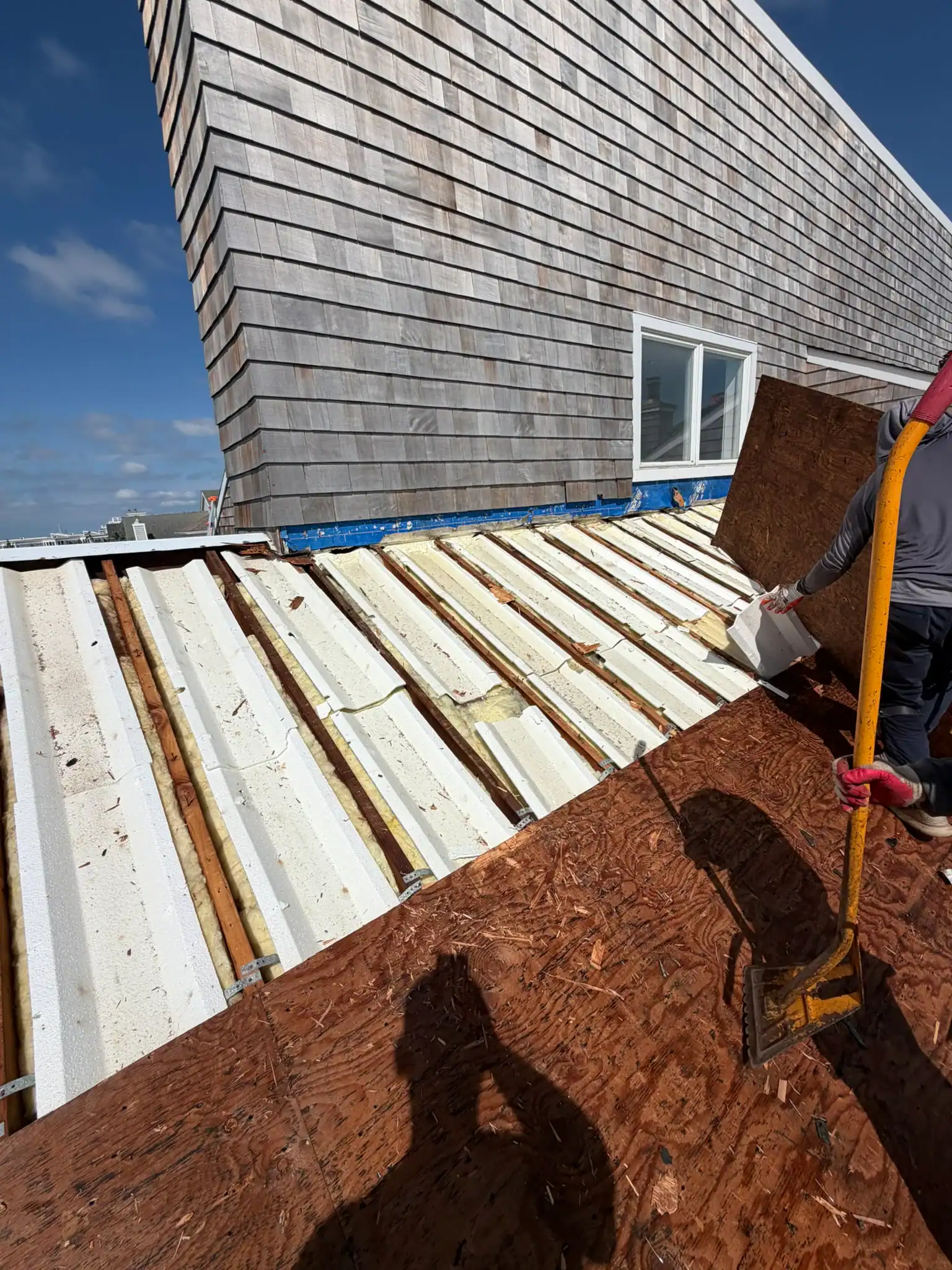
A full roof replacement with Home Team Construction covers the complete system not just the shingles on top. We start with a full tear-off of the existing roofing material down to the deck, then inspect every square foot of sheathing for rot, soft spots, and moisture damage. In Hampton Bays, especially on older homes near Tiana Bay or along the waterfront corridors, deck damage is common and often invisible until the old roof comes off. We document what we find and repair it before anything new goes on.
The new system includes synthetic underlayment across the full deck, ice and water shield at all eaves and valleys critical in a climate where freeze-thaw cycles and nor’easter-driven ice dams are a real annual risk and new flashings at every penetration point, including chimney bases, pipe boots, and wall transitions. We finish with properly installed ridge ventilation to extend the life of the new system from the inside out, and the shingles go on last, installed to manufacturer specifications to preserve the full warranty.
Material selection is deliberate for this environment. The shingles, flashings, and underlayment components we use are rated for coastal wind and salt exposure. We also offer 18-month interest-free financing on qualifying projects, which gives you the option to move forward now rather than wait while a compromised roof continues to deteriorate through another East End winter.
Yes and it’s worth understanding exactly when. Under Southampton Town’s building code, a roof replacement does not require a permit if you’re only replacing the surface layer without exposing the sheathing. But any full tear-off replacement the kind that involves removing everything down to the deck so you can inspect and repair the sheathing does require a building permit from the Town of Southampton Building Department.
Every legitimate full replacement job exposes the sheathing. That’s the whole point you need to see what’s underneath. So if a contractor tells you no permit is needed for a complete tear-off and replacement, that’s a red flag worth taking seriously. Unpermitted work on a high-value Hampton Bays property can complicate title searches, create issues during a sale, and in some cases void manufacturer warranties. We handle the permit process as a standard part of every qualifying job, so you’re covered from inspection to final sign-off.
Shorter than most manufacturers’ estimates suggest, and shorter than what you’d see in an inland market. Asphalt shingle roofs in coastal Suffolk County particularly in communities like Hampton Bays that sit between the Atlantic Ocean and Shinnecock Bay typically last 15 to 20 years under real-world conditions. The standard 25 to 30-year lifespan you see on shingle packaging is based on moderate inland climates, not the combination of salt air, UV exposure, wind uplift, and freeze-thaw cycling that your roof deals with every year.
Salt air is the biggest accelerant. It degrades the granule layer on asphalt shingles faster than UV alone, which is what those granules are there to resist. Once granule loss reaches a certain point, the shingle itself starts breaking down quickly. If your Hampton Bays home is 15 or more years old and hasn’t had a roof replacement, an inspection is worth doing not because replacement is automatically the answer, but because you should know where you actually stand before the next nor’easter makes the decision for you.
For a standard asphalt shingle replacement on a mid-size single-family home in Hampton Bays, you’re typically looking at somewhere in the $12,000 to $22,000 range. Larger homes, more complex rooflines, steeper pitches, or significant deck damage discovered during tear-off will push that number higher. Homes on Dune Road or along the waterfront corridors tend to run toward the upper end of that range or beyond, given their size and the extent of coastal wear that often shows up once the old roof comes off.
The most important thing to understand about pricing is what the estimate actually includes. A lump-sum number with no breakdown is not a useful quote it’s just a number. An itemized estimate that shows you the cost of tear-off, deck repair, underlayment, ice and water shield, flashings, ventilation, shingles, and cleanup is something you can actually evaluate and compare. That’s what we provide, and it’s the only way to know whether two quotes are really comparing the same job. Roofing material costs have also risen in 2025, so if you’re working from an older estimate, it’s worth getting a current one before making a decision.
For most Hampton Bays homes, architectural asphalt shingles also called dimensional or laminate shingles are the right call. They’re rated for high-wind uplift, they carry strong manufacturer warranties, and when you select a product specifically rated for coastal exposure, they perform significantly better than standard three-tab shingles in a salt-air environment. The specific product matters as much as the category, which is why material selection should be part of the conversation during your estimate, not an afterthought.
Beyond the shingles themselves, the components underneath them are what really determine how well a coastal roof holds up. Ice and water shield at the eaves and valleys is non-negotiable in this climate nor’easters drive water horizontally, and standard underlayment isn’t designed for that. Stainless steel or properly coated aluminum flashings resist salt-air corrosion far better than galvanized alternatives. And ridge ventilation isn’t just about energy efficiency it’s about keeping the underside of the deck dry, which is what prevents the kind of sheathing rot that shows up on Hampton Bays roofs that were installed without adequate airflow.
The first priority is stopping any active water intrusion. If you have visible damage missing shingles, exposed decking, a leak showing up inside temporary tarping or emergency patching buys you time until a proper assessment and repair or replacement can happen. Don’t wait on this. In Hampton Bays’ wet, salt-air environment, even a small opening in the roofing system can allow moisture to reach the sheathing, insulation, and framing quickly, and the downstream damage compounds fast.
Once the immediate situation is stabilized, get a documented inspection before you call your insurance company. Photos and a written assessment of the damage give you a clear record of what the storm caused, which matters significantly when you’re filing a claim. If your insurer sends an adjuster, having your own documentation including photos of the pre-existing roof condition versus the new damage protects you from disputes about what was storm-related and what wasn’t. We offer free post-storm inspections with photo documentation, and we can walk you through what we found before you decide on next steps.
The honest answer is that it depends on the age of the roof, the extent of the damage, and what the deck looks like underneath. A targeted repair makes sense when the damage is isolated a few missing shingles, a failed flashing, a single leak point on an otherwise sound roof that still has years of life left. A full replacement makes more sense when the shingles are at or past the end of their coastal lifespan, when granule loss is widespread, when you’re seeing multiple failure points across the roof, or when the deck itself has deteriorated to the point where patching the surface doesn’t address the underlying problem.
In Hampton Bays specifically, the age factor matters more than it does inland. A 17-year-old roof in a milder climate might have another decade left. That same roof near Shinnecock Bay has likely been through enough salt air, freeze-thaw cycles, and storm seasons that the math is different. The way to know for certain is a thorough inspection not a drive-by estimate, but someone actually getting on the roof, documenting what they see, and giving you a straight read on where things stand. That’s what our free inspections are for, and there’s no obligation attached to the answer you get.
Other Services we provide in Hampton Bays