

Hear From Our Clients

When a roof replacement is done right, you stop thinking about your roof. No more checking the ceiling after a nor’easter rolls through. No more wondering if that dark spot near the chimney is something or nothing. You just live in your house and that’s how it should be.
For Islip Terrace homeowners, that peace of mind matters more than it might somewhere else. The South Shore weather envelope that runs from Great South Bay through Fire Island Inlet puts real stress on roofing systems year-round. Salt-air humidity accelerates granule loss. Freeze-thaw cycles in January and February drive ice dams along eaves and valleys. Summer storms roll through fast and hard. A roof that was installed with the right underlayment, proper ice and water shield in the right places, and shingles rated for coastal wind loads handles all of that differently than one that wasn’t.
Most of the housing stock in Islip Terrace the ranches and hi-ranches built in the 1950s and 1960s is now old enough that a second or even third roof is overdue. If your home is in that range, the question isn’t really whether you need a replacement. It’s whether you want to do it on your schedule or after something fails. A free inspection gives you that answer in writing, with photos, so you’re deciding with real information instead of guessing.
Home Team Construction is a family-owned exterior company based in Mastic, Suffolk County on the same South Shore corridor as Islip Terrace. We’ve been working on Long Island roofs for over 10 years, and every job we’ve taken has been right here in Suffolk County. Not a regional chain. Not a franchise. A local crew that knows what coastal weather does to a 1960s hi-ranch in the Town of Islip.
Alban, the owner, is on the job not managing from an office somewhere. Customers mention him by name in reviews because he shows up, tells you what he actually found, and doesn’t push a full replacement when a repair will do. That kind of honesty builds a reputation in a tight-knit hamlet like Islip Terrace, where word travels fast.
Every job comes with photo and video documentation of the completed work so you can see exactly what was done under your old shingles. No other local competitor offers that as a standard part of the process.
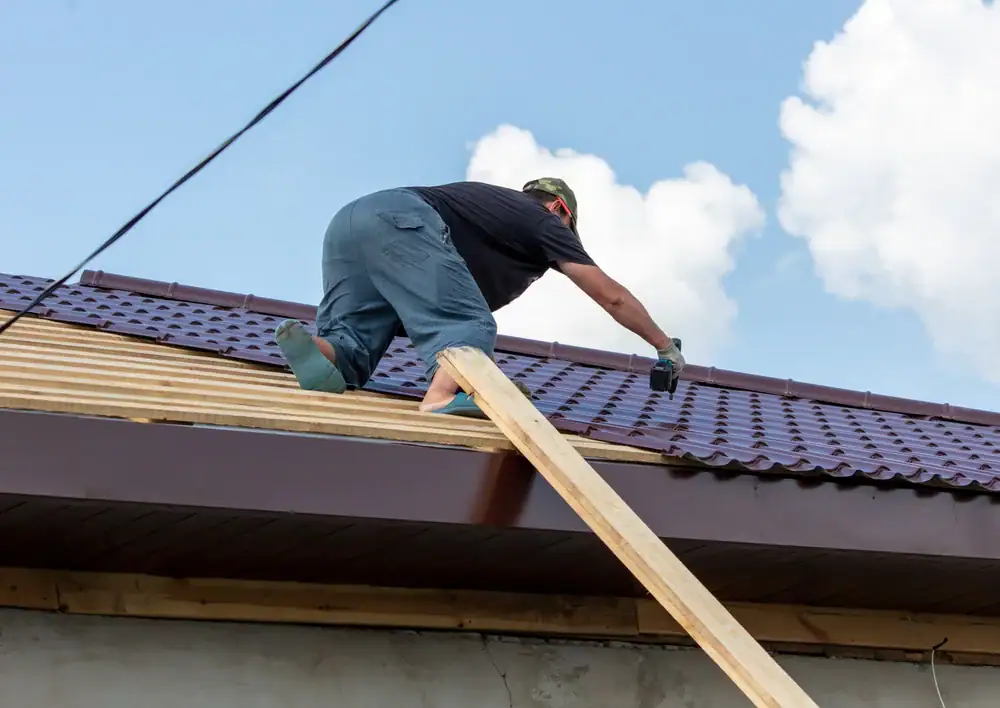
It starts with a free inspection. We come out, get on the roof, and document what we find current shingle condition, flashing details, ventilation, decking where it’s visible, and any areas showing early signs of failure. You get a written assessment with photos. If a repair is the right call, we’ll tell you that. If a full replacement is what the roof needs, we’ll walk you through exactly why.
From there, you receive a fully itemized estimate. Every line item is spelled out tear-off and disposal, deck inspection and any necessary repairs, underlayment, ice and water shield placement, flashing at every penetration and transition, ridge ventilation, shingles, and final cleanup. Nothing is bundled into a vague lump sum that leaves room for surprises once the old roof comes off.
Before any work begins, we pull the required building permit through the Town of Islip Building Division. That’s standard on every job not optional, not something we skip to move faster. Once the permit is in hand, our crew arrives, completes the tear-off and installation, and cleans the property thoroughly before leaving. When the job is done, you get photo and video documentation of the completed work, including what was addressed underneath. The permit is closed out properly, and you have a record of everything that was done which matters at resale, for your warranty, and for your own peace of mind.

Ready to get started?
A full roof replacement isn’t just new shingles over old ones. It’s a complete tear-off of the existing system, a deck inspection, and a rebuild from the substrate up done correctly so the new roof performs the way it’s supposed to for the next 15 to 20 years in this climate.
For homes in Islip Terrace, that means using architectural shingles rated for 110 to 130 mph wind resistance not the 3-tab shingles rated at 60 to 70 mph that are genuinely inadequate for South Shore Suffolk County storm exposure. It means ice and water shield installed in every valley, along every eave, and at every penetration because freeze-thaw cycling and ice dams are a real seasonal issue here, not a theoretical one. It means new flashings at every chimney, skylight, vent, and wall transition, because old flashings are one of the most common sources of leaks on aging Long Island homes. And it means proper ridge ventilation, because a roof that can’t breathe degrades faster and drives up energy costs.
If the deck inspection reveals rotted or damaged sheathing which is common on homes this age that work is priced and communicated clearly before it’s done. No mid-job phone calls asking for more money. If you’re working with a budget timeline, we also offer 18-month interest-free financing on qualifying projects, so a failing roof doesn’t have to wait while your home takes on water.

Yes a full roof replacement in Islip Terrace requires a building permit through the Town of Islip Building Division. This applies to any complete tear-off and re-roof, and to any roofline changes. Skipping the permit isn’t just a code violation it can create real problems when you go to sell your home, void your shingle manufacturer’s warranty, and leave you without documentation if a dispute ever comes up about the work.
The permit process through the Town of Islip is straightforward when a licensed contractor handles it. Applications typically get approved within one to three business days, and fees generally run between $150 and $250. We pull the permit on every job we do in the Town of Islip it’s part of the standard scope, not an add-on. You don’t need to navigate the building department yourself. We handle the filing, the insurance documentation, and the scope of work submission, and we close the permit out properly once the job is complete.
The honest answer is shorter than most national estimates suggest. Asphalt shingle roofs in areas like Islip Terrace typically last 15 to 20 years not the 25 to 30 years you’ll see cited in general roofing literature. The difference comes down to the environment. Salt-air humidity traveling inland from Great South Bay accelerates granule loss and makes shingles brittle faster. Nor’easters and tropical systems put repeated wind stress on fasteners and seams. Freeze-thaw cycling in winter drives moisture into any small gap and expands it.
For Islip Terrace’s dominant housing stock ranches and hi-ranches from the 1950s and 1960s this means a lot of homes are either currently due for replacement or will be within the next few years, even accounting for prior replacements. If your home is in that age range and you haven’t had a professional inspection recently, it’s worth knowing where you actually stand before a storm forces the issue.
This is the most common question we hear, and the honest answer is: it depends on what’s actually happening up there, and you need someone on the roof to tell you. A repair makes sense when the damage is isolated a few missing shingles after a windstorm, a flashing that’s pulled away from a chimney, a small area of granule loss around a vent. A full replacement makes more sense when the shingles are broadly deteriorated, when the decking shows signs of moisture damage, or when the roof is already 15-plus years old and a repair would just be delaying the inevitable by a year or two.
What you want to avoid is paying for a repair on a roof that’s fundamentally at the end of its life because you’ll be back in the same conversation in 18 months. During a free inspection, we give you a written assessment of what we found and a clear recommendation either way. If a repair will genuinely solve the problem, we’ll tell you that. We’re not in the business of selling replacements to people who don’t need them.
For most residential homes in Islip Terrace ranches, hi-ranches, Cape Cods a full roof replacement typically falls somewhere in the range of $8,500 to $25,000, depending on the size of the roof, its complexity, the number of penetrations and valleys, and the materials selected. Roofing material costs have increased significantly over the past few years up roughly 30 percent since 2022 so quotes from a few years ago are no longer a reliable benchmark.
The most important thing to understand about cost is what the estimate actually includes. A lump-sum quote with no line-item breakdown leaves a lot of room for surprises once the tear-off begins rotted decking, damaged sheathing, old flashings that need full replacement. Our estimates break every component out separately, so you know exactly what you’re paying for before anyone gets on the roof. If we find deck damage during tear-off, we price it clearly and communicate it before doing the work. No mid-job surprises.
For Islip Terrace and the broader South Shore Suffolk County area, architectural shingles rated for 110 to 130 mph wind resistance are the appropriate minimum. The 3-tab shingles that were standard on a lot of postwar Long Island homes are only rated for 60 to 70 mph which is genuinely inadequate for the kind of wind loads that nor’easters and tropical systems bring through this area. Upgrading to a properly rated architectural shingle is one of the most important decisions in a replacement project, and it doesn’t have to dramatically change the cost.
Beyond the shingle itself, the underlayment and ice and water shield selection matter a lot in this climate. Ice and water shield needs to cover every valley, every eave, and every penetration because freeze-thaw cycling in winter creates real ice dam risk along those edges. For homes close to the bay, impact-resistant shingles are worth considering as well. We’ll walk through the material options during the estimate process and explain the tradeoffs so you can make the call that fits your home and your budget.
For most single-story ranches and hi-ranches in Islip Terrace the most common home styles in the hamlet a full tear-off and replacement is typically completed in one to two days once our crew is on-site. Larger homes, more complex rooflines with multiple valleys and dormers, or jobs that uncover significant deck damage can run into a second or third day, but that’s the exception rather than the rule for the housing stock in this area.
Weather is always a factor on Long Island. We schedule jobs with the forecast in mind and don’t start a tear-off if rain is projected before the new system can be properly closed in. Islip Terrace’s spring and fall windows are the most reliable for scheduling temperatures are in the right range for shingle installation and the weather is more predictable than the middle of summer or the heart of winter. That said, we do work year-round, and winter replacements are entirely feasible here since temperatures rarely drop to the extremes that make shingle installation unsafe. If your roof needs to come off before spring, waiting isn’t always the right call.
Other Services we provide in Islip Terrace