

Hear From Our Clients

Most roof problems in Baywood don’t start with a missing shingle they start with a flashing that’s been quietly rusting for years, or an underlayment that was never replaced when the last set of shingles went on. By the time you notice a stain on your ceiling, water has usually been moving through your roof system for a while. The visible damage is rarely the whole story.
That matters a lot in a neighborhood like Baywood, where most homes were built in the 1950s and ’60s. These are solid houses ranch-styles, bi-levels, Cape Cods but they weren’t built with today’s insulation standards, and they weren’t designed for the kind of salt-air exposure that comes with sitting just north of Great South Bay. Metal flashings corrode faster here than they do in inland communities like Hauppauge or Commack. A repair that doesn’t account for that is just a repair that fails again in two years.
When the underlying cause gets fixed not just the surface symptom you stop chasing the same leak. Your insulation stays dry. Your ceilings stay clean. And you’re not calling a roofer again next spring wondering why the same spot is wet.
We’re Home Team Construction, a family-owned roofing company based in Suffolk County. Alban Hoxha, our owner, is personally involved in every job not just available by phone, but actually present on your roof. Customers reference him by name in reviews because he shows up, explains what he found, and makes sure the work is done before he signs off on it. That’s not how most contractors operate, and it’s the reason homeowners throughout the Town of Islip keep coming back.
We’ve spent over a decade working across South Shore communities Bay Shore, Brentwood, West Islip, and throughout the Islip corridor, including Baywood specifically. We know what the weather does to homes in this area. We know the Town of Islip permit process inside and out. And we know the difference between a flashing problem and a ventilation problem on a 1960s ranch in Baywood versus a newer build somewhere else.
No subcontractors. The crew that shows up is employed directly by us and answers to Alban. In a quiet, residential neighborhood like Baywood, that’s not a small thing.
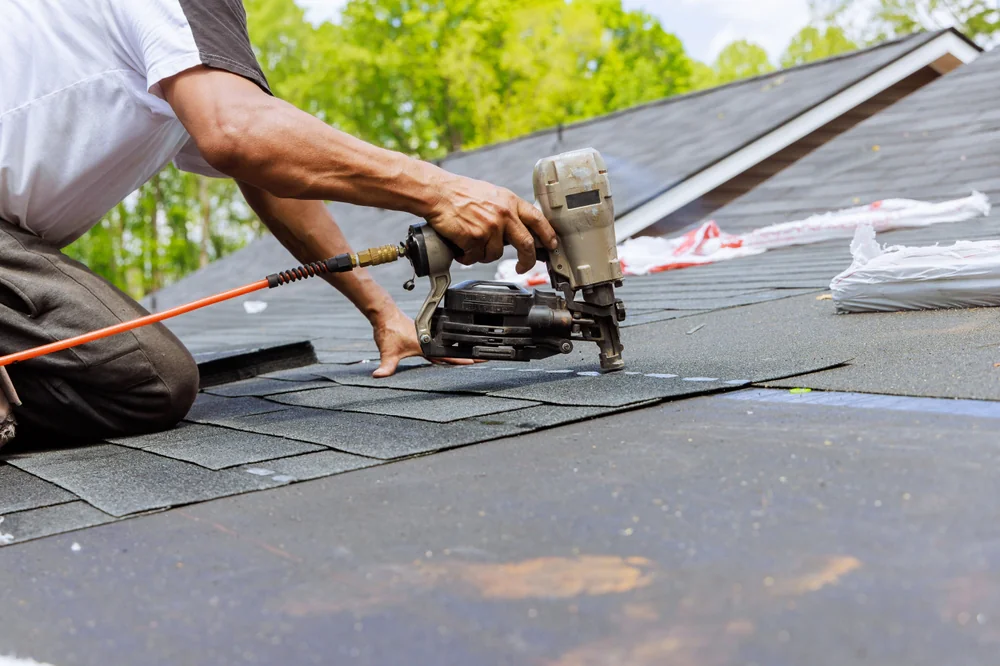
It starts with a real inspection not a quick glance from the driveway. We get on the roof, check the flashings, inspect the underlayment, look at the decking, and identify what’s actually failing and why. For homes in Baywood, that often means paying close attention to areas where salt-air corrosion tends to show up first: chimney flashings, valley metal, and any penetrations near the eave line. You’ll know what we found before any work begins.
From there, you get a clear written estimate all-in, no line items that appear later for plywood or disposal. If the repair requires a permit through the Town of Islip Building Division, we handle the application, the Suffolk County HIC licensing documentation, and the final inspection coordination. You don’t have to navigate the building department on Main Street in Islip or track down permit requirements on your own. We handle that.
Once the work is done, every repair is documented with photos and video before, during, and after. You see what was under the shingles, what we replaced, and what it looks like now. If a nor’easter rolls through next February and you want to know whether your roof held, you’ll have the documentation to reference. No wondering, no guessing.

Ready to get started?
Roof repairs in Baywood cover a range of issues and the most common ones reflect exactly what you’d expect from a housing stock this age in a coastal-adjacent location. Flashing failures at chimneys, skylights, and roof valleys are the most frequent culprits behind active leaks. Missing or lifted shingles after a nor’easter are close behind. Flat roof sections and low-slope garage additions common on Baywood’s ranch-style homes develop their own issues with membrane cracking, ponding water, and seam separation that standard shingle repair approaches don’t address.
Every repair we do includes a full inspection of the surrounding area, not just the spot that’s visibly damaged. If the decking beneath a failed shingle has soft spots or rot, we address that before new material goes on top. If the underlayment in the repair zone is compromised, we replace it not work around it. Ice dam damage, which is common in Baywood’s older Cape Cod and ranch stock during hard winters, often involves water intrusion at the eave line that looks like a simple leak but actually points to an attic ventilation problem. We flag that, explain it, and either address it or document it for future work.
If your damage is storm-related and you’re working with an insurance claim, the documentation we provide timestamped photos, detailed scope of work, written estimate is exactly what adjusters need to process a claim. That’s part of the job here, not an add-on.

It depends on the scope of work. In Baywood, you’re under Town of Islip jurisdiction, and the Town of Islip Building Division requires permits for full roof replacements and significant repair work particularly anything involving structural decking or large-scale material removal. For minor repairs like replacing a few shingles or resealing flashing, a permit may not be required, but it’s worth confirming based on the specific scope.
What’s important to know is that any contractor pulling a permit in the Town of Islip must hold a Suffolk County Home Improvement Contractor license that’s separate from a general state registration, and Islip specifically requires proof of it with every permit application. Permit fees typically run between $150 and $350, and the process takes about 7 to 14 business days with a final inspection required. We handle all of this the application, the documentation, and the inspection coordination. You don’t have to figure out the building department process on your own.
Roof repair costs vary based on what’s actually wrong. On Long Island, and particularly in South Shore communities like Baywood, costs tend to be higher than the national average given local labor rates and the specific material demands of coastal-adjacent environments where salt-air corrosion accelerates wear on metal flashings and roofing components.
For a straightforward missing shingle repair or minor flashing fix in Baywood, you might be looking at a few hundred dollars. For more involved work replacing damaged decking, addressing ice dam intrusion at the eave line, or repairing a flat roof section on a ranch-style addition the cost can climb into the low thousands. The most important thing is getting an all-in written estimate before any work starts, so there are no surprises when the job is done. We provide exactly that one number that covers materials, labor, underlayment, any decking work needed, and cleanup.
The most common culprits in Baywood’s 1950s and ’60s housing stock are flashing failures and aged underlayment two things that often go unaddressed when a roof gets re-shingled without a full inspection underneath. Flashings at chimneys, skylights, and roof valleys are metal components that expand and contract with temperature changes and corrode over time, especially in a salt-air environment like Baywood’s, where proximity to Great South Bay accelerates that breakdown faster than it would in an inland community.
Underlayment the water-resistant barrier between your shingles and the roof deck has a finite lifespan, and in homes this age, it’s often past it. When shingles are replaced but underlayment isn’t, you’re working with a compromised secondary defense. Add in the freeze-thaw cycling that Long Island sees every winter, where temperatures bounce around the freezing point for weeks at a time, and you have conditions that expose every small weakness in an aging roof system. Ice dams are another major factor in Baywood’s older ranch and Cape Cod homes water backs up under shingles at the eave line, and the damage shows up weeks later as ceiling stains or wet insulation.
The honest answer is that it depends on the age of your roof, the extent of the damage, and what’s underneath the shingles. A repair makes sense when the damage is localized a section of failed flashing, a few missing shingles, a small area of compromised decking. A replacement starts to make more sense when the shingles are at or past their design life, the underlayment is failing across a large portion of the roof, or you’re dealing with recurring leaks that keep coming back in different spots despite previous repairs.
For Baywood homeowners with homes from the 1950s and ’60s, the honest conversation often involves looking at how many times the roof has been re-shingled, whether the decking was ever replaced, and whether the ventilation system was ever updated. A roof that’s been patched repeatedly without addressing what’s underneath is usually closer to a replacement conversation than a repair one. We’ll give you a straight answer after a real inspection not a push toward the more expensive option if a repair will genuinely hold.
First, get something under the leak inside the house to protect your floors and belongings, and if you can safely do so, move anything valuable out of the affected area. Don’t go on the roof yourself wet roofing is dangerous, and a well-meaning temporary fix can sometimes cause additional damage or make the repair more complicated.
Call us directly. Emergency roof repair response in Baywood typically means arrival within hours, not days the goal is to get the roof weatherproofed as quickly as possible, usually with a temporary tarp or emergency sealing, to stop the water intrusion until a full repair can be completed. If the damage is storm-related, don’t make any permanent repairs before documenting everything with photos that documentation is critical if you’re filing a homeowners insurance claim. Wind damage, ice dam damage, and storm-related water intrusion are standard covered perils under most New York homeowners policies, and having clear before-and-after documentation makes the claims process significantly smoother.
This is one of the most important questions a Baywood homeowner can ask, especially after a significant storm. Storm chasers contractors who follow damage events into neighborhoods, knock on doors, and pressure homeowners to sign quickly are common on Long Island’s South Shore after nor’easters. They’re often not licensed in Suffolk County, they frequently use subcontractors with no local accountability, and they’re gone before you realize the work didn’t hold.
A legitimate roofing contractor working in Baywood must hold a Suffolk County Home Improvement Contractor license you can verify this through Suffolk County’s public licensing database before signing anything. Ask for the license number directly. A real contractor will give it to you without hesitation. Beyond licensing, look for a named owner you can actually reach, a local address, and a track record of work in the Town of Islip specifically not just a Long Island phone number with no verifiable history. We’re based in Suffolk County, licensed for Town of Islip work, and have been operating in South Shore communities including Baywood for over a decade. Alban answers the phone himself. That’s the bar to hold any contractor to before letting them on your roof.
Other Services we provide in Baywood