
Hear From Our Clients
A roof that was installed correctly doesn’t keep you up at night when a nor’easter rolls in off the bay. It doesn’t leak three months after the “repair.” It doesn’t leave you wondering whether those shingles are going to hold when the wind picks up on the canal side of the street. That’s the difference between work done right and work done fast.
For homeowners in Amityville especially those living south of Merrick Road near the water the stakes are higher than they are for most of Long Island. Salt air doesn’t just look bad on a roof. It corrodes the metal fasteners holding your shingles in place long before the shingles themselves show any visible damage. By the time you notice something from the driveway, the real problem has already been happening underneath for months. A proper inspection and quality installation address what you can’t see, not just what you can.
Many Amityville homeowners commute into the city during the week. If a storm comes through on a Wednesday and does damage, you may not even know until the weekend. When the work is documented with photos and video at every stage, you don’t have to guess what was done or take anyone’s word for it. You can see it.
We’re a family-owned exterior contractor based in Suffolk County, and we’ve been doing this work for over a decade. That means we’ve worked through post-Sandy repair seasons, back-to-back nor’easters, and every variation of coastal weather the South Shore produces. We know what that environment does to a roof over time and we build accordingly.
We handle roofing, gutters, siding, chimneys, skylights, and decks. That matters for Amityville homeowners because storm damage rarely stops at one system. When the same storm that lifts your shingles also clogs your gutters and compromises your chimney flashing, you shouldn’t have to call three different contractors and hope they coordinate. We take care of it.
Alban, our owner, is personally involved in every job. When you call, you’re reaching someone who’s accountable not a call center routing you to whoever’s available. That’s how it’s worked for ten years, and it’s not changing.
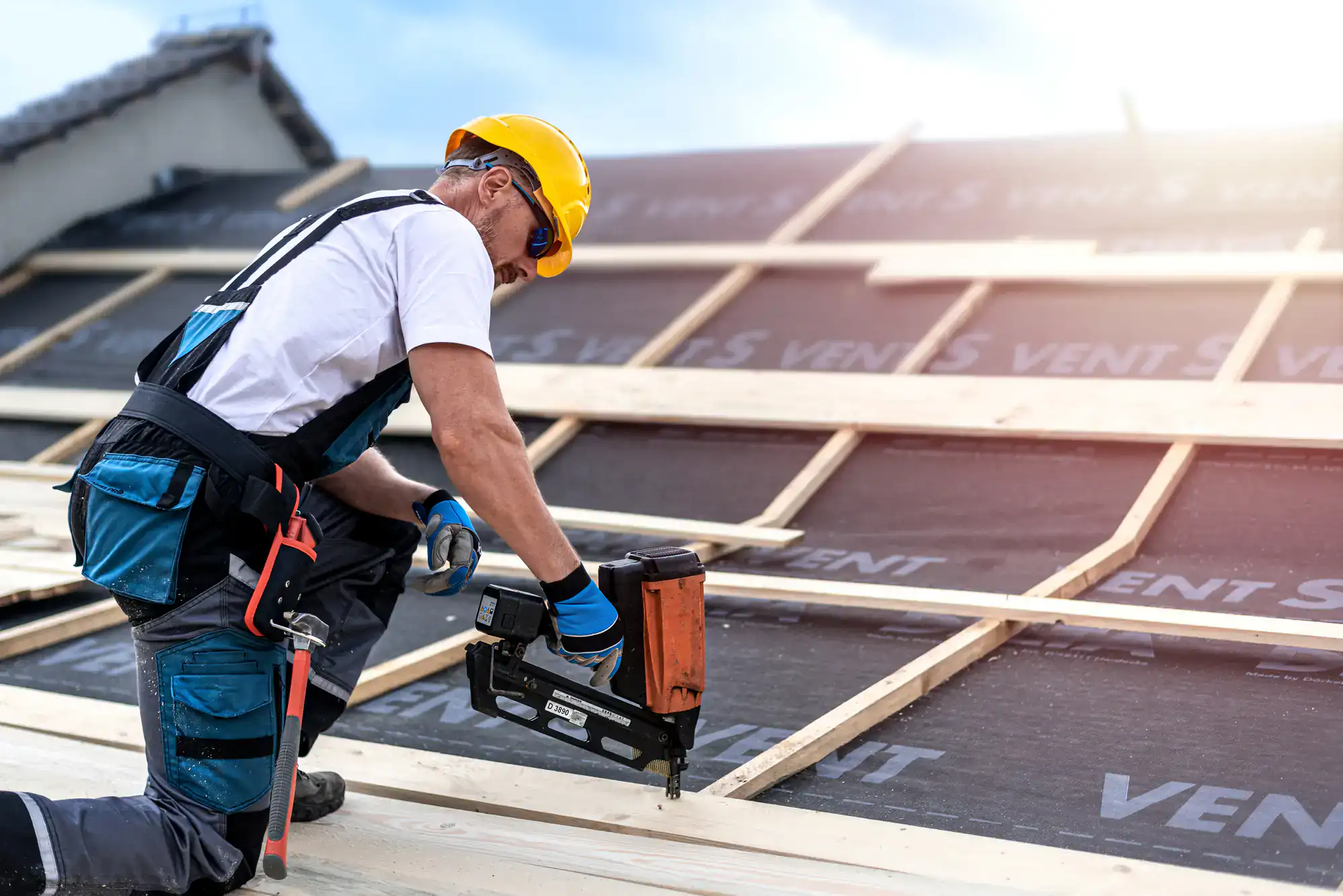
It starts with an inspection. We get on the roof and look at what’s actually happening not just the shingles, but the underlayment, the flashing around your chimney and skylights, the fastener condition, and the drainage situation. On coastal properties near the Great South Bay, that inspection often turns up salt air corrosion and moisture damage that wouldn’t be visible from the ground. You’ll know what we find before any work begins.
From there, you get a clear, written estimate. The number we quote is the number you pay. If we open something up and find structural damage that changes the scope, we stop and explain it before we proceed in writing, not verbally. No one likes surprises on a final invoice, and we don’t create them.
For full roof replacements in Amityville, we handle the permitting through the Town of Babylon Building Division. That includes the application, the required documentation, and coordinating the final inspection after installation. You don’t have to navigate that process on your own. Once the job is done, you get a full photo and video record of the completed work especially useful if you weren’t home during the project.
Ready to get started?
Most of Amityville’s housing stock the Cape Cods, the Dutch Colonials near Ocean Avenue, the ranch homes from the post-war years was built with standard asphalt shingles. Those shingles can absolutely perform well, but not all asphalt shingles are equal in a salt-air environment. The quality of the product, the underlayment beneath it, the ice and water barrier installation, and the flashing details around every penetration point are what separate a roof that holds from one that doesn’t. We don’t cut corners on any of it.
For homeowners on the canal peninsulas or directly on the bay, metal roofing is worth a serious conversation. Metal handles wind uplift better than standard shingles, resists salt air corrosion more effectively, and doesn’t develop ice dams the same way along roof edges. It costs more upfront. It also lasts significantly longer and requires far less maintenance which matters when your home is sitting in one of the most weather-exposed locations in Suffolk County.
Beyond roofing, we also handle gutters, siding, chimney repair and replacement, skylights, and decks. If a storm damages more than your roof and in Amityville, it often does you have one contractor to call instead of five. Every trade, one point of accountability.
Yes, a full roof replacement in Amityville requires a building permit through the Town of Babylon Building Division. The application needs to include your contractor’s New York State Home Improvement Contractor license number, a property survey or site plan, and proof of insurance Workers’ Compensation, Disability, and Liability. Permit fees typically run between $150 and $350 depending on the estimated cost of the work, and approval generally takes five to ten business days.
After the installation is complete, a final inspection is required before the permit can be closed out. Any contractor who suggests skipping the permit process is creating a legal liability for you as the homeowner and in most cases, it voids the manufacturer’s warranty on the roofing materials. We handle the entire permit process as part of the job so you don’t have to deal with the Town of Babylon Building Division on your own.
Salt air is one of the most underestimated roofing threats for homeowners in Amityville, particularly those living south of Merrick Road near the water or on the canal peninsulas. The issue isn’t just surface-level granule loss on shingles it’s the corrosion of the metal fasteners holding those shingles in place. When fasteners corrode, shingles lose their secure attachment long before they show any visible surface damage. From the driveway, the roof can look fine. In reality, the next strong wind event could lift sections that appear perfectly intact.
Salt air also accelerates deterioration of flashing the metal strips around your chimney, skylights, and roof edges that prevent water from getting in at the seams. Flashing failures are one of the most common sources of roof leaks on South Shore homes, and they’re almost always invisible until water is already coming through. A proper inspection on a coastal property looks specifically at fastener condition and flashing integrity, not just the shingle surface.
A standard asphalt shingle roof is typically rated for 20 to 30 years, but that rating assumes average conditions not constant salt air exposure, bay-driven humidity, and regular high-wind storm events. For homes in Amityville, particularly those on the canal-side streets or directly on the Great South Bay, a realistic lifespan is often closer to 15 to 20 years before you’re looking at significant repair needs or replacement. The quality of the original installation matters enormously here a roof installed with proper underlayment, ice and water barrier, and correctly sealed flashing will outlast one that was done to minimum code standards by years.
If your home was built in the 1950s or 1960s which describes a large share of Amityville’s Cape Cods and ranch homes and you haven’t replaced the roof since, you’re almost certainly overdue. Even if it isn’t actively leaking, the underlayment and fasteners on a 30-year-old coastal roof are likely compromised in ways that won’t be obvious until the next major storm.
A repair makes sense when the damage is isolated a few missing shingles after a wind event, a small section of flashing that’s pulled away from a chimney, a localized leak around a skylight. If the underlying structure is sound and the rest of the roof has meaningful life left in it, a targeted repair is the right call and significantly less expensive than a full replacement.
Replacement becomes the right answer when the damage is widespread, the roof is at or past its expected lifespan, or the underlying decking has sustained water damage. For older homes in Amityville particularly the pre-war Colonials and the post-war Cape Cods that make up a lot of the village’s housing stock it’s also worth considering whether a partial repair on an aging roof is actually saving money or just delaying an inevitable replacement by a year or two. We’ll give you an honest assessment of where your roof stands after the inspection, and we won’t push replacement if a repair is genuinely the better option for your situation.
For the right home, yes and Amityville is exactly the kind of environment where metal roofing earns its price premium. Metal handles wind uplift significantly better than standard asphalt shingles, which matters in a coastal village that sits directly on the Great South Bay and regularly sees high-wind warnings during nor’easters and tropical systems. It also resists salt air corrosion far more effectively than asphalt, and it doesn’t develop ice dams along roof edges the way shingle roofs can during freeze-thaw cycles.
The tradeoff is upfront cost. Metal roofing is more expensive to install than asphalt. But it also lasts 40 to 70 years with minimal maintenance, compared to 15 to 25 years for asphalt in a coastal environment. For homeowners on the canal peninsulas or in the bayfront areas of Amityville who are already on their second or third roof replacement, the long-term math often favors metal. It’s a conversation worth having before you default to replacing like-for-like.
After a major storm whether it’s a nor’easter, a tropical system, or one of the high-tide flooding events that Amityville sees even without a named storm the damage to your roof isn’t always obvious from the ground. Missing shingles are easy to spot. But the more common post-storm issues are subtler: lifted shingles that look intact but have broken their seal, flashing that’s been pulled slightly away from a chimney or skylight, granule loss that accelerates aging, or small punctures from debris that won’t show up as a leak until the next heavy rain.
If you commute into the city during the week and weren’t home when the storm came through, you may not have any visible signs at all and waiting until water shows up on your ceiling means the damage has already reached your decking or interior structure. Getting a post-storm inspection done promptly is the most cost-effective move, because catching a flashing failure or a lifted section early is a repair. Catching it after six months of water infiltration is a much larger conversation. We document everything we find with photos so you have a clear record regardless of whether you were home when we came out.
Other Services we provide in Amityville