
Hear From Our Clients
You’re not replacing gutters because you want to. You’re doing it because the current ones are failing, and you know what happens next. Water finds the path of least resistance—straight to your foundation, into your basement, through your landscaping.
When your gutters can’t handle what Suffolk County throws at them, you’re looking at foundation cracks, basement flooding, and erosion that costs ten times what proper rain gutter replacement would’ve run you. The average water damage repair in this area exceeds $10,000. That’s not a scare tactic—that’s what happens when Long Island’s 46 inches of annual rainfall has nowhere to go.
You need gutter replacement contractors who understand that West Sayville homes face salt air corrosion, nor’easters that dump feet of snow, and summer storms that test every seam. Our seamless aluminum systems eliminate the weak points where sectional gutters fail. Custom-fabricated on-site to match your roofline exactly, they handle the volume when storms hit and resist the salt air that eats through cheaper materials.
Your home either has gutters that protect everything you’ve built, or it has gutters that let water destroy it. There’s no middle ground when the next storm rolls in.
We’ve spent over a decade solving exterior problems for Suffolk County homeowners. We’re licensed contractors who’ve seen what happens when gutters fail during Long Island’s worst weather—and we’ve learned exactly how to prevent it.
West Sayville sits close enough to the coast that salt air is a constant factor. Your gutters aren’t just dealing with rain—they’re dealing with corrosive maritime conditions that weaken fasteners, eat through seams, and turn functional systems into liabilities. We use materials and installation methods designed specifically for these conditions.
Every home gutter replacement we complete uses weather-resistant fasteners, proper pitch calculations for Suffolk County’s rainfall intensity, and seamless construction that eliminates the vulnerabilities sectional systems create. You’re not getting a generic installation—you’re getting a system built for the climate that’s actually hitting your roof.
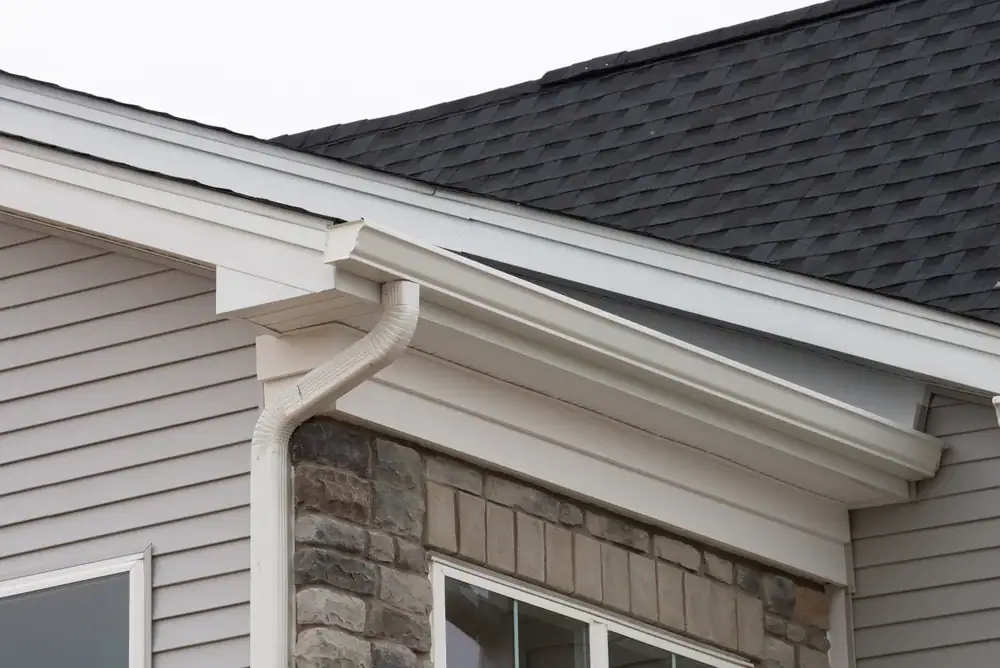
We start with an inspection of your current system and roofline. You need to know what’s failing and why—whether it’s corroded fasteners, improper pitch, undersized gutters, or damage from the last major storm. We measure your roofline and calculate the capacity you actually need based on your roof’s square footage and West Sayville’s rainfall patterns.
Next, we fabricate your seamless gutters on-site. This isn’t about installing pre-cut sections with joints every ten feet. We’re creating continuous runs custom-fitted to your home’s exact dimensions. Fewer seams means fewer leak points and less maintenance over the system’s lifetime.
Installation involves removing your old gutters, inspecting and repairing fascia if needed, and mounting your new system with corrosion-resistant fasteners spaced properly for Long Island wind loads. We set the pitch to ensure water flows toward downspouts even during heavy rainfall. Downspouts get positioned to direct water away from your foundation—at least six feet out, more if your property’s grading requires it.
Before we leave, we test the system with water to confirm proper flow and check every connection point. You’re not discovering problems during the next rainstorm.

Ready to get started?
Your gutter replacement includes seamless aluminum construction in your choice of colors to match your home’s exterior. Aluminum resists the salt air corrosion that destroys other materials near the coast. The gauge we use is thick enough to handle Suffolk County weather without denting or warping.
You’re getting hidden hangers or spike-and-ferrule systems depending on your fascia condition—whichever provides the strongest attachment for your specific situation. Downspouts are sized to handle the water volume your roof generates during heavy storms. We’re talking about the August 2024 event that dropped 10 inches of rain in hours, not some theoretical drizzle.
End caps are sealed, corners are mitered and sealed, and every connection point is secured against the wind loads that come with living this close to the Atlantic. Your system is pitched correctly so water doesn’t pool in low spots where it’ll freeze during winter and create ice dams.
Most complete gutter replacement projects in West Sayville run between $1,200 and $2,500 depending on your home’s size and configuration. That’s the investment that prevents the $10,000+ foundation repairs, the basement waterproofing, the landscaping restoration. You’re not spending money on gutters—you’re spending money to avoid spending a lot more money later.

Quality gutter installation using proper materials for coastal conditions typically lasts 10 to 15 years, sometimes longer. The key isn’t just the gutters themselves—it’s the fasteners, sealants, and installation techniques that determine longevity in Suffolk County’s salt air environment.
Aluminum construction resists corrosion better than steel in maritime climates. But even aluminum systems fail prematurely if the fasteners corrode or the pitch is wrong. Salt air causes metal to deteriorate from the inside out. A fastener might look fine from the ground but be so weakened that the next strong wind pulls your gutters loose.
We use corrosion-resistant hardware and proper sealants at every connection point. Your gutters need to survive not just rain, but the salt spray, temperature swings, ice formation, and wind that define Long Island weather. When installed correctly with materials designed for these conditions, seamless gutters outlast sectional systems by years.
Sectional gutters come in pre-cut lengths—usually 10 feet—that connect together with joints and seams every few feet along your roofline. Every joint is a potential leak point. Every seam is a place where debris catches and water backs up. Over time, those connections separate as fasteners corrode and sealants fail.
Seamless gutters are fabricated on-site in continuous runs that match your roofline’s exact length. You only have seams at inside and outside corners where they’re unavoidable. Fewer seams means fewer places for leaks to develop and less maintenance over the system’s lifetime.
The difference matters more in coastal climates. When salt air hits those sectional joints, corrosion accelerates. When nor’easters dump heavy snow and rain, those weak points fail first. Seamless construction eliminates most of those vulnerabilities. You’re getting a stronger system that requires less ongoing attention—which is the whole point of replacing your gutters instead of constantly repairing them.
Most complete gutter replacement projects in West Sayville range from $1,200 to $2,500 depending on your home’s size, the linear footage of gutters needed, and any fascia repairs required before installation. Larger homes or complex rooflines with multiple corners and downspouts run toward the higher end of that range.
The cost breaks down to roughly $6 to $13 per linear foot for seamless aluminum installation. That includes removal of your old gutters, any necessary fascia work, new seamless gutters custom-fabricated on-site, proper fasteners and hangers, downspouts, and end caps. You’re paying for materials designed to handle Suffolk County weather and installation that prevents the problems you’re trying to solve.
Compare that to the cost of not replacing failing gutters. Foundation repairs average $10,000 or more in this area. Basement waterproofing runs several thousand. Landscaping restoration, fascia replacement from water damage, even interior repairs from leaks—it adds up fast. Proper gutter replacement isn’t an expense, it’s insurance against much bigger problems.
We can replace gutters year-round in West Sayville as long as temperatures stay above freezing and conditions are safe for roof work. Winter installation is possible during Long Island’s milder days, though spring and fall are typically easier for scheduling.
The bigger question is whether you should wait. If your current gutters are failing, every rainstorm or snowmelt event is causing damage. Water that’s not being directed away from your foundation is pooling against it. Ice dams that form in clogged or sagging gutters are backing water under your shingles. Waiting until spring means accepting several more months of potential damage.
If you’re seeing signs of gutter failure—sagging sections, water overflowing during rain, ice dams in winter, or water stains on your fascia—get it addressed now. The cost of replacing gutters in December is the same as replacing them in May, but the damage that happens between December and May isn’t free. We’ll work with you to find a weather window that makes sense for your situation.
Gutter guards can reduce maintenance frequency, but they’re not essential for every home in West Sayville. Whether you need them depends on the trees around your property and how much time you’re willing to spend on gutter cleaning.
If you have oak trees, pine trees, or maples dropping leaves and needles on your roof, guards help keep that debris out of your gutters. You’ll still need to inspect and clean your system periodically—guards don’t eliminate maintenance, they just reduce it. Coastal storms and nor’easters can still deposit sand, twigs, and other debris that accumulates over time.
The downside is cost and complexity. Quality gutter guards add $7 to $10 per linear foot to your project. Cheaper screens and foam inserts often create more problems than they solve—they trap debris on top instead of inside, and they can prevent proper water flow during heavy rainfall. If you’re considering guards, go with a solid cover system that’s proven to work in Long Island conditions. Otherwise, plan on inspecting your gutters at least twice a year and cleaning them as needed.
If you’re seeing multiple failure points, extensive corrosion, or problems along most of your roofline, replacement makes more sense than patching individual sections. Repairs work when the damage is localized—one sagging section, a single leak, a loose downspout. But when your gutters are failing in several places, you’re just delaying the inevitable.
Look for these signs that point toward replacement: gutters pulling away from your fascia in multiple locations, visible rust or corrosion along the seams, water overflowing during moderate rainfall, sagging or improper pitch in several sections, or age over 15 years in coastal conditions. If your current system is sectional gutters with joints every few feet, upgrading to seamless construction eliminates the weak points causing your problems.
The cost difference between extensive repairs and full replacement often isn’t as big as you’d think. You’re paying for labor either way. Repairs might save you money this year, but if you’re back on the phone next year dealing with new leaks, you’ve spent more in the long run. We’ll inspect your system and tell you honestly whether repairs will actually solve your problems or whether you’re better off replacing everything now.
Other Services we provide in West Sayville