
Hear From Our Clients

A ceiling stain in January doesn’t mean the leak started in January. By the time water shows up inside your home, it’s already been working through your roof system for weeks maybe longer. By the time you see it, it’s usually been sitting in your roof assembly for a while the actual entry point is almost never where the stain is.
When the root cause gets addressed not just patched over you stop the cycle. No more calling a roofer every spring. No more wondering if this winter is the one that turns a repair into a mold remediation. For Holtsville homeowners sitting on $500,000-plus in home equity and paying close to $10,000 a year in property taxes, that kind of certainty isn’t a luxury. It’s the whole point.
Holtsville’s housing stock carries real risk here. A large share of homes in the 11742 zip code were built in the postwar era 1950s through 1970s with insulation standards that predate modern energy codes. That means ice dams along the eaves are a recurring threat every winter, not a freak occurrence. Because Holtsville sits in central Suffolk County, directly in the path of every nor’easter that tracks up the coast, your roof takes a beating from October through March without the wind break that coastal geography sometimes provides. Getting repairs done by someone who understands what Long Island weather actually does to these homes makes a real difference.
We’re based in Brookhaven the same town that governs building permits and inspections for most of Holtsville. That’s not a marketing detail. It means when your job needs a permit pulled, we know the Brookhaven Building Division’s process. And if your home sits in the Islip-governed portion of the hamlet which catches a lot of Holtsville homeowners off guard we know that process too.
Alban Hoxha, the owner, is personally involved in every job. Not in a figurative sense. He shows up, he’s reachable, and his name appears in customer reviews because he’s actually there. That level of accountability is rare in a roofing market that floods with out-of-area storm chasers every time a nor’easter moves through the Sachem area.
We’ve been working in Suffolk County for over a decade. We don’t subcontract. Every person on your roof is a trained Home Team Construction employee, and every repair is documented with photos and video so you can see exactly what we did not just take our word for it.
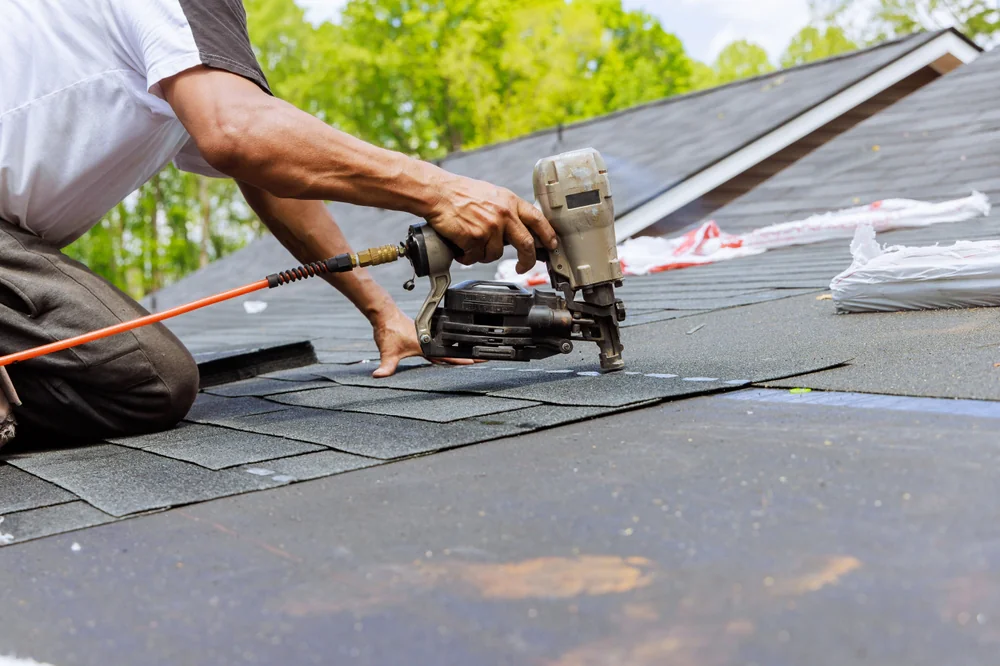
It starts with a real inspection not a five-minute walk-around designed to justify a sale. We get on the roof, look at the actual condition of your shingles, flashing, underlayment, ridge cap, and any penetrations like chimneys or pipe boots. We’re looking for the source of the problem, not just the symptom closest to your ceiling stain. In Holtsville, that usually means paying close attention to flashing at chimney bases and the eave line where ice dams do their damage over a typical Suffolk County winter.
From there, you get a written estimate itemized, upfront, and complete. Materials, labor, cleanup, and disposal are all included. If the job requires a permit under Brookhaven Town’s guidelines, we handle that. Repairs that replace more than roughly 25% of your roof surface typically require one; smaller repairs generally don’t. Either way, it’s not your problem to figure out.
Once work starts, we document everything with photos and video before, during, and after. When the job is done, you’re not left guessing about what happened under those shingles. If your damage is storm-related and you’re considering an insurance claim, we help with the documentation your adjuster will need photos, cause assessment, and clear communication about what failed and why. That’s part of the job, not an add-on.

Ready to get started?
Roof repairs in Holtsville cover a wide range of issues, and most of them trace back to a handful of recurring causes: failed flashing around chimneys and skylights, ice dam damage along the eave line, missing or wind-lifted shingles after a storm, deteriorated pipe boots, and flat roof sections on garages or additions that weren’t installed or maintained properly. These aren’t random failures they’re predictable outcomes of Long Island’s climate hitting homes that were built decades ago.
For shingle roofs, we address the full picture: replacing damaged sections, reseating or replacing flashing that’s pulled away from the chimney or wall, and making sure the underlayment beneath the repair area is sound. A missing shingle repair that ignores what’s underneath it is just a delayed callback. For flat roofs common on garage additions and low-slope sections throughout the 11742 zip code we assess the membrane, drainage, and any areas where water is pooling and accelerating deterioration.
Emergency roof repair is also part of what we do. If a storm comes through off the LIE corridor and you’re dealing with an active leak or exposed decking, we respond around the clock. We’ll get your home weatherproofed and give you a clear plan for permanent repair not a tarp and a promise to call you next week. Whether it’s a minor fix or a situation that’s been building for years, the goal is the same: find the actual problem and fix it so it stays fixed.

This is the right question to ask before anyone starts selling you anything. The honest answer is that most roofs even ones with active leaks don’t automatically need full replacement. A lot depends on the age of the roof, the extent of the damage, and the condition of the decking underneath the shingles. If your roof is under 15 years old and the damage is isolated to a specific area a few missing shingles, a failed flashing joint, a section damaged by a fallen branch repair is almost always the right call. It’s significantly less expensive and, when done correctly, it extends the life of the roof without the disruption of a full tear-off.
Where replacement becomes the honest recommendation is when the shingles are at or past the end of their useful life (typically 20–25 years for standard asphalt), when granule loss is widespread across the surface, or when an inspection reveals that the decking beneath has sustained water damage in multiple areas. In Holtsville, where a large portion of the housing stock dates to the 1950s–1970s, it’s not uncommon to find roofs that have already been replaced once and are now on their second lifecycle. If you’re in that situation, we’ll tell you plainly what we find and what we’d recommend not what generates the larger job.
Repair costs in the Holtsville area generally fall into a few ranges depending on what’s actually wrong. Minor repairs replacing a handful of shingles, resealing a pipe boot, or addressing a small flashing issue typically run somewhere between $500 and $1,500. Moderate repairs involving larger shingle sections, chimney flashing replacement, or a flat roof patch on a garage addition usually land in the $1,500 to $4,000 range. More significant repairs partial re-roofing, decking replacement in a water-damaged section, or extensive flashing work can run $4,000 to $8,000 or more depending on the scope.
What drives costs up in Suffolk County right now is the same thing driving them up nationally: material prices have increased sharply over the past few years, and labor costs on Long Island reflect the local market. The more important number to keep in mind is what deferred repair costs. A $1,200 leak repair addressed in the fall becomes a mold remediation and structural repair conversation if it’s left to work through a Holtsville winter. We provide written, itemized estimates before any work starts so you know exactly what you’re agreeing to no line items that appear after the crew is already on your roof.
For most minor repairs replacing a few shingles, patching a small area, fixing flashing around a penetration no permit is required in the Town of Brookhaven. The threshold that typically triggers a permit requirement is when the scope of work crosses into replacing a significant portion of the roof surface, generally around 25% or more. At that point, Brookhaven’s Building Division treats it as a more substantial alteration, and a permit is required before work begins.
There’s one detail specific to Holtsville that’s worth knowing: the hamlet straddles two town boundaries. The majority of Holtsville falls under Brookhaven, but the southwestern portion of the hamlet is governed by the Town of Islip. If your home is in the Islip-governed section, the permit process runs through Islip’s building department, not Brookhaven’s and the requirements aren’t identical. A lot of homeowners don’t know which side of that line they’re on until it becomes a problem. We know both jurisdictions, and we handle the permit process as part of the job so you don’t have to figure it out on your own.
Ice dams cause real structural damage, and it often doesn’t show up inside your home until weeks or months after the fact. Here’s what happens: snow accumulates on the roof, heat escaping through the attic warms the roof deck and melts the snow from underneath, and that water runs down toward the eaves where it’s colder and refreezes. The ice dam that forms at the eave line acts like a wall, trapping water behind it. That water has nowhere to go except under your shingles and once it’s under the shingles, it works its way through the underlayment and into the roof deck.
In Holtsville, this is a recurring issue rather than a rare one. The hamlet’s housing stock includes a large share of homes built in the 1950s through 1970s with attic insulation that doesn’t meet modern standards. Inadequate insulation allows more heat to escape through the roof deck, which accelerates the melt-refreeze cycle that creates ice dams. The damage shows up as water stains on ceilings and walls, often in late winter or early spring when temperatures rise and the ice melts. If you had ice dams this past winter and haven’t had your roof inspected, it’s worth doing before next season.
The most important thing you can do immediately after storm damage is document what you can safely see from the ground photos of missing shingles, visible damage to the roof edge, any debris that came down and then call a contractor before you call your insurance company. The reason is simple: your adjuster is going to ask what failed and why, and having a contractor’s assessment of the cause gives you a much stronger position than a homeowner’s description of what they saw from the driveway.
Wind and hail are the two most common causes of insurance-covered roof damage in Suffolk County, and both can be difficult to document without getting on the roof. Hail damage to asphalt shingles granule loss, bruising, cracking is often invisible from the ground and requires close inspection to photograph properly. We assist with insurance documentation as a standard part of what we do when storm damage is involved. We photograph the damage, document the cause, and communicate with your adjuster so the claim reflects what actually happened. We’ve helped Holtsville homeowners through this process after nor’easters and summer hail storms, and the difference between a well-documented claim and a poorly documented one can be significant in terms of what your insurance covers.
After every major nor’easter, the roofing market on Long Island gets flooded with out-of-area contractors who work the storm damage circuit knocking on doors, offering free inspections, and pushing homeowners to sign contracts quickly before they’ve had a chance to think it through. Some of them do decent work. A lot of them don’t, and most of them won’t be around if something goes wrong six months later.
The most reliable filter is Suffolk County’s Home Improvement Contractor license. Unlike some other counties, Suffolk actually requires contractors to pass an exam before being licensed it’s not just a registration. You can look up any contractor in the county’s public database and verify their license is current. Ask for the license number before anyone gets on your roof. Beyond that, look for a verifiable local address not a P.O. box or a town-specific landing page with a toll-free number and check whether the reviews are from real, named customers describing specific jobs. A contractor who’s been operating in the Sachem area for years, whose owner’s name shows up in customer reviews, and who can show you a valid Suffolk County HIC license is a fundamentally different situation than someone who showed up after the storm and will be gone before spring.
Other Services we provide in Holtsville