

Hear From Our Clients

A roof repair done right means you stop watching the ceiling every time it rains. It means the next nor’easter that rolls up the South Shore doesn’t turn into a four-figure water damage claim. That’s the real outcome not just a patched shingle, but actual confidence that your home is sealed and protected.
For Blue Point homeowners, that matters more than it does in most places. The bay-facing exposure here accelerates wear on metal flashing, roof vents, and underlayment in ways that inland Suffolk County homes simply don’t experience at the same rate. Salt-laden moisture off the Great South Bay works into every seam and fastener over time. Most roof leaks in Blue Point don’t start at the shingles they start at failed flashing around chimneys, skylights, and valleys. Patching the shingle without addressing that is just delaying the next call.
A lot of Blue Point’s housing stock the ranches and cape cods built in the 1950s and ’60s may have had shingles replaced once or twice, but the underlayment and decking underneath haven’t been touched since the original build. That’s the kind of thing you can’t see from the ground, and it’s exactly what a thorough repair inspection should surface before it becomes a much larger problem.
We’re based in Brookhaven the same town that issues building permits for Blue Point. That’s not a coincidence. It means we know the Town of Brookhaven Building Division’s requirements, we pull the permits that need to be pulled, and we’re not disappearing after the check clears. We operate in the same regulatory environment as your home, and we’ve been doing it for over a decade across Suffolk County’s South Shore.
Owner Alban Hoxha is personally involved in jobs not managing from an office while a subcontracted crew shows up at your door. Every person on your roof is a trained Home Team Construction employee. That’s not standard in this industry. Most larger operations use subcontractors, which means the person who quoted your job and the person doing the work are two completely different people with no shared accountability.
In a hamlet the size of Blue Point 1.8 square miles, roughly 5,000 residents word travels. We’ve built our reputation on showing up when we say we will, pricing jobs honestly, and doing work we’d stand behind if your neighbor asked about it.

It starts with a real inspection, not a quick glance from the driveway. We get on the roof, look at the actual condition of your shingles, flashing, underlayment, and any penetration points chimneys, vents, skylights. In Blue Point specifically, we pay close attention to the metal components because salt air corrosion tends to show up there first, long before the shingles give you any visible warning signs.
From there, you get a clear, upfront price before anything is touched. No estimates that balloon once we’re already mid-job, no “we found additional damage” conversations that only happen after you’ve committed. If we do find something unexpected when we open a section up, we stop, show you exactly what we’re looking at, and talk through the options. You decide what happens next not us.
Once the repair is underway, we document everything with photos and video, including what’s underneath the shingles. That record is yours to keep. It’s useful for insurance claims, future repairs, and home sales and it’s something no other roofing company serving Blue Point offers as a standard part of the job. When the work is done, we clean up completely and walk you through what was done and why. If the repair requires a permit through the Town of Brookhaven Building Division, we handle that too.

Ready to get started?
Roof repairs aren’t one-size-fits-all, especially on the South Shore. What we do on a 1960s ranch off Montauk Highway looks different from what we do on a waterfront townhouse at Harbour at Blue Point or a unit at the Vineyards. The materials, the failure points, and the conditions are different and the repair has to account for that.
For missing shingle repair and storm damage, we assess the full scope before touching anything. A few missing shingles after a nor’easter might be the visible part of a larger problem lifted flashing, compromised ridge caps, or water that’s already worked its way under the surface. We find out before we close it back up. For roof leak repair, we trace the water to its actual source, which is almost never directly above the stain on your ceiling. Leaks travel. We find where they start.
We also handle flat roof repair for lower-slope sections common on additions and garage roofs throughout Blue Point, as well as emergency roof repair calls when a storm doesn’t wait for business hours. If you’re dealing with active water intrusion, we respond around the clock and can provide immediate weatherproofing to stop the damage while a permanent repair is scheduled. For storm damage that involves a homeowners insurance claim, we document everything your adjuster needs and communicate with the insurance company directly that’s part of the service, not an add-on.
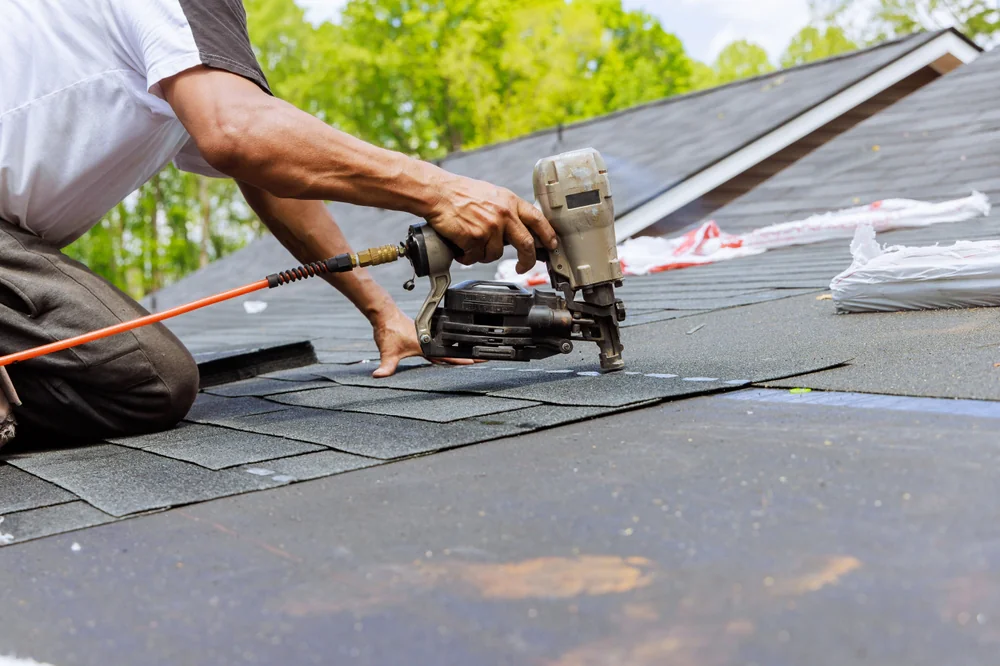
This is probably the most common question we get, and it’s a fair one because a lot of contractors have a financial incentive to push you toward a replacement whether you need it or not. The honest answer is that it depends on the age of the roof, the extent of the damage, and the condition of what’s underneath the shingles.
If your roof is under 15 years old and the damage is localized missing shingles from a storm, a flashing failure at the chimney, a cracked boot around a vent pipe a targeted repair is almost always the right call. If the roof is 25 or 30 years old, has widespread granule loss, and the decking underneath has moisture damage in multiple areas, replacement starts to make more financial sense than repeated repairs. For Blue Point’s older housing stock especially the post-WWII ranches and cape cods we often find that the shingles have been replaced once or twice, but the underlayment and flashing are original. That changes the conversation. We’ll give you an honest read on where your roof actually stands, not a sales pitch in either direction.
The short answer: flashing failure, not shingle failure. This surprises a lot of Blue Point homeowners because shingles are the most visible part of the roof, so that’s where most people assume the problem starts. But in a coastal environment like this one, the metal components the flashing around your chimney, the step flashing along dormers, the valley metal, the pipe boots are under constant stress from salt air, moisture cycling, and temperature swings.
Metal flashing that might last 20 to 25 years on an inland home can start showing failure signs in 12 to 15 years when it’s exposed to bay air year-round. When flashing fails, water gets in at the seams and it travels before it shows up as a stain on your ceiling, sometimes several feet from where the actual entry point is. That’s why tracing a leak to its true source matters so much. A contractor who caulks over a visible gap without checking the full flashing system is not fixing the problem. They’re buying you a few months.
It depends on the scope of the work. Blue Point is within the Town of Brookhaven, so all building and permitting activity goes through the Town of Brookhaven Building Division not the Town of Islip, which covers neighboring Bayport just across Namkee Creek.
For minor repairs replacing a few shingles, resealing flashing, patching a small section a permit is typically not required. For a full roof replacement or tear-off, or any work that involves structural components of the roof deck, a permit is generally required before work begins. This matters more than most homeowners realize. Unpermitted work can create real problems when you go to sell the house, file an insurance claim, or refinance. We know the Town of Brookhaven’s requirements, and when a permit is needed, we handle the process you don’t have to figure that out on your own.
Repair costs vary depending on what’s actually wrong, but to give you a realistic range: minor repairs a few missing shingles, a resealed flashing joint, a replaced pipe boot typically run a few hundred dollars. Mid-range repairs involving a section of damaged decking, full flashing replacement at a chimney, or a larger area of shingle damage generally fall in the $800 to $2,500 range. More extensive repairs involving multiple failure points or significant water damage to the underlying structure can run higher.
What matters more than any average is getting an accurate scope before work begins. We price jobs completely upfront materials, labor, disposal so there are no line items that appear after the fact. For Blue Point homeowners dealing with storm damage, a portion of the repair cost is often covered by homeowners insurance, and we handle the documentation needed to support that claim.
Yes, and it’s more of a concern than most South Shore homeowners expect. Ice dams form when heat escapes through a poorly insulated or ventilated attic, melts snow on the upper part of the roof, and that meltwater refreezes when it reaches the colder eaves. The ice backs up under the shingles and forces water into the roof structure into the decking, the underlayment, and eventually the interior.
Blue Point’s older housing stock is particularly susceptible to this. Homes built in the 1950s and ’60s were constructed well before modern insulation standards, and many haven’t had their attic ventilation systems updated since. If you’re seeing water stains near exterior walls or along the ceiling at the edge of a room after a cold stretch, ice dam infiltration is a likely cause. The fix isn’t just removing the ice it’s addressing the ventilation and insulation conditions that allowed it to form. We assess both when we’re diagnosing a winter leak, not just the visible damage at the surface.
We offer 24/7 emergency response and typically arrive within a few hours of the call. Blue Point’s position directly on the Great South Bay means storms hit this community hard a nor’easter tracking up the South Shore can drive sustained winds into the 50 to 60 mph range, and the bay amplifies coastal moisture in ways that compound the damage quickly. Waiting until Monday morning to address active water intrusion isn’t a neutral decision. Every hour a roof is open to the elements, the damage spreads into the decking, the insulation, the framing, and eventually the interior.
When we arrive for an emergency call, the first priority is stopping the water from getting in. We provide immediate weatherproofing temporary covering or sealing to protect the structure while we assess the full scope and schedule the permanent repair. If the damage was caused by a storm and you have a homeowners insurance claim to file, we document everything on-site so you’re not trying to reconstruct the evidence later. We’ve answered calls on nights and weekends throughout Suffolk County’s South Shore, and we’ll answer yours.
Other Services we provide in Blue Point