
Hear From Our Clients

When a storm tears through the Three Village area and your ceiling shows a stain the next morning, the last thing you want is a patch that fails by February. A real repair means finding where the water is actually entering not just where it’s showing up inside. Flashing around chimneys and skylights, deteriorated underlayment, lifted shingles from wind these are the real culprits on most North Shore homes, and they don’t fix themselves.
Homes in the Stony Brook University area have another factor working against them that most contractors don’t talk about: salt air from Long Island Sound. It corrodes metal flashing faster than you’d expect, especially on homes that have been here since the university’s expansion in the sixties and seventies. If your roof is more than fifteen years old and hasn’t had its flashing inspected, there’s a reasonable chance that’s where your next leak is coming from.
Getting this right means you stop paying for the same problem twice. You stop watching the ceiling stain grow. And when the next nor’easter comes through with near-hurricane-force winds which, according to the university’s own emergency documentation, happens in multiple winters your roof is ready for it.
Home Team Construction is owned and operated by Alban Hoxha, and he’s not a figurehead. He answers the phone, shows up on jobs, and is the person responsible for what happens on your roof. That’s not a sales pitch it’s just how we run. When you call, you’re talking to the person who will make sure the work is done correctly.
We’re based in Brookhaven the same town that governs the Stony Brook University area and issues permits for roofing work here. That means familiarity with the Town of Brookhaven Building Division, the local permit process, and the specific conditions that affect North Shore homes from Nicolls Road to Route 25A. This isn’t a contractor parachuting in from out of the area after a storm. We’ve been serving Suffolk County for over a decade, and we’ll be here long after the next one.
Every person who works on your roof is a trained Home Team Construction employee. No subcontractors. No strangers showing up in an unmarked truck. That’s the standard on every job, every time.

It starts with a real conversation not a form submission that disappears into a queue. When you call Home Team Construction, you reach someone who can actually talk through what you’re seeing: a ceiling stain, a missing shingle after a storm, a flashing issue you noticed during a gutter cleaning. From there, we schedule an inspection at a time that works for you.
On-site, our team identifies the actual source of the problem not just the visible damage. On North Shore homes, that often means checking flashing integrity around chimneys and skylights, looking at the condition of the underlayment in areas exposed to prevailing winds off the Sound, and assessing whether ice dam activity over the winter has forced water under the shingles at the eaves. You get a clear explanation of what’s wrong and what fixing it actually involves, with upfront pricing before any work begins.
Once you approve the scope, we complete the repair with the same team that assessed it no handoffs, no subcontractors. Every step of the repair is documented with photos and video so you can see exactly what was done, including areas that are now covered back up. If the work requires a permit through the Town of Brookhaven Building Division, we handle that as part of the process. When the job is complete, the site is cleaned and you have documentation you can keep for your records or your insurance file.

Ready to get started?
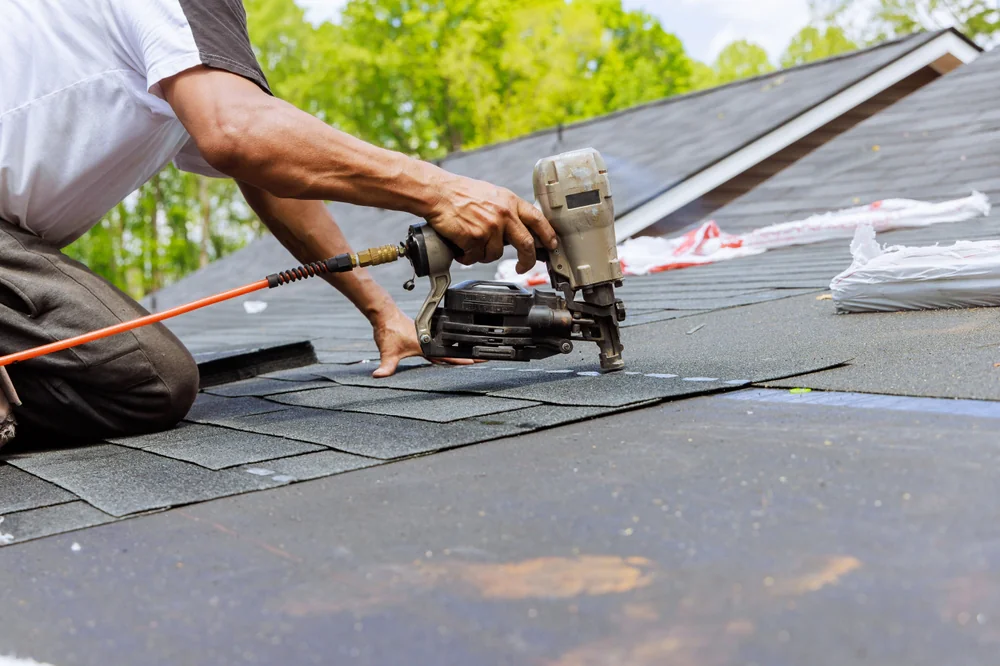
Roof repairs near Stony Brook University cover more ground than most homeowners expect going in. The most common calls are for roof leak repair after a nor’easter missing shingles, damaged or lifted flashing, and water intrusion at valleys and penetrations. We also handle flat roof repair for homes and additions with low-slope sections, skylight resealing, chimney flashing repair, and emergency weatherproofing when a storm causes immediate structural exposure.
For homes along the wooded corridors off Route 25A and around the East Setauket and Setauket neighborhoods, storm debris and falling branches from mature trees are a recurring issue. That kind of impact damage doesn’t always look serious from the ground, but it can compromise the roof deck and underlayment in ways that only show up as a leak weeks later. A proper inspection catches it before it becomes a bigger repair.
All materials we use are selected for Long Island’s coastal North Shore conditions not generic off-the-shelf products that perform fine inland but degrade faster within a few miles of the Sound. Pricing is itemized and presented before work begins, covering labor, materials, and disposal with no line items added after the fact. If you’re dealing with storm damage that may be covered under your homeowners insurance, we handle the documentation and communicate with your adjuster that’s included, not an add-on.

This is the most important question to get an honest answer on, because the difference in cost is significant. A repair makes sense when the damage is isolated a section of failed flashing, a few missing or cracked shingles, a single area of water intrusion. Replacement becomes the right conversation when the shingles are at the end of their lifespan across the whole roof, when there’s widespread granule loss, or when the decking underneath has sustained repeated water damage over time.
For homes in the Stony Brook University area, many of which were built during the university’s expansion in the 1960s and 1970s, the honest answer is that a lot of roofs in this corridor are approaching or past the point where repairs become a recurring cost rather than a one-time fix. That doesn’t mean you automatically need a replacement but it does mean the inspection needs to look at the full picture, not just the spot that’s currently leaking. We’ll tell you straight which situation you’re actually in.
The majority of roof leaks on North Shore homes come from failed flashing the metal that seals transitions around chimneys, skylights, vents, and valleys. Salt air from Long Island Sound accelerates corrosion of these metal components faster than most homeowners realize, and it’s a slow enough process that it doesn’t get noticed until water is already getting in. Shingle damage from wind and storm debris is the other major cause, particularly after the nor’easters that hit this area with near-hurricane-force winds in multiple winters.
Fixing it correctly means removing the damaged or corroded material entirely, not caulking over it. Flashing repairs involve cutting back the surrounding material, installing properly sized and graded replacement flashing, and resealing in a way that accounts for the thermal movement the roof experiences through Long Island’s seasonal temperature swings. Shingle repairs involve matching the profile and weight of the existing field as closely as possible and ensuring the underlayment beneath the damaged area hasn’t been compromised. We document both types of repair with photos so you can see exactly what was replaced and why.
The first thing is to document what you can safely see from the ground or from inside ceiling stains, water intrusion points, visible missing shingles. Don’t go on the roof yourself, especially if there’s still ice, wet debris, or structural uncertainty. Call a licensed contractor as quickly as you can, because emergency weatherproofing in the first hours after a storm prevents a manageable repair from becoming a major interior water damage situation.
We provide 24/7 emergency roof repair response for the Stony Brook University area and typically arrive within hours to assess the damage and install temporary weatherproofing if needed. After the immediate situation is stabilized, our team documents everything thoroughly photos, written scope, material specifications which becomes the foundation of your insurance claim if the damage is covered. Suffolk County homeowners insurance claims for wind and storm damage require specific documentation to be processed correctly, and having that in order from the start makes the claims process significantly smoother.
It depends on the scope of the work. Minor repairs replacing a few shingles, resealing flashing, patching a small section of damaged roofing typically don’t require a permit. But more substantial work, including structural repairs, repairs that involve the roof deck, or anything that changes the roofline, generally does require a permit from the Town of Brookhaven Building Division, which administers the New York State Uniform Fire Prevention and Building Code for all residential construction in this area.
Working without a required permit creates real problems down the road particularly when you sell the home, file an insurance claim, or have an inspection that turns up unpermitted work. We’re familiar with the Town of Brookhaven permitting process and handle permit requirements as part of the job when they apply. You don’t need to figure that out yourself. It’s worth asking any contractor you’re considering whether they pull permits when required a contractor who skips that step is creating a liability that ends up on your plate, not theirs.
Salt air is one of the more underappreciated factors affecting roofs in the Stony Brook University area. It doesn’t cause dramatic, visible damage overnight it works slowly, accelerating the corrosion of metal flashing, drip edge, and any exposed fasteners. Over time, flashing that might last twenty-five years in an inland environment can fail significantly sooner on a home within a few miles of the Sound. The damage is usually invisible until water is already getting in.
What to look for: rust staining on the fascia or siding below the roofline, which often indicates corroding drip edge or flashing. Discoloration or lifting at the base of a chimney or around a skylight. Any area where two roofing surfaces meet valleys, transitions, penetrations because those are where flashing is used and where salt air corrosion shows up first. If your home is in the Stony Brook, East Setauket, or Setauket corridor and the flashing hasn’t been inspected in the last five to seven years, it’s worth having someone look at it before it becomes a leak rather than after.
In Suffolk County, roofing contractors performing residential work are required to hold a Home Improvement Contractor license issued by the county. What makes Suffolk County’s licensing meaningful is that it requires passing an exam not just filing paperwork and paying a fee. That’s a higher bar than Nassau, Westchester, and Putnam counties, which don’t require an exam. A licensed Suffolk County HIC has demonstrated competency through a formal process, and you can verify any contractor’s license through the county’s public database before you agree to anything.
Beyond the HIC license, confirm that the contractor carries general liability insurance and workers’ compensation coverage. Ask for the certificate of insurance directly a legitimate contractor will provide it without hesitation. For work in the Town of Brookhaven, you can also check whether the contractor is familiar with local permit requirements, which is a practical signal of how long they’ve actually been operating in this area. We’re fully licensed and insured in Suffolk County, and you can verify that before you call us back.
Other Services we provide in Stony Brook University