
Hear From Our Clients

A roof repair done right means you stop watching the ceiling every time a storm rolls in off the Sound. No more towels on the floor, no more wondering if the damage is spreading somewhere you can’t see. That’s the outcome not just a patch, but actual confidence that your home is protected.
Fort Salonga homes face a specific set of conditions that most roofing pages won’t bother to mention. The salt air coming off Long Island Sound accelerates corrosion on metal flashings faster than anything you’d find on the South Shore or inland. A flashing that looks fine from the driveway can have rust pitting underneath that wind-driven rain exploits immediately. If your home is anywhere near Crab Meadow or the Sound-facing bluffs, that’s not a hypothetical it’s a real and recurring issue.
The mature tree canopy here is the other factor. With Sunken Meadow State Park sitting right on the northern edge of the hamlet, storm debris and falling branches are a consistent source of cracked ridge caps, missing shingles, and punctured underlayment. Getting the repair right means finding the actual cause not just replacing what’s visible from the ground.
We’re a family-owned exterior contractor based in Suffolk County, and we’ve been working on Long Island roofs for over ten years. No franchises, no rotating subcontractors every person who shows up at your Fort Salonga property is a trained employee of ours, and that’s been true since day one.
Fort Salonga sits across two town lines Huntington to the west, Smithtown to the east and that matters when it comes to permits, inspections, and getting the paperwork right. We’ve navigated both building departments for years. Whether your property falls under the Northport-East Northport school district side or the Kings Park side, we know which department to call and what they need.
Owner Alban Hoxha is personally involved on jobs not just in the office. If something comes up on your roof, you’re not being handed off to a call center. That kind of accountability is exactly what homeowners in Fort Salonga expect, and it’s exactly what we deliver.

When you reach out, the first thing we do is get eyes on the problem. We come out, inspect the damaged area, and look beyond the obvious because in most cases, what you can see isn’t the whole story. A missing shingle is a symptom. The cause might be failed flashing, a ventilation issue, or ice dam damage that’s been building since last winter.
Once we understand what’s actually happening, we give you a clear, itemized estimate before any work begins. No vague numbers, no surprise charges for plywood or disposal after the fact. What we quote is what you pay. For Fort Salonga homeowners dealing with storm damage, we also document everything needed for an insurance claim photos, scope of work, adjuster communication so you’re not handling that piece on your own.
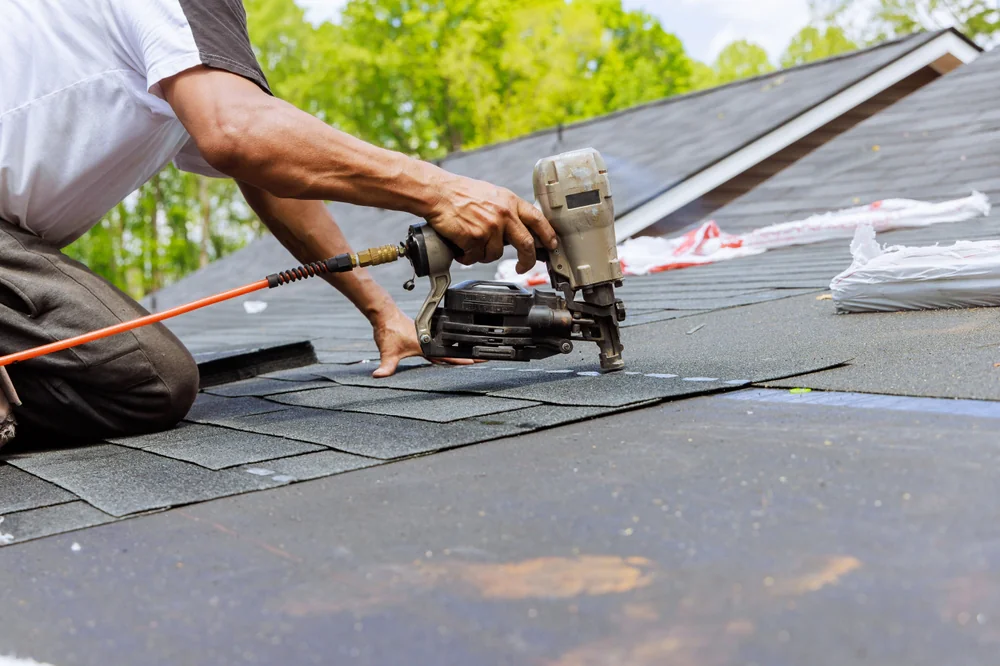
We complete the repair using our own crew, with materials selected for North Shore coastal conditions. When the job is done, we photograph the completed work so you have a visual record of what was done beneath the surface. Cleanup is thorough your driveway, landscaping, and property are left the way we found them. That’s not a bonus. That’s just how the job gets done.
Ready to get started?
Roof repair covers a wide range of issues, and the scope depends entirely on what your roof actually needs not what’s easiest to quote. Common repairs we handle include missing or damaged shingle replacement, flashing repair and replacement at chimneys, skylights, and valleys, flat roof repair, ice dam damage remediation, and emergency weatherproofing after storm events. If you’re dealing with a leak and aren’t sure where it’s coming from, that diagnostic work is part of what we do not an upsell.
Because Fort Salonga straddles the Towns of Huntington and Smithtown, permit requirements vary depending on which side of the town line your property sits on. Huntington’s Building Division requires specific insurance certificates naming the Town as a certificate holder a detail that catches out-of-area contractors regularly. Smithtown typically processes straightforward repair permits in one to two business days. We handle all of that. You don’t need to figure out which building department applies to your address.
Suffolk County also requires a Home Improvement Contractor license with a mandatory examination a higher bar than most New York counties. That license is verifiable in the County’s public database, and we’re in it. For a home in Fort Salonga where median values exceed $900,000, the contractor you hire should be able to clear that basic bar without hesitation. We do.

The honest answer is that most roofs don’t need full replacement when homeowners think they do and some do need replacement when homeowners assume a repair will hold. The key is an honest inspection by someone who isn’t incentivized to push you toward the larger job.
Generally, if your roof is under 15 years old and the damage is isolated a few missing shingles, a failed flashing, a small leak near a chimney or skylight repair is almost always the right call. If the roof is 25 years or older, has widespread granule loss, multiple leak points, or compromised decking in more than one area, replacement starts to make more financial sense than stacking repairs.
For Fort Salonga homes, the salt air from Long Island Sound can accelerate flashing and fastener corrosion even on relatively newer roofs. So age alone isn’t always the deciding factor material condition matters. We’ll give you a straight assessment with documentation, and we’ll tell you what we’d do if it were our own home.
Repair costs vary depending on what’s actually wrong, but to give you a realistic range: minor repairs like replacing a few shingles or resealing a flashing joint typically run $300 to $800. Mid-range repairs flashing replacement, valley repair, or fixing a leak with some underlying damage usually fall between $800 and $2,500. More involved repairs involving decking damage, ice dam remediation, or multiple problem areas can reach $3,000 to $5,000 or more.
On the North Shore near Fort Salonga, material costs tend to run slightly higher than inland Suffolk County because coastal-grade materials heavier underlayments, corrosion-resistant flashings are the right choice for homes near the Sound. Cutting corners on materials in a salt-air environment creates the same problem again in three years instead of fifteen.
We provide itemized estimates before any work begins, so you know exactly what you’re paying for and why. No line items that appear after the job is done.
In most cases, yes if the damage was caused by a covered peril like wind, hail, or a falling tree. What insurance typically does not cover is damage from gradual wear, lack of maintenance, or age-related deterioration. The line between storm damage and wear-and-tear is exactly where most claim disputes happen, and the documentation you provide upfront makes a significant difference in how the claim goes.
After a nor’easter or any significant wind event hits Fort Salonga, it’s worth having your roof inspected even if you don’t see an obvious leak. Some damage lifted shingles, cracked ridge caps, compromised flashing isn’t visible from the ground but shows up clearly in an inspection. We document everything with photos and prepare the scope of work in a format that supports your claim. We also communicate directly with adjusters when needed. That’s included in the job, not a separate service.
Ice dams form when heat escaping from your living space warms the upper portion of the roof deck, melting snow that then refreezes at the colder eaves. The water backs up under the shingles and finds its way inside often showing up as a ceiling stain or wall leak days after the storm, which makes it easy to misdiagnose.
Fort Salonga’s winter temperatures, moderated somewhat by Long Island Sound but still capable of sustained freezing, create the right conditions for ice dam formation on homes that don’t have adequate attic insulation or ventilation. Older homes in the hamlet particularly those built in the 1960s through 1980s are most at risk because they often lack modern ice-and-water shield underlayment at the eaves.
The fix isn’t just removing the ice. It’s addressing the underlying cause: improving attic ventilation, adding ice-and-water shield during the next repair or replacement, and making sure the insulation isn’t creating the warm-roof condition in the first place. We identify and address the root cause, not just the visible damage.
For active emergencies an open roof after a storm, a major leak with water coming in we typically respond within hours, not days. We offer 24/7 emergency roof repair, and when we arrive, the first priority is getting the damaged area weatherproofed to stop any further water intrusion while we assess what a permanent repair requires.
Timing matters more on the North Shore than people sometimes realize. When a nor’easter hits Fort Salonga and tears off shingles or damages a ridge cap, water doesn’t wait for business hours. And with homes in this area valued well above $900,000, the cost of a delayed response mold, structural damage, ruined ceilings and walls compounds fast.
We’re already here. We’ve been working in Suffolk County for over a decade, and we’re not going anywhere after the storm passes.
It depends on the scope of work and which town your property falls under. Fort Salonga is split between the Town of Huntington and the Town of Smithtown, so the answer isn’t the same for every address in the hamlet.
For minor repairs replacing a few shingles, resealing a flashing permits are generally not required in either town. For more substantial work, including full section replacements or anything involving structural decking, permits are typically required. In Huntington, the process involves submitting insurance certificates that specifically name the Town as a certificate holder a detail that trips up contractors who don’t regularly work in the area. Smithtown tends to process straightforward permits within one to two business days.
We handle the permit process as part of the job. You don’t need to research which building department serves your address or figure out what documentation they need. We’ve done this across both towns many times, and we make sure everything is filed correctly before work begins.
Other Services we provide in Fort Salonga