
Hear From Our Clients

Most homes in North Amityville were built between the late 1940s and early 1960s. That’s not a knock on the neighborhood it’s just a fact that changes what a roof repair actually involves. Beneath those shingles, there’s often original pine board decking, old underlayment, and flashing that’s been patched over more than once. When something fails, it rarely fails alone.
A real repair means finding out what’s actually going on under the surface not just replacing the shingles on top and calling it done. That’s the difference between a fix that holds through February and one that has you calling again by March. The South Shore doesn’t give you a grace period between storms, and your roof shouldn’t either.
The other thing worth saying plainly: you’ll know exactly what was done. Every repair we complete gets documented with photos and video before, during, and after. Not as a sales pitch, but because a roof is something you can’t see once it’s done, and you deserve to know what you paid for.
We’re a family-owned exterior contractor serving North Amityville and the surrounding communities along the South Shore. Alban Hoxha owns and runs the business he’s not a name on a website, he’s the person reviewing your job. Customers mention him by name in reviews because he actually shows up.
One thing that sets us apart in a market full of subcontracted crews: every person working on your roof is a Home Team Construction employee. No handoffs, no strangers, no accountability gaps. The crew that gives you the estimate is the crew doing the work.
We’ve been serving North Amityville and western Suffolk County homeowners for over a decade through Sandy’s aftermath, through the August 2024 flooding, through nor’easter after nor’easter. We know what post-war housing stock looks like from the inside out, and we hold a valid Suffolk County Home Improvement Contractor license, which in this county requires passing a mandatory exam that most other New York counties don’t require.
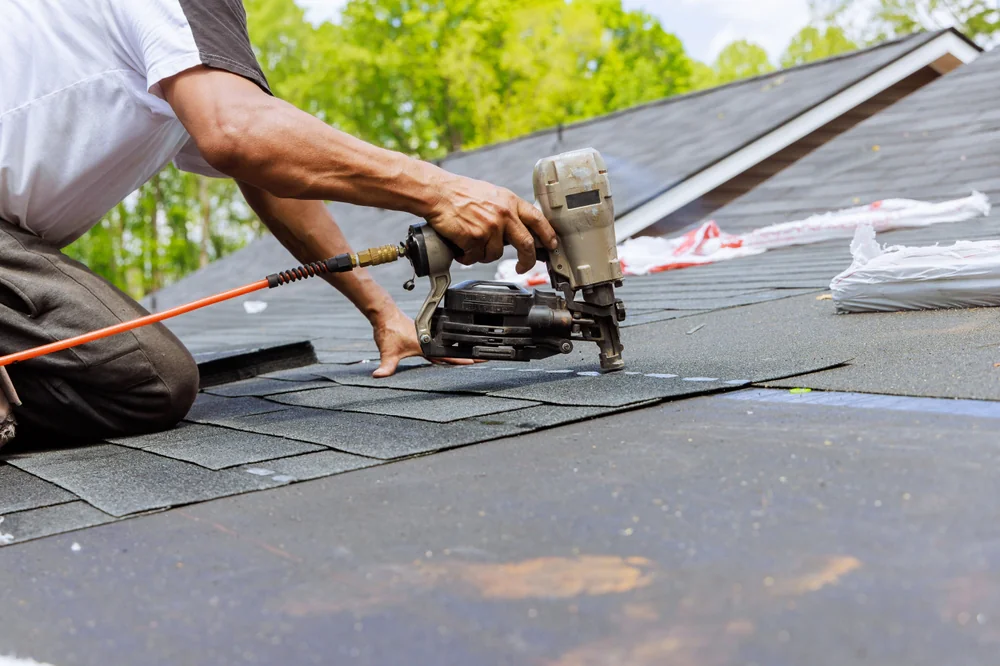
It starts with an honest assessment. Someone from our crew comes out, gets on the roof, and looks at what’s actually there not just the shingles, but the decking, the flashing, the underlayment, and any areas where water has already started working its way in. In North Amityville, where a lot of homes have flat roof sections on rear additions or garage builds, that inspection covers more ground than a standard pitched-roof job.
From there, you get a clear, itemized estimate. Everything is spelled out materials, labor, plywood replacement if the decking needs it, underlayment, and disposal. What’s quoted is what you pay. There are no fees that appear after work has started.
Once the job is approved, the work gets done by the same crew you met. Everything is photographed and documented throughout the process, so when it’s finished, you have a complete record of what was found and what was fixed. If the repair falls under a storm damage claim, the documentation is already there for your insurance company. And because roofing emergencies in North Amityville don’t wait for business hours, we offer emergency response around the clock when water is actively coming in.

Ready to get started?
Roof repair in North Amityville covers a wide range of issues and the scope varies depending on what’s underneath. Missing or blown-off shingles are the most visible problem after a nor’easter, but they’re often a symptom of something deeper. Flashing failure around chimneys, skylights, and dormers is one of the most common sources of roof leaks in the Cape Cod-style homes throughout this area. Ice dams are another recurring issue in winter, especially in homes with limited attic insulation the heat escaping through the roof melts snow, which refreezes at the cold eaves and forces water back under the shingles.
Flat roof sections get specific attention here because they’re common in North Amityville’s housing stock on ranch homes, garage additions, and the rear additions that got tacked onto Cape Cods over the decades. Flat and low-slope roofs fail differently than pitched roofs, and they need a different repair approach. Standing water, membrane deterioration, and failed seams are the usual culprits.
All work we perform is done in compliance with the New York State Building Code, and full replacement jobs are permitted through the Town of Babylon as required. Our Suffolk County HIC licensing is current and verifiable in the public contractor database something worth checking before you hire anyone for work on your home.

This is the right question to ask before you agree to anything. A lot of homeowners in North Amityville get told they need a full replacement when a targeted repair would have solved the problem and some get the opposite, a patch job on a roof that’s genuinely past its useful life. The honest answer depends on a few things: the age of the roof, the condition of the decking underneath, how widespread the damage is, and whether previous repairs were done correctly or just covered over.
For homes in North Amityville, where the housing stock is largely 1950s and 1960s construction, the underlying structure matters as much as the shingles. If the decking is soft, if there are multiple layers of old shingles already on the roof, or if water has been getting in long enough to cause structural damage, a repair may not be the right call. But if the damage is localized a section of blown-off shingles, a failed flashing joint, a compromised flat roof membrane a proper repair can add years to the roof’s life without the cost of a full replacement. The inspection will tell you which situation you’re actually in, and you’ll have the documentation to back it up.
On the South Shore and especially in North Amityville where the housing stock is 60 to 80 years old the most common causes of storm-related roof leaks aren’t always the most obvious ones. Yes, missing shingles after a nor’easter are a direct entry point for water. But flashing failure is actually more common and more frequently missed. Flashing is the metal material that seals the joints around chimneys, skylights, dormers, and roof valleys. Over decades of thermal expansion and contraction, it separates, corrodes, or gets sealed over with caulk instead of properly replaced.
Ice dams are another major cause in winter months. When heat escapes through a poorly insulated attic, it melts snow on the upper part of the roof. That water runs down and refreezes at the cold eaves, creating a dam that forces water back up under the shingles. The leak shows up inside the house usually as a ceiling stain near an exterior wall and it looks like a roofing problem, but the root cause is insulation and ventilation. A roofer who only replaces shingles without addressing the underlying cause is setting you up for the same problem next winter.
It depends on the scope of the work. In the Town of Babylon which governs North Amityville minor repairs like replacing a small number of shingles or patching flashing typically don’t require a permit. But a full roof replacement, or any work that involves replacing the roof decking, generally does require a building permit and inspection under the New York State Uniform Building Code.
This matters for a few reasons. Unpermitted work can create complications when you go to sell your home, and it can affect your homeowner’s insurance coverage if a claim arises from work that wasn’t properly permitted. We know exactly what triggers a permit requirement for your specific job and will handle the permitting process as part of the scope of work you shouldn’t have to figure that out on your own. If a contractor tells you a permit isn’t needed for a full replacement, that’s a red flag worth taking seriously.
Faster than most people expect. Once water has a path into the structure, it doesn’t stay contained to the entry point. It follows the path of least resistance down rafters, along sheathing, into insulation, and eventually through ceilings and walls. In a 1950s or 1960s home with original insulation and pine board decking, that process can move quickly because the materials have less resistance to moisture than modern construction.
The practical timeline depends on how large the opening is and how much rain is getting in. A small gap in flashing during a moderate rainstorm might cause slow, gradual damage that takes months to show up as a ceiling stain. A section of missing shingles during a nor’easter can cause visible interior water damage within hours. Either way, the longer it goes unaddressed, the more the repair scope expands what starts as a roofing repair can turn into drywall, insulation, and mold remediation if water sits long enough. That’s why 24/7 emergency response matters in a community that sees the storm exposure North Amityville does.
Yes and in many cases, they have to be. Waiting until spring to address an active leak or storm damage isn’t a real option when water is getting into your home. Most roofing repairs can be completed in winter on Long Island as long as temperatures are above freezing and the roof surface is dry enough to work safely. Asphalt shingles need to be above a certain temperature to seal properly, so cold-weather installs require some additional care but we know what we’re doing.
What’s more important than the season is acting before the next storm hits. North Amityville gets hit by nor’easters from October through March, and each storm compounds whatever damage the last one left behind. If you had shingles blow off in November and you’re waiting until April, you’re letting water work its way in through multiple storm events. Emergency weatherproofing tarping or temporary sealing can stop the bleeding while conditions aren’t right for a full repair, and then the permanent fix follows as soon as the weather allows. Don’t let a mild week in January pass without getting it addressed.
After any significant storm event and North Amityville has had its share, from Sandy through the August 2024 flooding out-of-area contractors flood the South Shore looking for quick jobs. Some do decent work. Many don’t, and some disappear entirely after taking a deposit. The most reliable way to protect yourself is to verify the contractor’s Suffolk County Home Improvement Contractor license before you agree to anything.
Suffolk County is one of the few counties in New York that requires contractors to pass a mandatory written exam to receive their HIC license Nassau, Westchester, and Putnam don’t have that requirement. The Suffolk County contractor database is public and searchable online. Look the company up before you sign anything. Beyond the license, ask specifically whether they use subcontractors. A contractor who hands your job off to a crew you’ve never met creates an accountability gap that’s hard to close after the fact. Ask for references from jobs in North Amityville or nearby communities, and ask whether the work will be documented with photos. A contractor who’s done the job right has nothing to hide and one who won’t show you the work should raise questions.
Other Services we provide in North Amityville