What your gutters are quietly doing to your foundation — and what you can do about it before the damage adds up.
Share:
Summary:
Most of the damage gutters cause happens slowly and out of sight. Water pools at the foundation. Fascia boards quietly rot. Basement walls absorb moisture for months before you notice a stain. By the time something looks wrong, you’re usually dealing with a repair bill that dwarfs what prevention would have cost. This guide is for Suffolk County homeowners who want to get ahead of it — whether your gutters are aging, underperforming, or you just want to understand what good gutter protection actually looks like and whether yours measures up.
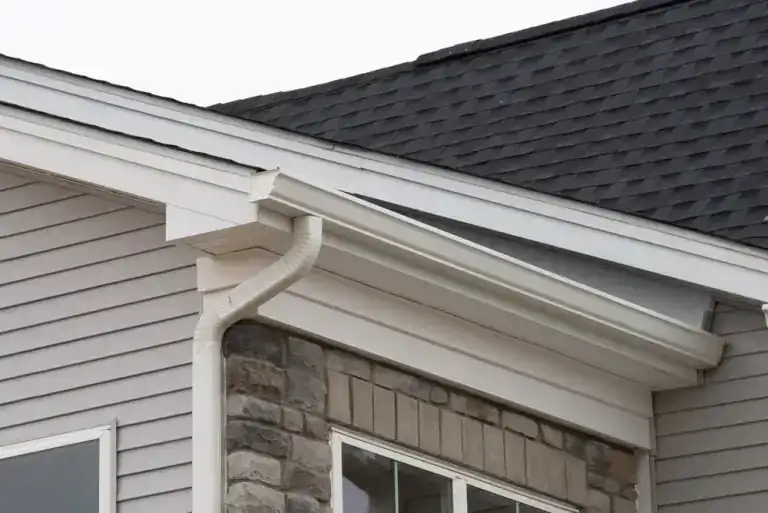
Gutter protection is a broad term, but the core idea is straightforward: keep water moving off your roof, through your gutters, and away from your home’s foundation. When that system works, it works quietly. When it doesn’t, the consequences tend to be expensive.
Suffolk County presents a specific set of challenges that make gutter performance more critical here than in many other markets. Between the mature oak and maple trees that blanket communities like Huntington, Smithtown, and Brookhaven, the pine needle debris drifting in from the Long Island State Pine Barrens, and the coastal salt air that accelerates corrosion on metal systems near the Sound and the Atlantic, your gutters are dealing with a lot more than just rain. We’ve seen the difference that local conditions make — and we design our gutter solutions around what actually happens in Suffolk County.
Walk into any hardware store and you’ll find foam inserts, plastic screens, and brush guards marketed as easy gutter protection solutions. Most of them fail within a season or two in Suffolk County conditions. Foam guards trap debris inside the gutter itself, holding moisture against the metal and accelerating rust. Brush guards collect pine needles and seed pods like a magnet. Plastic screens crack under freeze-thaw cycles and pop loose after the first real nor’easter.
The system that holds up best in Suffolk County is professionally installed micro-mesh. The mesh openings are fine enough to block pine needles, oak tassels, and maple helicopters — the small, sticky debris that standard screens can’t stop — while still allowing water to pass through freely. These systems are typically rated for 20 to 30 years and come with lifetime warranties from most manufacturers when installed correctly.
That said, no gutter guard system is completely maintenance-free. We’re honest about that. Micro-mesh guards dramatically reduce how often you need to clean, but an occasional inspection — especially after a heavy storm — is still smart. What they eliminate is the twice-yearly ladder climb, the clogged downspouts, and the overflow events that send water straight down your foundation wall.
There’s also a sizing consideration that often gets overlooked. Many Suffolk County homes were built with 5-inch gutters, which were standard for decades. But homes with larger roof areas, steep pitches, or significant tree coverage often perform better with 6-inch gutters. During an event like the August 2024 storm that dropped 9.4 inches of rain in 24 hours across Suffolk County, undersized gutters simply can’t move water fast enough — and the overflow goes exactly where you don’t want it.
This is the part most homeowners don’t fully connect until they’re staring at a waterproofing estimate. When gutters overflow, water doesn’t just run down the side of your house and disappear. It pools at the base of your foundation, and in Suffolk County’s clay-heavy soil, it stays there. Clay doesn’t drain the way sandy or loam soil does. It holds moisture against your foundation walls, creating hydrostatic pressure that works on concrete and block over months and years.
The result is a progression most homeowners recognize in hindsight: first a musty smell in the basement, then a water stain on the wall, then an actual crack. By the time you’re at the crack stage, you’re looking at anywhere from $3,000 to $10,000 for basement waterproofing — and potentially $7,500 to $30,000 for foundation piering if the settlement has already started.
There’s also an insurance dimension worth knowing. Standard homeowner’s policies cover sudden and accidental water damage, but adjusters are trained to look for evidence of deferred maintenance. If your gutters were clogged and overflowing before the damage occurred, your claim can be denied on the basis of gradual neglect. Water damage is the second most common home insurance claim nationally. Documented, maintained gutters protect more than your foundation. They protect your ability to file a claim when you actually need it.
The math on prevention is hard to argue with. Professional gutter cleaning in Suffolk County runs $150 to $300 per visit. A quality guard system is a one-time investment of roughly $1,500 to $3,000 for most homes. Compare that to a $14,000 water damage event, and the case for getting ahead of it becomes obvious.
Want live answers?
Connect with a Home Team Construction expert for fast, friendly support.
Long Island’s seasons each create their own gutter challenges, and Suffolk County sits at the more demanding end of the spectrum. The county receives around 48 inches of precipitation annually, including 35 to 40 inches of snowfall, and the Atlantic exposure means colder, windier winters than you’ll find further west in Nassau County.
For most Suffolk County homes, two professional cleanings per year are the baseline — one in late fall after the leaves are down, one in early spring after winter debris has settled. Homes with heavy tree coverage, particularly those near oak stands or within reach of pine trees, often benefit from a third cleaning in late spring to clear out pollen, seed pods, and oak tassels before summer storm season hits. We work with homeowners to build a maintenance schedule that matches what their specific property actually needs.

The window between late October and early December is the most important time of year for gutter maintenance in Suffolk County. Once the oak and maple leaves are fully down — and in communities like East Hampton, Huntington, and Nesconset, that can mean a serious volume of debris — your gutters need to be clear before temperatures start dropping below freezing.
Here’s why that timing matters. When gutters are clogged with leaves and debris, snowmelt from your roof has nowhere to drain. It backs up at the eaves, refreezes overnight, and forms ice dams that push up under your shingles. From there, water finds its way into your attic, your insulation, and eventually your ceiling. Suffolk County’s winters don’t deliver sustained deep freezes the way upstate New York does — instead, temperatures swing above and below freezing repeatedly, which means the thaw-and-refreeze cycle happens again and again throughout the season. Every cycle is another opportunity for ice dam damage to compound.
A professional fall cleaning does more than clear leaves. A trained eye will catch loose gutter hangers, separated seams at joints, and early signs of fascia rot that you’d never see from the ground. These are the small issues that become expensive repairs if they go unaddressed through a Suffolk County winter. Getting them caught in October is a very different outcome than discovering them in March when the damage is done.
Emergency gutter repairs after a nor’easter or ice storm are also worth planning for. When a storm tears a gutter section loose or collapses a downspout, water is actively flowing in the wrong direction until it’s fixed. We can typically reach homeowners within 24 hours of a storm event — not something you can always count on with contractors who are booked weeks out.
This is one of the most common questions we hear, and the honest answer is that it depends on what’s actually going on — which you often can’t determine without getting up there and looking. That said, there are patterns worth knowing.
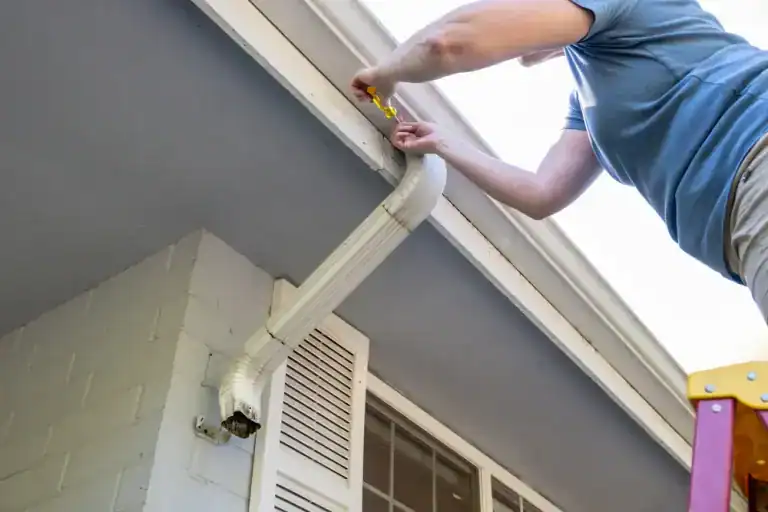
Repair usually makes sense when the problem is isolated. A single section pulling away from the fascia, a joint that’s separated and leaking, a downspout that’s come loose from its strap — these are fixable without replacing the whole system, provided the gutters themselves are in reasonable shape and the underlying fascia is sound. If your gutters are aluminum and less than 15 years old, repair is often the right call.
Replacement starts to make more sense when the problems are recurring or widespread. If you’re dealing with multiple sections that sag, gutters that consistently overflow despite being clean, visible rust or corrosion across a significant portion of the system, or fascia boards that have rotted behind the gutters, you’re likely patching a system that’s past its useful life. Aluminum gutters typically last 20 to 30 years with proper maintenance, but many homes in Brookhaven, Islip, and Babylon are still running original sectional gutters from the 1970s and 80s — and sectional systems fail at the seams, which are everywhere.
When replacement is the right move, seamless is the professional standard. Seamless aluminum gutters are custom-fabricated on-site to the exact dimensions of your home, with no seams between downspout connections. That eliminates the primary failure point of sectional systems and means a properly installed seamless gutter can go 20 to 30 years without the kind of joint leaks that cause fascia rot and foundation overflow. For homes near the water — in Bay Shore, Sayville, or out toward the East End — the material and coating quality matter even more, because salt air will work on an unprotected aluminum system faster than most homeowners expect.
One more thing worth noting: when gutters are replaced, the condition of the fascia boards behind them should be assessed before anything new goes up. Installing new gutters over rotted fascia is a shortcut that fails fast. We always check that before the first hanger goes in.
The pattern we see most often is this: a homeowner ignores their gutters for a few years, something goes wrong, and they end up spending far more fixing the downstream damage than they ever would have spent on prevention. It’s not negligence — it’s just that gutters are easy to forget about until they’re not.
What good gutter protection looks like in Suffolk County is a system that’s sized correctly for your roof, installed by someone who actually knows the local conditions, and maintained on a schedule that accounts for what your specific property throws at it. That combination — right system, right installation, right maintenance — is what keeps water where it belongs.
If your gutters are overdue for an inspection, showing signs of wear, or you’ve been dealing with recurring basement moisture and haven’t connected it to what’s happening at your roofline, we’re happy to take a look. We’ve been doing exactly that for Suffolk County homeowners for over a decade.
Article details:
Share:
Continue learning: