
Summary
Suffolk County sits in one of the most storm-exposed corners of the country, with nor'easters, hurricanes, and coastal weather battering homes from Babylon to Montauk every single year. This guide walks you through what actually protects a roof before a storm rolls in, what to do when one does, and how to handle the aftermath without getting burned by the process.
Whether your home is a post-war Cape Cod in Brookhaven or a waterfront property in Southampton, the steps are the same — and the stakes are real.
Suffolk County has absorbed significant hurricane activity since 1930. Add in the nor'easters that roll through from October to April, the summer thunderstorms that dump inches of rain in an hour, and the salt air that quietly corrodes everything it touches — and you start to understand why roofing on Long Island is its own category entirely. Most homeowners don't think about their roof until water shows up somewhere it shouldn't. By then, the damage is already done. This guide covers what you can do before that happens: a straightforward look at storm damage prevention that's specific to where you actually live.
Hurricane Preparation for Suffolk County Roofs
Hurricane season officially runs from June 1 through November 30, but the window of real risk for Long Island stretches well beyond that. Eastern Suffolk County is ranked among the top ten most hurricane-vulnerable areas in the entire country. That's not a statistic to file away — it's a reason to get ahead of things before the forecast changes.
The good news is that most storm damage is preventable. Not all of it, but enough that a few hours of attention before the season starts can make a meaningful difference in what you're dealing with afterward.
What to Inspect on Your Roof Before Storm Season in Suffolk County
The most common mistake homeowners make is walking outside after a storm, looking up, seeing shingles still in place, and assuming everything is fine. Wind doesn't have to remove a shingle to break its seal. Flashing can pull away from a chimney or vent by a fraction of an inch and let water in for months before you notice. The damage is often invisible from the ground, and by the time it shows up on your ceiling, it's been working against you for a while.
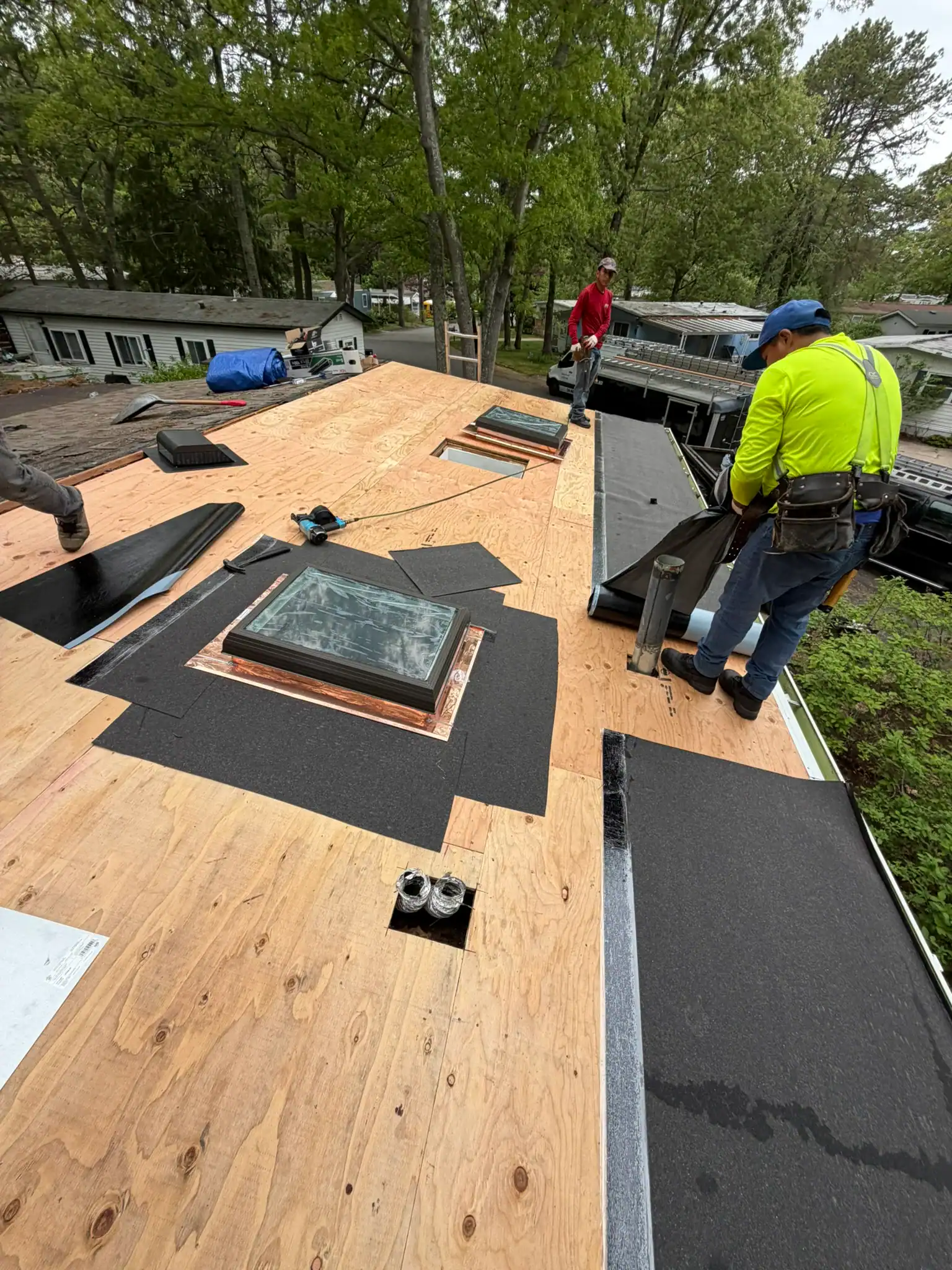
Before storm season, focus on a few specific areas. Flashings — the metal strips that seal transitions around chimneys, skylights, vents, and roof valleys — are the first thing to check. Salt air accelerates corrosion on metal faster here than almost anywhere else in the Northeast, and a flashing that looked fine two years ago may have developed gaps you can't see from a ladder. If your home was built in the 1950s or 1960s, as many in Brookhaven, Babylon, and Islip were, the roof decking underneath your shingles may be original pine board rather than plywood — which offers limited resistance once water finds a way in.
Gutters deserve attention before storm season too, not after. Clogged gutters during a heavy nor'easter don't just overflow — they back water up under your shingles and against your fascia boards, which leads to rot that compounds quickly. In winter, that same backed-up water freezes at the eaves, creates ice dams, and forces water under the shingles from below. It's a slow process that causes expensive damage, and cleaning your gutters in late September before the leaves finish falling is one of the simplest things you can do to prevent it.
If your roof is 15 years or older and hasn't been professionally inspected, that's worth doing before June. In Suffolk County's coastal environment, asphalt shingles age faster than they would inland. A roof that might last 25 years in a landlocked suburb may show significant wear at 18 years here, especially on south- and west-facing slopes that take the brunt of Atlantic weather.
DIY Storm Prep vs. When to Call a Roofing Professional on Long Island
There's a reasonable amount you can do yourself before storm season, and it's worth being clear about what falls into that category. Cleaning your gutters, trimming back branches that overhang your roof, clearing debris from valleys and around vents — these are legitimate maintenance tasks that make a real difference and don't require a contractor.
What requires a professional is anything that puts you on the roof itself, or anything that involves assessing the integrity of materials you can't properly evaluate from the ground. Walking on a roof without training and the right equipment is genuinely dangerous, and beyond the safety issue, it's easy to cause damage to shingles or flashing without realizing it. A visual inspection from a licensed roofer will catch things that a homeowner walking the perimeter simply won't see — granule loss patterns that indicate shingle aging, subtle lifting at the edges, nail pops that have broken the seal, or flashing that's been slowly working loose over several seasons.
The other situation that calls for a professional is anything involving your insurance. If you're thinking about upgrading to impact-resistant shingles — which can qualify you for a premium discount with some carriers — or if you want documentation of your roof's current condition before storm season starts, those conversations are better had with a licensed contractor who can provide written assessments and photos. In New York, work done by an unlicensed contractor can actually complicate or void an insurance claim, which is a risk that isn't worth taking. Suffolk County requires contractors to hold a Home Improvement Contractor license issued through the county's Department of Labor, Licensing and Consumer Affairs — that's the specific credential to ask for before anyone sets foot on your roof.
The honest answer is that storm damage prevention is partly a DIY project and partly a professional one. Knowing which parts are which is most of the battle.
Roof Storm Damage: What to Do When a Storm Hits Suffolk County
Even a well-maintained roof can take a hit from a direct nor'easter or a summer storm that drops a tree branch through a valley. When that happens, what you do in the first 24 to 48 hours matters more than most people realize. Water doesn't wait, and in a humid coastal climate like Long Island's, the window between initial storm damage and secondary damage — mold, structural rot, ceiling collapse — is shorter than you'd expect.
The immediate priority is stopping water from getting in further. After that comes documentation, and then the insurance process. Getting those three things in the right order is what protects both your home and your claim.
Emergency Roof Tarping After a Storm: What It Actually Involves
Emergency roof tarping is one of those services that sounds simple until you see what it actually requires. A properly installed tarp doesn't just get thrown over a hole — it needs to be sized correctly, anchored in a way that won't create new leak points, and positioned so it sheds water rather than collecting it. A tarp that's improperly installed can trap moisture against the decking, accelerate the damage it was supposed to stop, and create complications when an insurance adjuster comes out to assess the claim.
DIY tarping after a storm is a situation where the risk usually outweighs the benefit. Beyond the safety issue of getting on a wet or damaged roof in post-storm conditions, there's a practical concern: insurance companies look at how damage was handled after the fact. If secondary damage occurred because a tarp was installed incorrectly, that can affect your claim. A professional tarping job creates a documented record of what was done, when, and how — which is exactly what you want going into the claims process.
When we respond to storm calls in Suffolk County, tarping is typically the first step before any permanent repair work begins. It stops the bleeding while we assess the full scope of the damage. That assessment matters because storm damage is rarely limited to what's visible from outside. A missing shingle is obvious. Damaged underlayment, compromised decking, or water that's already worked its way into the attic space — those take a closer look to find. Getting a complete picture before starting repairs is what separates a permanent fix from a patch job that fails in the next storm.
Post-storm contractor availability in Suffolk County is a real constraint worth thinking about before you need it. After a major nor'easter or a named storm makes landfall, every roofing contractor in the area is fielding calls at the same time. Homeowners who haven't established a relationship with a contractor ahead of time often wait weeks — while water continues to work through their home. That's one of the less-discussed reasons why storm damage prevention includes knowing who you're going to call before the storm arrives.
Filing a Roof Storm Damage Insurance Claim in Suffolk County, NY
The insurance claim process after storm damage is one of the areas where homeowners most commonly make avoidable mistakes — usually because no one walked them through it before they needed it.
The most important thing you can do before calling your insurance company is document everything. Photos and video of the damage, taken as soon as it's safe to do so, create a record that protects your claim. If you've had a pre-storm inspection done and have documentation of your roof's condition before the storm, that's even better — it eliminates the argument that the damage was pre-existing. Insurance companies are not adversarial by nature, but they do look carefully at maintenance history. A claim that arrives with clear before-and-after documentation moves faster and with fewer complications than one that doesn't.
One thing many homeowners don't know is that having your contractor present during the insurance adjuster's visit can significantly improve the outcome of your claim. An adjuster is looking at a lot of properties quickly, often in the days immediately following a storm. A licensed contractor who can walk the roof alongside the adjuster, point out specific damage, and explain what repairs are actually required gives your claim a better foundation. It's not about arguing — it's about making sure nothing gets missed.
There's also the question of timing. New York State gives homeowners a reasonable window to file a storm damage claim, but waiting too long creates its own problems. Secondary damage — water that's spread from the initial breach, mold that's begun to develop, rot that's taken hold in the decking — can blur the line between storm damage and maintenance neglect in the eyes of an adjuster. Filing promptly, with complete documentation, keeps that line clear.
One last note on contractor selection during the claims process: after a major storm in Suffolk County, door-to-door contractors appear quickly. Some are legitimate. Many are not. The pattern is well-documented — contractors who show up unsolicited after storms, pressure homeowners into signing contracts before they've had time to get multiple quotes, and then either disappear or deliver work that doesn't hold up. Suffolk County homeowners have been specifically warned about this by local officials. Verifying a contractor's Suffolk County HIC license before signing anything is a simple step that protects you from a situation that's far more common than it should be.
Storm Damage Prevention on Long Island Starts Before the Season Does
The homes in Suffolk County take a beating that most of the country doesn't. Between the Atlantic exposure, the nor'easters, the salt air, and the aging housing stock in towns like Brookhaven and Islip, the conditions here are specific — and the approach to protecting your roof should be too.
Storm damage prevention isn't one big thing. It's a pre-season inspection that catches what you can't see from the ground, gutters that are clear before the first October storm, and knowing who you're calling before you need them at 2 a.m. Getting those pieces in place before June, or before the next nor'easter, is what separates a manageable situation from an expensive one.
If you want a straight assessment of where your roof stands before storm season — no pressure, no inflated estimates — we've been doing this work in Suffolk County for over a decade. Reach out and we'll take a look.
Article details