
Summary
Storm damage looks manageable from the ground. A few missing shingles, a sagging gutter, maybe some cracked siding — and suddenly you're on YouTube looking up repair tutorials. But in Suffolk County, NY, what you do in the first 24 to 48 hours after a storm can determine whether your insurance pays out in full, partially, or not at all.
This page breaks down the real difference between DIY and professional storm damage repair — not just in terms of safety, but in terms of documentation, licensing, and what insurers actually require. If you're trying to make a smart decision right now, this is worth reading before you pick up a ladder.
A storm rolls through Suffolk County and you wake up to damage. Maybe it's obvious — shingles scattered across the yard, a gutter hanging off the fascia. Maybe it's subtle — a faint water stain on the ceiling that wasn't there last week. Either way, the instinct for a lot of homeowners is to get up there and handle it before things get worse.
That instinct isn't wrong. But the execution matters more than most people realize. What you do before an adjuster sees your roof — and who does the work — can directly affect what your insurance company agrees to pay. Here's what to actually think through before you make a move.
Storm Roofing Damage: What You Can See vs. What's Actually Wrong
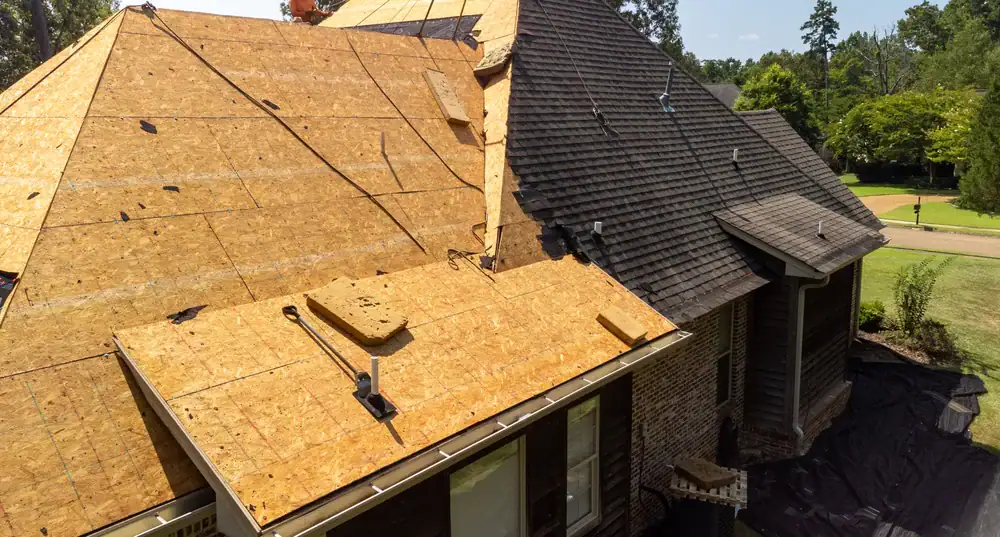
The tricky thing about storm roofing damage is that the visible stuff is rarely the whole story. A few lifted shingles might look like a minor fix, but underneath them, the underlayment could be compromised, the decking could be soft from moisture, or the flashing around your chimney or skylights could have shifted just enough to let water in — slowly, quietly, for weeks.
Suffolk County gets hit from multiple directions. Nor'easters drive wind and ice from the northeast. Summer thunderstorms come up fast from the south. Tropical remnants push rain horizontally. Each type of storm stresses your roof system differently, and each leaves a different damage signature. What looks like a surface-level shingle issue after a nor'easter in January might actually be the result of ice dam formation that's been forcing water under your roofline for days.
That's not something you can diagnose from the ground, or even from a quick look from the top of a ladder.
Storm Damage Contractors vs. DIY: What the Difference Costs You
Let's be honest about why people consider DIY after a storm. It's not recklessness — it's cost anxiety, the desire to act quickly, and the assumption that a small fix is a small fix. And sometimes it is. A loose piece of flashing, a single cracked shingle on a low-slope section you can safely access — there are scenarios where a capable homeowner can make a temporary patch without causing harm.
But here's where it gets complicated: your insurance company doesn't know the difference between a careful temporary repair and a botched one. What they see is that the damage was altered before their adjuster had a chance to document the original condition. That creates ambiguity. And in the insurance world, ambiguity tends to resolve in the insurer's favor, not yours.
We understand this dynamic because we work with Suffolk County homeowners and their adjusters regularly. A professional assessment — with timestamped photos, a written scope of work, and documentation of every damaged component — gives your adjuster a clear, defensible picture of what the storm actually did. Without that, you're relying on the adjuster to find everything themselves. They don't always.
There's also the warranty question. Most roofing material manufacturers void their warranties if installation or repair is performed by an unlicensed contractor — or by a homeowner. So if you patch a section yourself and something fails later, you may have no warranty protection and no insurance coverage for the resulting damage. The cost of a "free" DIY repair has a way of showing up later.
The average storm and wind damage repair in New York runs around $8,500. That's not a small number. It's worth protecting your ability to recover as much of that as possible through your policy — and that starts with keeping the damage documentation clean.
Suffolk County's Licensing Rules and Why They Affect Your Insurance Claim
This is the part most homeowners don't know about until it's too late. In Suffolk County, NY, all residential roofing and construction work must be performed by a contractor holding a Home Improvement Contractor (HIC) license — this is a mandatory requirement under New York State law, and it applies to every town in the county, from Babylon to Southold.
New York State doesn't issue a single statewide roofing license. Instead, each county administers its own program. Suffolk County's HIC license is issued through the Department of Consumer Affairs and covers roofing, siding, gutters, chimneys, masonry, and more. If a contractor can't show you that license, they're operating illegally — and any work they do may not be recognized by your insurance company when it comes time to process your claim.
It goes further than that. Full roof replacements in Suffolk County require a permit, and permit requirements vary across all ten towns — Babylon, Islip, Brookhaven, Smithtown, Huntington, Riverhead, Southampton, East Hampton, Southold, and Shelter Island each run their own building department with different timelines, inspection requirements, and approval processes. We work across all of these towns and know each department's requirements. A contractor who doesn't may skip the permit entirely, leaving you with unpermitted work that can surface as a problem when you sell the house or when your insurer reviews the claim.
Workers' compensation coverage matters here too. Under New York Workers' Compensation Law, if a contractor's employee is injured on your property and the contractor doesn't carry active workers' comp, you — the homeowner — can be held liable. It's not a hypothetical risk. It's a documented legal exposure, and it's one more reason why verifying a contractor's license and insurance before any work starts isn't optional.
We've been working in Suffolk County for over 10 years. We know every town's permit process, and we pull every permit a project legally requires. That's not a selling point — it's just how the work is supposed to be done.
What Insurance Actually Covers After Storm Damage in Suffolk County
Homeowners insurance is more complicated on Long Island than most people expect. For starters, many policies in coastal Suffolk County — particularly in towns like Southampton, East Hampton, and along the South Shore — carry percentage-based windstorm deductibles rather than flat amounts. On a $400,000 home with a 2% windstorm deductible, you're paying $8,000 out of pocket before your insurance covers a dollar. Most homeowners don't realize this until they're already mid-claim.
Standard homeowners policies also frequently exclude wind damage entirely for coastal properties, requiring a separate windstorm endorsement. If you have that coverage and you've maintained it, you're in a better position — but only if your claim is documented correctly from the start.
ACV vs. RCV: The Coverage Detail That Changes Everything
When your insurer evaluates a storm damage claim, one of the most important variables is whether your policy pays Actual Cash Value (ACV) or Replacement Cost Value (RCV). It sounds like fine print, but the difference can be thousands of dollars.
ACV policies depreciate your roof based on its age and condition at the time of the storm. If your roof was 15 years old when it got hit, you won't receive what it costs to replace it — you'll receive what a 15-year-old roof is worth, which is considerably less. RCV policies pay the full cost of replacement, but typically in two stages: an initial payment based on depreciated value, followed by a supplemental payment once the work is actually completed and documented.
Here's where professional documentation becomes critical again. To receive the full RCV payout, you need to demonstrate that the work was done — properly, completely, and by a licensed contractor. If the scope of work submitted to the insurer doesn't match what was actually needed, or if the contractor missed damage during the initial assessment, you may not get a second chance to supplement the claim.
We document every project with photos and video, from initial inspection through completed repairs. That documentation exists for your records, for your adjuster, and for any supplemental claims that come up after the initial payout. It's not extra — it's standard. Because in Suffolk County, where construction costs run 35 to 55 percent above national averages, the gap between what insurance initially offers and what repairs actually cost can be significant. You need someone who knows how to close that gap.
Why One Storm Often Damages More Than Just Your Roof
Suffolk County storms don't discriminate. A nor'easter that tears up shingles usually also pulls gutters away from the fascia, drives water behind siding panels, and stresses chimney flashing that was already weakened by salt air corrosion. A summer thunderstorm that drops hail on your roof is also dropping it on your skylights, your AC condenser housing, and your deck boards.
The problem with hiring separate contractors for each trade is that your insurance claim ends up fragmented. One contractor documents the roof. Another handles the gutters. A third looks at the siding. Each submits their own scope of work, with their own photos, on their own timeline. Adjusters see a patchwork of claims with no unified picture of what the storm actually did to the house — and gaps between trades are easy to deny.
We handle roofing, gutters, siding, and chimney repairs under one roof. When we assess a storm-damaged home, we're looking at the entire exterior envelope — not just the part that's easiest to quote. That means one inspection, one coordinated scope of work, one documentation package, and one point of contact with your adjuster. For homeowners across Suffolk County, from Brookhaven and Islip to Huntington, where post-storm contractor availability gets stretched thin fast, that also means faster turnaround and less coordination headache on your end.
There's a specific risk worth mentioning for East End homeowners in Southampton and East Hampton: seasonal vacancy. Storm damage that occurs while a property is unoccupied from October through May can go undetected for months. By the time someone notices the leak or the collapsed soffit, what might have been a $3,000 repair has turned into a $15,000 remediation. Getting a professional inspection before you close up for the season — and after any significant storm — is genuinely worth the time.
When to Call a Storm Damage Repair Contractor in Suffolk County, NY
The short answer: before you do anything else. Not because DIY is always dangerous, but because the first 48 hours after a storm set the terms for everything that follows — your insurance claim, your repair timeline, and your out-of-pocket costs.
Suffolk County's combination of coastal exposure, aging housing stock, complex permit requirements, and percentage-based windstorm deductibles means there's more at stake here than in most markets. The decisions you make right after a storm — who you call, what you touch, what you document — have real financial consequences.
If you're dealing with storm damage right now, or you want a professional assessment before filing a claim, we're based in Brookhaven and have been serving Suffolk County homeowners for over 10 years. We respond 24/7, we handle the documentation, and we work directly with your adjuster so you're not navigating that process alone. Reach out and we'll take it from there.
Article details