
Summary
A roof replacement in Suffolk County isn't a one-day event — it's a process that spans two to four weeks when you account for permits, material ordering, installation, and final inspection. Understanding that timeline upfront is what separates a smooth experience from a frustrating one.
This guide walks you through every phase, from the moment you schedule your estimate to the day our crew packs up and leaves your driveway clean. If you want to know what to expect — and why each step matters — you're in the right place.
Most contractors hand you a contract and go quiet until installation day. No heads-up on what's happening, no explanation of what comes next, no answer to the question you're too nervous to ask: how long is this actually going to take?
If you're a Suffolk County homeowner trying to plan around a roof replacement, this is the page you've been looking for. We're going to walk you through the real timeline — not the optimistic two-day version you've probably seen online, but the actual sequence of events from first call to final inspection. By the end, you'll know exactly what to expect, when to expect it, and why each step exists.
How Long Does a Roof Replacement Take in Suffolk County?
Here's the honest answer: active installation typically takes one to two days for a standard asphalt shingle roof. But the full project — from the day you call to the day the permit is closed out — usually runs two to four weeks.
That gap surprises a lot of homeowners. It shouldn't, but it does, because most of what they've read online focuses only on the installation itself. What those articles skip over is everything that has to happen before and after the crew shows up with their equipment.
Suffolk County has its own permit requirements, its own inspection process, and its own weather patterns that affect scheduling. Once you understand the full sequence, the timeline makes complete sense — and you'll be in a much better position to plan around it.
The Week Before Installation: Permits, Materials, and Scheduling
The process starts before anyone sets foot on your roof. After your estimate is approved and you've signed the contract, the first thing that happens is permit filing — and in Suffolk County, this step alone can take anywhere from five business days to two weeks depending on which town you're in.
Suffolk County doesn't have one central building department. Each of its ten towns — Brookhaven, Babylon, Huntington, Islip, Smithtown, and the rest — operates its own permitting office with its own forms, fees, and timelines. Permit fees across the county typically run between $150 and $500. Babylon's building department tends to process roofing permits in five to ten business days. Brookhaven, which covers a large swath of the county including Patchogue, Coram, and Port Jefferson, operates across multiple offices depending on the geographic zone of your home.
The point is: this isn't a same-week formality. It takes time, and a contractor who tells you otherwise is either skipping the permit or hasn't done this in Suffolk County before.
We handle the permit filing for every job we do. You don't need to call the town, figure out which office applies to your address, or track down the right forms. We take care of it because we've done it dozens of times across these towns and we know how to move it through without delays.
While the permit is processing, materials are being ordered and your installation date is being locked in. Architectural shingles — the standard we recommend for Long Island homes — need to be coordinated with your material supplier, and lead times vary. This is also when we confirm the installation window with you, accounting for the weather forecast. On Long Island, that matters more than most places.
Installation Day: What the Tear-Off Process Actually Looks Like
Installation day is the part most homeowners picture when they think about roof replacement. It's also the part they have the most questions about — the noise, the mess, the debris, whether they need to be home.
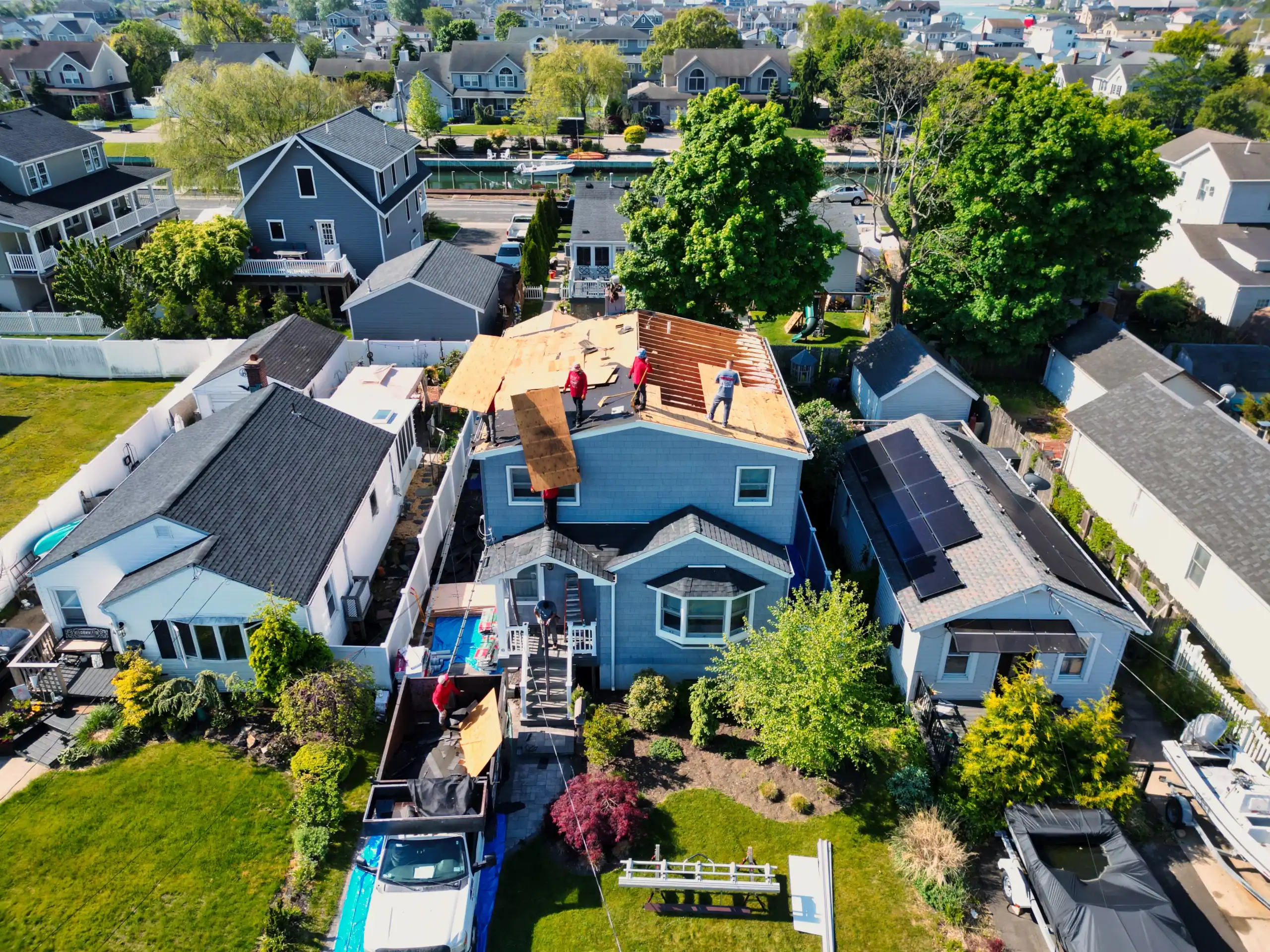
Here's what a typical installation day looks like. The crew arrives early, usually around 7 or 8 in the morning. The first order of business is protecting your property: tarps go down along the perimeter of the house to catch falling debris and old shingles. Your landscaping, your driveway, and anything close to the house gets covered before a single nail is pulled.
Then the tear-off begins. This is the part that sounds exactly like what it is — loud, physical work. The old shingles and underlayment are stripped down to the roof deck, and that's where the real inspection happens. Once the deck is exposed, we can see everything that was hidden underneath: soft spots, rot, water damage, areas where previous leaks have been quietly doing damage for years. If we find anything that needs to be addressed, we walk you through it before we proceed. No surprises.
After the deck is inspected and any damaged sections are repaired, the new system goes on in layers. First comes the underlayment — on Long Island homes, that includes ice-and-water shield at the eaves and valleys, which is critical for preventing the freeze-thaw leakage that causes so many interior ceiling stains during nor'easters. Then the shingles go on, fastened with six nails per shingle rather than the standard four. That extra fastening makes a meaningful difference in wind resistance, which matters when you're in a coastal zone that sees sustained wind events every winter.
By the end of the day, the new roof is on, the flashing around chimneys and skylights has been replaced, and the magnetic nail sweep has gone over your yard and driveway to pick up stray fasteners. Most jobs are fully complete in one day. Larger or more complex roofs sometimes carry into a second morning.
Throughout the day, we document the work with photos. You get a visual record of what was done, what the deck looked like before and after, and confirmation that the job was completed correctly. That documentation matters if you ever need to reference it for a warranty claim or an insurance question down the road.
After Installation: The Inspection Step Most Homeowners Don't Expect
Once the roof is installed, the job isn't technically finished. In Suffolk County, a permitted roof replacement requires a final inspection by the town's building department before the permit can be closed out. This is the step that catches most homeowners off guard — not because it's complicated, but because nobody told them it was coming.
The inspection itself is straightforward. A building inspector visits the property, verifies that the installation meets code, and signs off on the permit. Scheduling that inspection adds time to the overall timeline, typically a few additional days to a week depending on the town's current workload.
This step is not optional, and it's not bureaucratic red tape. A closed permit is the paper trail that protects you — at resale, during an insurance claim, and in any future dispute about the condition of the roof.
Do You Need a Permit for a Roof Replacement in Suffolk County?
Yes. Every full roof replacement in Suffolk County requires a building permit, in every town. This is not a gray area.
Some contractors will suggest skipping the permit to speed things up or reduce paperwork. It's a shortcut that creates serious problems down the road. An unpermitted roof shows up in a title search when you sell your home — and it can stop a sale cold while you scramble to retroactively address the violation. It also gives your insurance company grounds to deny a storm damage claim, because the installation was never officially verified as code-compliant.
The permit process exists to protect you, not to slow us down. When we pull a permit, a licensed inspector verifies that the work was done correctly. That's a layer of accountability that benefits you as the homeowner, not just the contractor.
We've filed permits across Brookhaven, Babylon, Huntington, Islip, and the other Suffolk County towns many times over. We know which offices handle which zones, what each town's application requires, and how to avoid the back-and-forth that delays unprepared contractors. The permit fees — which typically run $150 to $500 depending on the town — are factored into your estimate upfront. No surprises at the end.
If you're getting quotes from multiple contractors and one of them is vague about the permit or suggests it's not necessary, that's a significant red flag. It's worth asking directly: will you pull the permit, and will you handle the final inspection?
Can You Replace a Roof in Winter on Long Island?
This question comes up more than you'd expect, especially after a nor'easter reveals a problem that can't wait until April.
The short answer is yes — with the right protocols in place. The longer answer involves a specific number: 40 degrees Fahrenheit. That's the threshold at which asphalt shingles' self-sealing adhesive strips activate correctly during installation, per guidelines from GAF and the Asphalt Roofing Manufacturers Association. Below that temperature, the adhesive doesn't bond properly on its own.
Here's the relevant local fact: Long Island's average January high is 39 degrees. That puts a lot of winter days right at or just below the threshold, which means winter roofing on Long Island isn't impossible, but it does require an experienced crew that knows how to work around it. Hand-sealing each shingle individually and using cold-weather adhesives are the standard workarounds — they're effective, but they add labor time and require attention to detail that a less experienced crew might skip.
There's also the salt air factor that's specific to Long Island's coastal environment. Cold temperatures combined with coastal humidity can create a frost layer on the roof deck that isn't visible to the naked eye. An experienced local crew knows to check for this before laying underlayment, because installing over a frost layer creates an adhesion problem that won't show up until the following summer.
The upside of winter roofing is real: scheduling is easier, wait times are shorter, and you're not competing with the spring and summer rush. If your roof has a problem that can't wait, winter replacement is a legitimate option — it just needs to be done by a crew that's done it before on Long Island, not one that's applying warm-weather habits to a cold-weather job.
We do work through the winter. We monitor forecasts carefully, adjust our schedule around temperature windows, and use the installation methods that make cold-weather work viable. If you've got storm damage in January, you don't have to sit with a compromised roof for three months waiting for spring.
Getting a Roof Replacement Right in Suffolk County
The two-day timeline you've seen advertised is only part of the story. The real process — permit filing, material ordering, installation, inspection, and closeout — takes two to four weeks from start to finish. That's not a problem. It's just how a properly permitted, correctly installed roof replacement works in Suffolk County.
What matters is that you go in knowing what to expect. When you understand why each step exists, the timeline stops feeling like a delay and starts feeling like a process that's working in your favor.
If you're a Suffolk County homeowner with questions about your roof — whether you're ready to move forward or still figuring out whether you need a repair or a full replacement — Home Team Construction is a straightforward call or message away. We've been doing this work in this county for over a decade, and we'll give you a straight answer before we ask for anything.
Article details