
Summary
Most Suffolk County homeowners don't think about their gutters until something goes visibly wrong — water cascading over the sides, a section pulling away from the house, or puddles forming right next to the foundation. But by then, the damage has usually already started. This guide walks through the most common gutter problems on Long Island, what they actually cost to fix, and why the weeks between leaf drop and first freeze are the most important window of the year to act.
There's a narrow window every fall — roughly mid-October through late November — when Suffolk County homeowners can realistically clean, inspect, and repair their gutters before winter locks everything in. After that, frozen debris, ice, and nor'easter conditions make the work harder, more expensive, and sometimes impossible until spring. The problem is that spring is when you discover what a damaged gutter did all winter: ceiling stains, rotted fascia, foundation moisture, ice dam damage. This guide covers what to look for, what the common repairs actually involve, and what happens when you let it slide another season.
How to Tell If Your Gutters Need Repair Before Winter
Most gutter problems announce themselves if you know what to look for — and most of them are visible from the ground. A section pulling away from the roofline, a visible sag in the middle of a run, water stains streaking down your siding, or pooling near your foundation after a rainstorm are all signs that something in the system isn't working the way it should.
The tricky part is that the symptom you can see is rarely the whole problem. A sagging gutter usually means the hangers have failed — but hangers often fail because the fascia board behind them has started to rot. Fix only the hanger and you'll be back in the same spot within a season or two. That's why a real inspection looks at the full picture, not just the piece that's obviously broken.
What Causes Gutters to Sag, Leak, or Pull Away From the House
Sagging is probably the most common gutter complaint we hear from homeowners across Suffolk County, and it almost always comes down to one of three things: failed gutter spikes or hangers that can no longer support the weight of debris and water, a fascia board that has softened with rot and can't hold a fastener anymore, or the sheer accumulated weight of wet leaves and standing water that was never cleared out.
Long Island's tree canopy is particularly demanding. The oaks, maples, and beeches that line streets throughout Brookhaven, Islip, and Babylon don't just drop leaves — they drop leaves that decompose into dense, sponge-like masses inside the gutter channel. That material holds water, adds significant weight, and creates exactly the conditions that accelerate hanger failure and fascia rot. If your gutters haven't been cleaned in more than a year, there's a reasonable chance this is already happening.
Leaking seams are a separate but equally common issue. Most older homes in Suffolk County have sectional gutters — aluminum runs joined at seams with sealant — and that sealant doesn't last forever. Freeze-thaw cycles, which Long Island gets plenty of between November and March, cause the metal to expand and contract repeatedly, eventually breaking the seal. You'll often notice this as a water stain on the fascia or a drip that appears during rain even when the gutters aren't visibly clogged.
Gutters pulling away from the roofline are the most urgent version of the hanger problem. When a section separates from the fascia, it creates a gap where water runs directly behind the gutter and down the wall — exactly where you don't want it going, especially heading into a winter with 35 to 40 inches of average snowfall.
Downspout Problems That Homeowners Usually Overlook
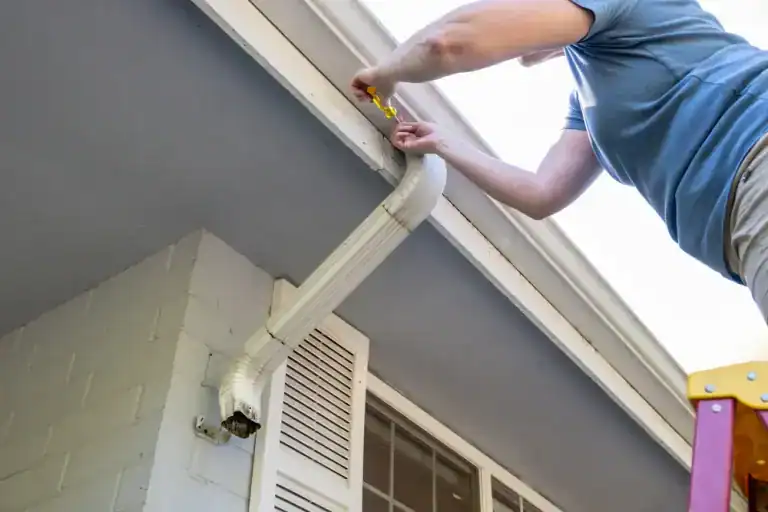
Downspouts get far less attention than the gutter channels themselves, but a blocked or damaged downspout can make a perfectly clean gutter completely useless. If water can't exit the system, it backs up, overflows, and puts the same stress on the hangers and seams as a clogged channel would.
The most common downspout issues we see are blockages from compacted debris at the elbow where the downspout bends away from the wall, disconnected sections that have separated at a joint, and discharge points that are too close to the foundation. That last one matters more than most homeowners realize. The industry standard is to direct water at least five to ten feet away from the foundation — and a lot of DIY repairs and older installations fall well short of that. When downspouts discharge right at the base of the house, every rainstorm is pushing water toward your basement or crawl space.
On Long Island, where the housing stock includes a large share of post-WWII ranch homes and cape cods throughout Brookhaven and Islip — many of them now 60 to 70 years old — the original downspout configurations were often installed with minimal clearance from the foundation. If your home is in that age range and you've never had the drainage layout evaluated, it's worth checking before winter.
Downspout repairs are generally among the more straightforward and affordable fixes in the gutter system. The issue is that they tend to get ignored precisely because they're not as visible as a sagging gutter run or overflowing channel. A blocked downspout during a nor'easter, though, can overwhelm the entire system in a matter of hours.
Gutter Repair Costs on Long Island — and What Happens If You Wait
One of the most common things we hear is some version of "it's just gutters — I'll deal with it in spring." We understand the logic. There are always more pressing things competing for attention and money. But the math on waiting is genuinely bad, and it's worth walking through once so it's clear what the actual trade-off is.
Minor gutter repairs on Long Island — sealing a leaking seam, re-hanging a sagging section, clearing a blocked downspout — typically run between $150 and $450 depending on what's involved. Moderate repairs across a full system generally land somewhere between $500 and $1,200. Those are real numbers, and they're not nothing. But they're also not $8,000, which is the average cost of foundation repairs that stem from chronic water infiltration.
How Damaged Gutters Lead to Ice Dams and Interior Water Damage
This is the failure chain that most homeowners don't think through until they're dealing with a water stain on their ceiling in February. It starts with a gutter that's clogged or damaged heading into winter. When snow falls and the roof surface generates any warmth — either from heat loss or sun exposure — the snowmelt runs down toward the eave. If the gutter is blocked or the downspout can't drain, that water has nowhere to go. It pools at the roof's edge, refreezes overnight, and builds into an ice dam.
Ice dams are more than an inconvenience. As the dam grows, it forces water back up under the shingles, where it finds its way into the roof deck, insulation, and eventually the interior of the home. By the time you see a ceiling stain or a bubble in the drywall, the water has already been sitting in places it shouldn't be for weeks. The repair at that point isn't a gutter job — it's a roofing, insulation, and potentially drywall job.
Suffolk County averages 35 to 40 inches of snowfall per year, and nor'easters can drop 12 to 24 inches in a single event with wind gusts reaching 60 miles per hour. A gutter system that's already compromised going into that kind of winter isn't just a maintenance problem — it's a liability. The cost of addressing a leaking seam or a sagging section in October is a fraction of what it costs to deal with the downstream damage in March.
The other piece of this is salt air. Long Island's coastal exposure accelerates corrosion on aluminum gutters in ways that aren't always obvious from the outside. A gutter that looks structurally intact may have thinning walls or weakened seams that won't hold up under the weight of ice and wet snow. That's another reason a visual inspection by someone who knows what they're looking for is worth doing before the season turns.
Gutter Guards: Do They Actually Work in Suffolk County?
Gutter guards come up in almost every conversation about fall gutter maintenance, and the honest answer is that they help — but they're not a substitute for maintenance, and their performance varies a lot depending on the type and the environment.
Suffolk County's tree canopy is particularly demanding on gutter guards. The oaks and beeches that dominate the landscape in towns like Setauket, Port Jefferson, and Medford drop smaller, denser debris than pine needles or large maple leaves. Fine debris can work its way through or around screen-style guards and accumulate in the channel below, sometimes in ways that are harder to clean out than an unguarded gutter. Micro-mesh guards perform better in this environment because the openings are small enough to block most debris while still allowing water through — but even micro-mesh systems need periodic inspection and occasional cleaning.
What gutter guards genuinely do well is reduce the frequency of cleaning. For a homeowner with a two-story home and mature trees overhead, that's a meaningful safety and convenience benefit. For a ranch home with a manageable roofline and moderate tree coverage, the cost-benefit calculation is different.
The more important point is that guards should only be installed on gutters that are already clean, properly pitched, and in good repair. Installing guards over a system with existing problems just makes those problems harder to access and diagnose. If you're considering gutter guards, the right sequence is to address any repairs first, clean the system thoroughly, verify the pitch is correct, and then evaluate whether guards make sense for your specific situation. We're straightforward about this with every homeowner we talk to — guards aren't always the right answer, and the decision should be based on your actual roof and tree situation, not a sales pitch.
Getting Your Gutters Ready for a Long Island Winter
The window to deal with gutter repairs before winter is real, and it closes faster than most people expect. Once temperatures drop consistently below freezing, options narrow and the risk of compounding damage goes up. The good news is that most gutter problems — sagging sections, leaking seams, blocked downspouts — are straightforward to fix when caught early and addressed by someone who knows what they're doing.
Suffolk County's licensing requirement for home improvement contractors exists for a reason. Any contractor doing this work is required to hold a valid Home Improvement Contractor license through the county — and hiring someone without one can affect your ability to make an insurance claim if something goes wrong. It's worth asking before anyone gets on a ladder.
If your gutters are showing any of the signs covered here, or if you simply haven't had them inspected before a Long Island winter, reach out to Home Team Construction. We serve all of Suffolk County, we'll tell you honestly what needs attention and what can wait, and we back our work with warranties up to 10 years on labor and up to 30 years on materials.
Article details