
Summary
Most Suffolk County homeowners never think about their chimney crown — until a water stain shows up on the ceiling or a contractor flags it during an inspection. By then, what could have been a straightforward repair has often turned into something much more involved.
This post covers what the chimney crown actually does, how Long Island's coastal climate accelerates the damage, and how to tell whether you're looking at a repair or a full replacement. If you're heading into another winter without knowing the condition of your crown, this is worth a few minutes of your time.
Most chimney crowns can't be seen from the ground. You can walk around your house, look up at the roofline, and have no idea whether your crown is solid or crumbling. That's exactly why so many Suffolk County homeowners end up with a small problem that's quietly grown into a large one — they simply didn't know it was happening.
If you're heading into fall with an uninspected chimney, this is the right time to pay attention. What follows covers what the chimney crown actually is, why Long Island's climate is particularly hard on it, what repair and replacement typically cost, and how to make a confident decision before the first hard freeze.
What Is a Chimney Crown and What Does It Actually Do?
The chimney crown is the concrete or masonry cap that covers the entire top surface of your chimney. It slopes away from the flue on all four sides, directing rainwater and snowmelt off the chimney and away from the masonry below.
A properly built crown also has a drip edge — a slight overhang beyond the chimney's outer edge — so water doesn't run down the side of the brickwork. It's not glamorous, but it's one of the most important components on your chimney.
Without a functioning crown, water gets into the masonry, works its way into the mortar joints, and starts the kind of slow, invisible damage that shows up as a big repair bill a few years later.
What's the Difference Between a Chimney Crown and a Chimney Cap?
This is probably the most common point of confusion homeowners run into, and it's worth clearing up before you talk to any contractor.
The chimney crown is the wide, flat-to-sloped concrete surface that covers the entire top of the chimney structure — from one edge of the brick to the other. It's built into the chimney itself. The chimney cap, by contrast, is a smaller metal cover that sits directly over the flue opening. Its job is to keep rain, birds, squirrels, and sparks from entering or exiting the flue.
Both components matter, and both can fail independently of each other. When a contractor tells you the crown is damaged, they're talking about the concrete surface — not the metal cap over the flue. When they say the cap is missing or rusted out, that's a separate issue. You can have a perfectly intact crown and a missing cap, or a solid cap sitting on top of a crown that's cracked all the way through.
Knowing the difference helps you have a smarter conversation about what actually needs to be done. On Long Island, we see both fail with some regularity — often at the same time, because they're exposed to the same weather. If one is being addressed, it makes sense to check the other while our crew is already on the roof.
How Do You Know If Your Chimney Crown Is Damaged?
Since you can't see the crown from the ground, most homeowners find out about damage one of two ways: either a chimney professional spots it during an inspection, or interior water damage makes itself known first — a stain on the ceiling near the fireplace, efflorescence on the brick surround, or a musty smell coming from the firebox.
The signs that typically show up on the crown itself include hairline cracks running across the surface, larger fractures that have allowed chunks to break away, the crown lifting slightly off the top course of brick, or a surface that's visibly spalling and deteriorating. A crown without a proper drip edge — which was common in older construction — will show accelerated erosion along the outer edges because water has been running directly down the brick face for years.
Hairline cracks on an otherwise solid crown can often be addressed with a proper repair. Large fractures, missing sections, or a crown that's separating from the chimney structure usually point toward replacement. You need eyes on it before anyone can tell you which category you're in — and that means getting someone on the roof with a camera, not just an estimate over the phone.
A well-built concrete crown can last 50 to 75 years under reasonable conditions. But many Suffolk County homes were built in the post-WWII boom of the 1950s through 1970s, and a lot of those original crowns were made with standard mortar rather than proper concrete mix. Mortar crowns have a much shorter effective lifespan — sometimes as little as 5 to 10 years — which means if your home is 60 years old and the crown has never been replaced, it's likely been failing for decades.
Why Long Island's Climate Makes Chimney Crown Damage Worse
Suffolk County isn't a forgiving environment for masonry. The combination of salt air from the Atlantic to the south and Long Island Sound to the north, repeated freeze-thaw cycles through winter, and nor'easters that drive rain horizontally into structures creates conditions that accelerate wear significantly faster than inland markets.
What might take 30 years to fail in a drier climate can fail in 10 to 15 years here. That's not an exaggeration — it's the reality of building on coastal Long Island, and it changes how you should think about chimney maintenance timelines.
How Freeze-Thaw Cycles Turn Small Cracks Into Structural Problems
Here's the mechanics of it. A small crack forms in the crown — maybe from age, maybe from a storm. Rain gets in. Temperatures drop below freezing, and that trapped moisture expands as it turns to ice. The crack widens slightly. Then it thaws, contracts, and the next rain event fills it again. This cycle repeats dozens of times between December and March on Long Island.
Each freeze-thaw cycle does a little more damage than the last. What starts as a hairline crack becomes a fracture. A fracture becomes a gap. Water that was once staying near the surface of the crown is now getting into the masonry below, then into the mortar joints, then potentially into the flue liner and the chimney's interior structure. By spring, what looked like a minor surface issue in October has become something significantly more involved.
The salt air compounds everything. Salt draws moisture into brick and mortar like a sponge, and when that moisture freezes, the expansion pressure is working against material that's already been weakened. This is why we use marine-grade materials — specifically stainless steel for flashing and liners — on Long Island chimneys. Standard galvanized steel or aluminum corrodes in this environment. The same logic applies to crown repair: the materials and methods that work fine in a dry inland climate aren't necessarily the right call here.
Nor'easters add another layer to this. Wind-driven rain hits chimneys from angles that standard construction doesn't fully account for. Flashing that seals well in calm conditions can fail under horizontal rain pressure. A crown that's technically intact can still allow water infiltration during a hard coastal storm if the slope is wrong or the drip edge is missing.
What Does Chimney Crown Repair Cost in Suffolk County?
Crown repair typically runs $500 to $1,500, depending on the extent of the damage and what materials are needed. Full crown replacement generally falls in the $1,000 to $3,000 range. Our crew can usually complete a replacement in one to three hours once we're on the roof.
Those numbers can shift on Long Island based on a few practical factors. Steep roofs, tall chimneys, or limited access take more time and require more safety setup, which moves the starting point higher. Coastal materials — the kind that actually hold up in a salt-air environment — cost more than standard alternatives. If the crown damage has allowed water to get into the mortar joints below, chimney repointing may need to happen at the same time, which adds to the scope.
Here's the number that puts it in perspective: a full chimney rebuild, when deferred maintenance reaches the structural level, can run anywhere from $4,000 to $15,000. Crown repair is the most cost-efficient intervention in the chimney maintenance lifecycle. Addressing a cracked chimney crown at $500 to $1,500 is a straightforward decision when the alternative is a five-figure rebuild.
On the insurance question — homeowners' insurance typically covers sudden, accidental damage from events like a fallen tree or storm impact. Gradual deterioration from age or lack of maintenance generally falls outside coverage. If a nor'easter caused visible damage to your crown, that's worth a conversation with your insurer before you pay out of pocket. We work directly with all major insurance companies and can help document storm-related damage if that's the situation you're in.
Summer and early fall are the better windows for this work. Masonry repairs need reasonable temperatures and dry conditions to cure properly. Scheduling in September rather than waiting until November means you're not competing with every other homeowner who suddenly remembered their chimney when the first cold snap hit.
Getting Your Chimney Crown Inspected and Repaired Before Winter
Chimney crown damage is invisible from the ground, it gets worse every winter, and the cost of fixing it early is a fraction of what it becomes if you wait. For Suffolk County homeowners — especially those in homes built in the 1950s through 1970s — the question isn't really whether to check it, it's whether to check it now or after the damage has already compounded.
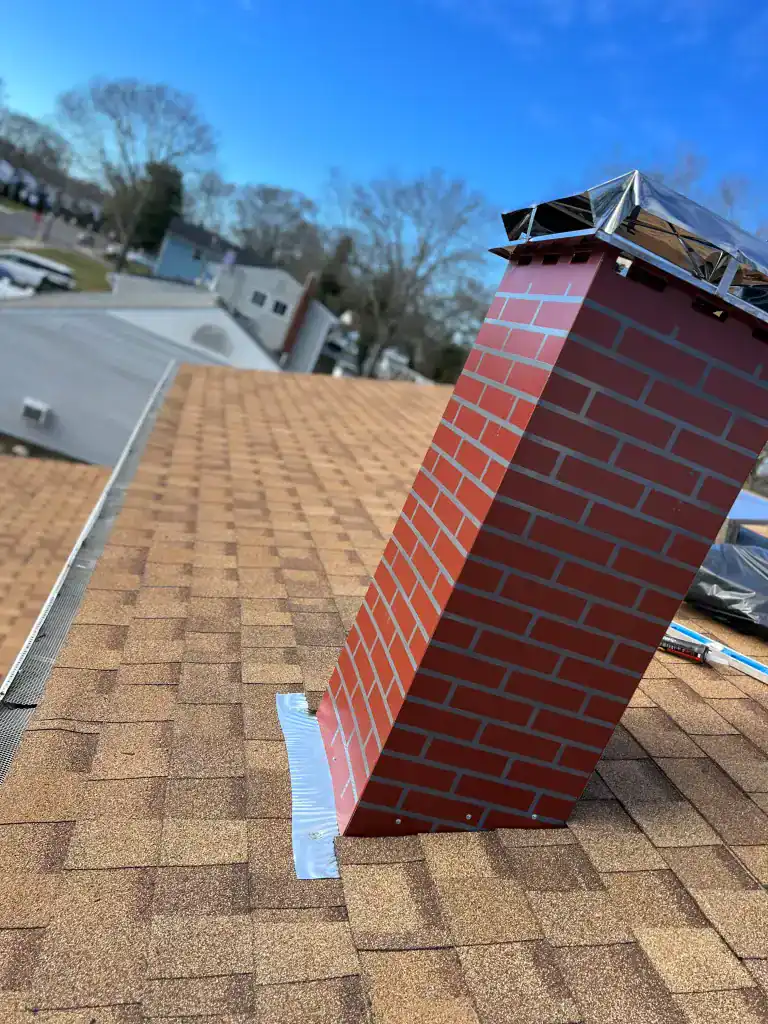
We've spent over a decade working on chimneys across Suffolk County, from Brookhaven and Islip to Huntington, Smithtown, and out to the East End. We know what coastal weather does to masonry, and we show up with the materials and methods that actually hold up here. Every job is documented with photos so you see exactly what we found and what we fixed — no guessing, no pressure.
If you want to head into winter knowing your chimney crown is in solid shape, reach out to Home Team Construction for an inspection before the fall rush makes scheduling harder.
Article details