Summary
Choosing the best roofing material isn't just about price. For Suffolk County homeowners, it's about what holds up against nor'easters, salt air, and freeze-thaw cycles that most national comparison guides never account for.
This page breaks down the real cost difference between asphalt shingles and metal roofing, how each material performs in Suffolk County's coastal climate, and what total ownership actually looks like over 20 to 30 years. If you're making this decision soon, read this first.
Replacing a roof is one of the bigger decisions you'll make as a homeowner — and it gets more complicated when you're not sure which material is actually worth the investment. Asphalt or metal? Cheap now or smart long-term? The internet gives you a dozen different answers, most of them written for a general audience that has nothing to do with Long Island.
We've been installing and replacing roofs across Suffolk County for over 10 years, from Brookhaven to Babylon to the East End. What we've seen in the field doesn't always match what the brochures say. Here's what you actually need to know.
Asphalt Shingles vs. Metal Roof: What Homeowners in Suffolk County Are Actually Choosing
Asphalt shingles cover roughly 75 to 80 percent of residential roofs in the U.S., and Suffolk County is no different. They're familiar, widely available, and less expensive upfront — which is why most homeowners default to them. But "most common" doesn't always mean "best fit," especially when your home sits a mile from the Great South Bay or takes the full force of a nor'easter every winter.
Metal roofing has been gaining ground steadily, and for good reason. It lasts longer, performs better in high-wind and high-moisture environments, and costs less to maintain over time. The tradeoff is a higher upfront price — one that stops a lot of people before they do the full math. That math, it turns out, often tells a different story than the sticker price suggests.
Roofing Material Durability: How Long Does Each Option Actually Last on Long Island?
On paper, a 30-year architectural shingle sounds like a long-term solution. In practice, the lifespan you get depends heavily on where your home sits and how well the roof was installed. In coastal Suffolk County — where salt air accelerates granule loss, nor'easters push wind-driven rain under compromised edges, and freeze-thaw cycles work on any small gap all winter long — a standard architectural shingle roof often delivers closer to 20 to 25 years of reliable performance. Lower-grade products in exposed locations have been known to show serious wear in 12 to 15 years.
Metal roofing tells a different story. A properly installed standing seam or metal shingle system typically lasts 40 to 70 years in coastal environments when the right material is used. For homes near the water, aluminum or galvalume steel (an aluminum-zinc alloy coating) is the right call. Standard galvanized steel corrodes faster in saltwater environments, which matters a lot if your home is within a few miles of the Atlantic, Long Island Sound, or Peconic Bay.
The lifespan gap between the two materials is also a replacement cost gap. Over 50 years, an asphalt shingle homeowner is likely replacing their roof at least once, possibly twice — at future labor and material rates that are almost certainly higher than today's. Roofing costs jumped 6 to 10 percent in 2025 alone. When you factor in one or two future replacements, the total cost of asphalt over a 30 to 50 year period often comes out higher than a single metal installation, even though metal costs more on day one.
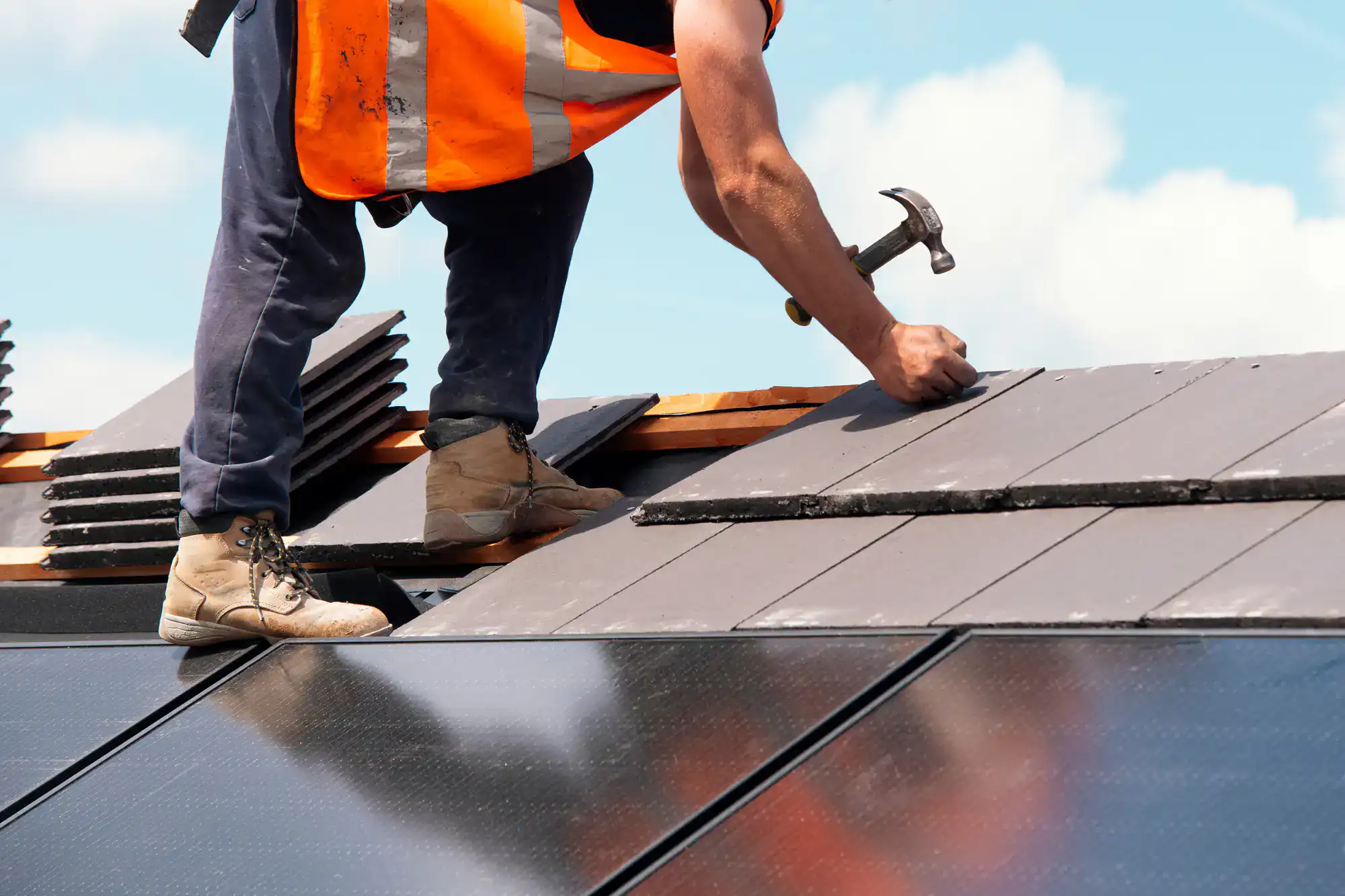
The other thing worth knowing: lifespan is only partly about the material itself. Installation quality matters just as much. A 30-year shingle installed by an undertrained subcontractor won't last 30 years. That's why we only put our direct employees on every job — not day laborers hired for the week. The material warranty is only as good as the crew behind it.
Which Roofing Material Holds Up Better in Nor'easters and Coastal Weather?
Long Island's weather is genuinely different from most of the country, and it matters when you're choosing a roofing material. Nor'easters roll through from October through April, bringing sustained winds of 40 to 60-plus mph, heavy rain, and sometimes significant snow loads. Hurricane season runs June through November. Anyone who owned a home during Sandy in 2012 doesn't need a reminder of what coastal storms can do to a roof that wasn't built for them.
Wind resistance is where the gap between materials becomes clearest. Quality architectural asphalt shingles are rated to withstand winds of roughly 60 to 110 mph depending on the grade and how they're installed. Standing seam metal roofing, with its continuous fastening system and interlocking panels, can handle 120 to 140-plus mph. In a market where coastal wind events are a regular part of life — not a once-in-a-generation anomaly — that difference is worth taking seriously.
Salt air is the other factor that most national comparison guides skip entirely. Homes in waterfront communities in Brookhaven, along the South Shore in Babylon and Islip, or out on the East End in East Hampton and Southampton face accelerated material degradation from saltwater exposure. Salt air attacks the granules on asphalt shingles — those granules are the protective layer between the shingle surface and UV radiation. Once granule loss accelerates, the underlying mat is exposed and the clock runs faster. For metal roofing in coastal zones, the coating matters: aluminum and galvalume hold up far better than standard galvanized steel, and Kynar-coated panels offer the highest level of corrosion resistance for homes closest to the water.
Ice dams are a Suffolk County-specific concern that often gets overlooked until there's water on the ceiling. When snow on the roof melts and refreezes at the eave edge, it creates a ridge of ice that forces water back under the shingles. Proper ice and water shield underlayment — required by New York building code — is the primary defense, along with adequate attic ventilation. Metal roofing's smooth surface sheds snow and ice more readily than asphalt, which reduces ice dam risk naturally. But regardless of material, if the underlayment and ventilation aren't done right, you're exposed.
Metal Roof vs. Shingles Cost: Real Numbers for Suffolk County
National cost estimates for roofing are consistently lower than what Suffolk County homeowners actually pay. Labor costs, licensing requirements, permitting fees, and the general cost of operating in the New York metro area push local pricing 20 to 35 percent above the national average. A number you read on a home improvement website written for a general audience isn't a reliable baseline here.
For a typical Suffolk County home, architectural asphalt shingle replacement runs roughly $8,500 to $16,000 depending on roof size, pitch, and material grade. A metal roof installation on the same home typically runs $20,000 to $35,000 or more. That's a real difference — and it's the number that stops most conversations before they get to the long-term math.
What Does Total Roof Ownership Actually Cost Over 30 Years?
The upfront cost comparison is the wrong comparison to make on its own. The more useful question is: what does each option actually cost you over the life of your home?
Here's a straightforward way to think about it. An architectural asphalt shingle roof installed today for $12,000 may need replacement in 20 to 25 years. At current cost escalation rates, that second replacement could run $18,000 to $22,000 or more. That puts your 40-to-50-year total for asphalt somewhere in the range of $30,000 to $34,000, before accounting for any maintenance, repairs, or emergency patching along the way.
A metal roof installed today for $28,000 covers the same 40 to 50 year period with no replacement. Maintenance is minimal. There are no future installation costs to project. And in coastal Suffolk County, where homeowner's insurance premiums are already elevated due to wind and hurricane risk, metal roofing's wind resistance can qualify for insurance discounts that partially offset the upfront premium over time.
The math doesn't automatically make metal the right answer for every homeowner. If you're planning to sell in the next five to ten years, the additional upfront cost of metal may not be recovered in the sale price, though it does add measurable resale value and curb appeal. If you're staying long-term — which describes most homeowners in communities like Port Jefferson, Huntington, Smithtown, and the Patchogue area — the long-term case for metal is genuinely strong. The honest answer is that it depends on your timeline, your proximity to the coast, and what you're willing to spend now to avoid a larger decision later.
What shouldn't factor into the decision: choosing the cheapest bid without understanding what's behind it. In Suffolk County, roofing contractors are required to hold a Home Improvement Contractor license issued by the county's Department of Consumer Affairs. A permit is required for any full roof replacement, processed through your town's building department — Babylon typically turns permits around in one to three business days; Brookhaven runs seven to fourteen days and longer during the spring and summer rush. Contractors who skip permits, work without an HIC license, or use unlicensed subcontractors are cutting corners that eventually become your problem — in the form of failed inspections, insurance claim denials, or work that doesn't hold up.
Energy Efficiency and Property Value: Does Roofing Material Actually Matter on Long Island?
Energy efficiency is one of those topics that sounds like marketing until you look at what PSEG Long Island charges per kilowatt-hour. Long Island has some of the highest residential electricity rates in the country. That changes the math on energy-efficient roofing considerably.
Metal roofing reflects solar radiant heat rather than absorbing it, which reduces attic temperatures and cuts air conditioning demand. The Metal Roofing Alliance estimates cooling cost reductions of 10 to 25 percent for homes with reflective metal roofing. In Suffolk County's climate — where you're running air conditioning from May through September in a high-rate utility market — that's a real annual dollar savings. Our own experience with energy-efficient roof replacements across Long Island suggests homeowners can see energy bill reductions in the 25 to 35 percent range when roofing improvements are combined with proper attic ventilation and insulation upgrades.
Asphalt shingles have improved on this front. Cool roof asphalt products with reflective granules are available and do reduce heat absorption compared to standard shingles. They're not as effective as metal at reflecting radiant heat, but for homeowners who choose asphalt for budget reasons, selecting a cool roof-rated product is a meaningful upgrade over a standard shingle.
On property value, both materials add resale value — but in different ways. A new architectural asphalt roof signals to buyers that they won't face an immediate replacement cost. A metal roof signals durability and lower long-term maintenance, which is an increasingly valued feature in the Long Island market where buyers are sophisticated about what they're taking on. In higher-value communities on the North Shore or East End, a premium metal roof can be a genuine differentiator. In more price-sensitive markets in central and western Suffolk, a quality asphalt installation is typically sufficient to satisfy buyers and appraisers.
The aesthetic question comes up often, and it's worth addressing directly. Standing seam metal roofing has a clean, modern look that works well on contemporary homes. Metal shingles — which can mimic the appearance of slate, wood shake, or clay tile — are virtually indistinguishable from traditional materials in residential settings. Modern residential metal roofing looks like a premium product, because it is one.
Choosing the Best Roofing Material for Your Suffolk County Home
There's no single right answer here — but there is a right answer for your home, your location, and your timeline. Asphalt shingles are a proven, cost-effective choice for homeowners who want a quality roof without the upfront cost of metal. Architectural shingles, installed correctly with proper underlayment and ice and water shield, will perform well for 20 to 25 years in Suffolk County's climate. Metal roofing costs more on day one but covers more years, handles coastal conditions more reliably, and often comes out ahead when you run the full ownership math.
What matters just as much as the material is who installs it. The best shingle on the market fails early when the installation cuts corners. We've been doing this work across Suffolk County for over a decade — same crew, same standards, no subcontractors — and we've seen firsthand what holds up and what doesn't in this specific climate.
If you're weighing your options and want a straight answer about what makes sense for your home, reach out to us for a free estimate. We'll give you real numbers, not a sales pitch.
Article details