

Hear From Our Clients

A roof that’s been properly repaired isn’t something you think about anymore. No water stains creeping across the ceiling after a hard rain. No anxiety every time a storm warning pops up on your phone. That’s the outcome and it’s the only one worth paying for.
South Huntington’s housing stock tells the story pretty clearly. A lot of the homes here especially on the west end near the smaller Cape Cods and ranches were built in the post-war years, which means many roofs are carrying decades of wear. Shingles get brittle. Flashing around chimneys and skylights starts to fail. What looks like a minor drip inside is often the result of something that’s been slowly breaking down for years. A real repair finds that and fixes it. A patch just delays the next call.
The winters here don’t help. Long Island averages 25 to 36 inches of snow per year, and a nor’easter doesn’t discriminate between a well-maintained roof and one that’s been limping along. Add in the freeze-thaw cycles that are common from December through March where temperatures swing above and below freezing repeatedly and you get ice dam conditions that force water back under shingles and into your attic before you even know there’s a problem. Getting ahead of that, or fixing it properly after it happens, is what separates a roof that holds from one that keeps failing.
Home Team Construction is a family-owned exterior contractor based on Long Island, and Alban Hoxha has been running it for over a decade. We were built on a straightforward idea: show up, do the work correctly, and stand behind it. No subcontractors. No passing the job off. Every person who steps onto your roof is a trained Home Team Construction employee which means there’s a clear line of accountability that runs directly back to us.
We’ve been serving homeowners across Suffolk County, including throughout South Huntington and the broader Town of Huntington, long enough to know what these homes need. We know the Cape Cods on the west end of South Huntington. We know what aging flashing looks like on a 1960s ranch. We know South Huntington’s permit requirements, and we handle all of it the Suffolk County HIC license, the Workers’ Comp documentation, the building permit so you don’t have to navigate any of that yourself.
When the job is done, you’ll have photos and video showing exactly what we repaired and what it looked like underneath. That’s not standard practice in this industry. We do it because you deserve to see what you paid for.

It starts with a call or a message. We’ll get out to your South Huntington home quickly same day or next day for urgent situations and do a thorough inspection of the roof. Not a glance from the driveway. We go up, we look at the shingles, the flashing, the underlayment, the decking, and anything else that could be contributing to the problem. If there’s storm damage, we document it in a way that’s usable for an insurance claim.
After the inspection, you get a clear, itemized estimate. The number we give you is the number you pay. There are no line items that appear after the crew starts working no surprise charges for plywood replacement, underlayment, or disposal. If something unexpected comes up during the repair, we tell you before we do anything, not after.
Once the work is underway, everything gets photographed and recorded. You’ll see the before and after what the decking looked like, where the flashing was failing, what we replaced and why. For roof work in South Huntington, the Town of Huntington requires a building permit for most repairs and replacements. We pull that permit, we do the work to code, and we pass the final inspection. When we leave, the job is done not “done for now.”
Ready to get started?
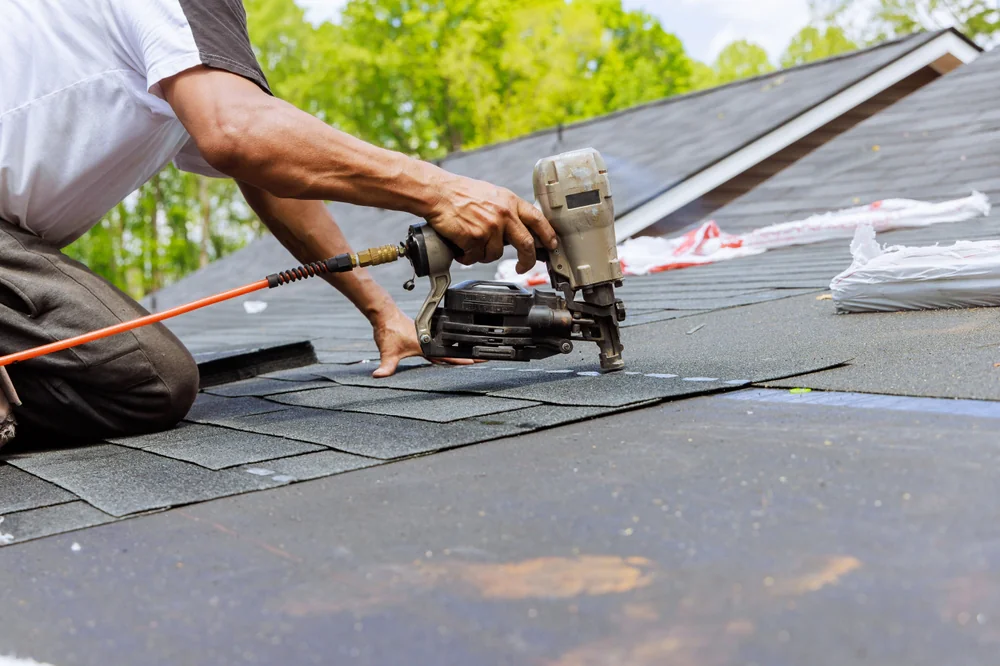
Roof repairs aren’t one-size-fits-all, and what your roof needs depends heavily on its age, materials, and what it’s been through. For South Huntington homes many of them built decades ago with standard three-tab asphalt shingles the most common repairs we handle are missing or damaged shingles, failed or improperly installed flashing around chimneys, skylights, and vents, damaged underlayment, and issues caused by ice dam formation during winter. Flat roof repair is also something we handle for homes and additions that have low-slope sections, which aren’t uncommon on the ranches and split-levels throughout this area.
Every repair includes a full inspection of the surrounding area not just the obvious damage point. A missing shingle repair that ignores the compromised underlayment underneath it isn’t a repair; it’s a delay. We look at the whole picture and give you an honest assessment of what needs to happen now versus what can wait.
If your damage is the result of a storm a nor’easter, a summer thunderstorm, a fallen tree limb we’ll document everything in a format that supports a homeowners insurance claim. A lot of South Huntington homeowners don’t realize their policy covers wind and hail damage, or they’re not sure how to present it to the adjuster. We handle that documentation as part of the job, not as an add-on.

For most roof repairs in South Huntington, a building permit is required through the Town of Huntington’s Department of Engineering Services. The town’s code is clear: construction, alteration, repair, or modification of a structure requires a permit before work begins. That includes roof replacements and significant repairs not just cosmetic shingle swaps.
Pulling that permit requires a valid Suffolk County Home Improvement Contractor license, proof of Workers’ Compensation insurance with the Town of Huntington named as the certificate holder, and compliance with New York State Building Code. We handle all of that. We file the paperwork, we do the work to code, and we schedule the final inspection. For a home in South Huntington worth $700,000 or more, unpermitted roof work isn’t just a technicality it can complicate a future sale, void your insurance coverage, and leave you personally exposed. It’s not a corner worth cutting.
The honest answer is that it depends on the age of the roof, the extent of the damage, and what’s happening underneath the shingles. A roof that’s 10 to 15 years old with localized storm damage a few missing shingles, a section of failed flashing is usually a strong repair candidate. A roof that’s 25 to 30 years old, showing widespread granule loss, multiple soft spots, and recurring leaks in different areas, is typically past the point where repairs make financial sense.
A lot of South Huntington’s housing stock falls into that second category. Post-war Cape Cods and ranches on the west end, even homes that got a replacement in the late 1990s, are now looking at roofs that are well past their expected lifespan. The only way to know for sure is a proper inspection not an estimate from the driveway. We go up, we look at the decking and underlayment, and we give you a straight answer. If repair is the right call, we’ll tell you. If replacement makes more sense, we’ll tell you that too.
Ice dams form when heat escapes from your living space through the roof, melts the snow sitting on the upper portions, and that water runs down and refreezes at the cold eaves where there’s no heat below to keep it liquid. That ice backs up under your shingles and forces water into your attic, insulation, and eventually your ceilings and walls. By the time you see a stain inside, the damage has usually been building for a while.
South Huntington and the broader Town of Huntington area are particularly susceptible to this because of the combination of mature tree canopy, older homes with inadequate attic insulation and ventilation, and Long Island’s winter pattern of hard freezes followed by above-freezing days. That constant temperature cycling is exactly what creates the conditions for ice dam formation. Cape Cod homes common on the west end of South Huntington are especially vulnerable because of their roof geometry and the way heat moves through the upper floors. If you’ve had ceiling staining near exterior walls after winter, ice dams are a likely culprit, and that’s something we can assess and repair properly.
Repair costs vary depending on what’s actually wrong, how much of the roof is affected, and what materials are involved. For context, the national average for residential roof repair in 2025 is around $4,699 but that number covers a wide range of scope. A straightforward shingle repair or flashing fix on a smaller Cape Cod is going to look very different from addressing ice dam damage across a larger colonial on the east end of South Huntington.
What we can tell you is that the estimate you get from us is the number you pay. There are no fees added after the crew starts working no surprise charges for plywood replacement, underlayment, or debris disposal. Those items are accounted for upfront. The most expensive roof repair is the one that gets done twice because the first contractor cut corners or missed the underlying problem. We’d rather give you an honest number at the start than have you call us back in six months with the same issue.
For genuine emergencies a storm tears off shingles, a tree limb comes through the roof, active water intrusion we respond same day, often within hours. After a major nor’easter moves through the Town of Huntington, we know the phones are going to ring. We plan for it. If your roof is actively letting water in, the priority is getting out there, assessing the damage, and getting temporary weatherproofing in place so the interior damage stops getting worse while we plan the full repair.
One thing worth knowing: after big storms on Long Island, out-of-area contractors show up fast, going door to door and offering quick fixes. Some of them are fine. A lot of them aren’t licensed in Suffolk County, don’t pull permits, and won’t be around if something fails six months later. We’ve been serving Suffolk County for over a decade. We’re not here for the storm we’re here year-round, and we stand behind every job with our name and license on it.
In most cases, yes if the damage was caused by a sudden event like wind, hail, or a falling tree. Long Island homeowners insurance policies generally cover storm-related roof damage, and given that wind and hail account for more than half of all residential claims nationally, there’s a real chance your damage qualifies. What insurance typically does not cover is deterioration from age or lack of maintenance which is why documentation matters so much.
If your South Huntington roof was damaged in a storm, the way you document and present that damage to your adjuster has a direct impact on your claim outcome. We photograph and record the damage in detail the shingles, the underlayment, the decking, the flashing and we can help you understand what to submit and how to communicate with your insurance company. We’re not adjusters, and we don’t make promises about what your policy will pay. But we make sure you’re going in with the strongest possible documentation, which is something a lot of homeowners don’t get from contractors who just want to start the job and move on.
Other Services we provide in South Huntington