

Hear From Our Clients

A roof repair isn’t just about stopping the drip you see today. It’s about making sure the same spot isn’t leaking again after the next nor’easter rolls through the South Shore. That’s the standard every Lindenhurst homeowner deserves and it’s the only standard worth paying for.
The homes in Lindenhurst, especially those south of Montauk Highway near the canal neighborhoods, deal with conditions that inland towns simply don’t. Salt air off the Great South Bay corrodes flashing faster than most contractors account for. Wind-driven rain during a coastal storm doesn’t behave the same way it does five miles inland. A repair that ignores those realities is just a temporary fix with a countdown clock on it.
When the work is done correctly with the right materials, proper flashing, and a real look at what’s underneath you stop worrying every time the forecast turns ugly. Your ceiling stays dry. Your home stays protected. And you’re not back on the phone with a roofer six months later wondering what went wrong.
Home Team Construction is a family-owned exterior contracting company based in Suffolk County, owned and operated by Alban Hoxha. Alban is personally involved in every job not in a marketing-slogan kind of way, but in an actual boots-on-the-ground, answers-the-phone, shows-up-on-site kind of way. That matters more than most people realize until something goes wrong with a contractor who doesn’t operate that way.
We’ve been working across Suffolk County for over a decade, including the South Shore communities like Lindenhurst that deal with the specific wear patterns coastal exposure creates. From the post-WWII Cape Cods and ranches along Lindenhurst’s residential streets to the bay-front homes sitting in the flood zones south of Montauk Highway, the housing stock here is familiar territory.
Every worker on your job is a Home Team employee no subcontractors, no unfamiliar crews. And every repair is documented with photos and video so you can see exactly what was done, even if you were on the LIRR when the work happened.
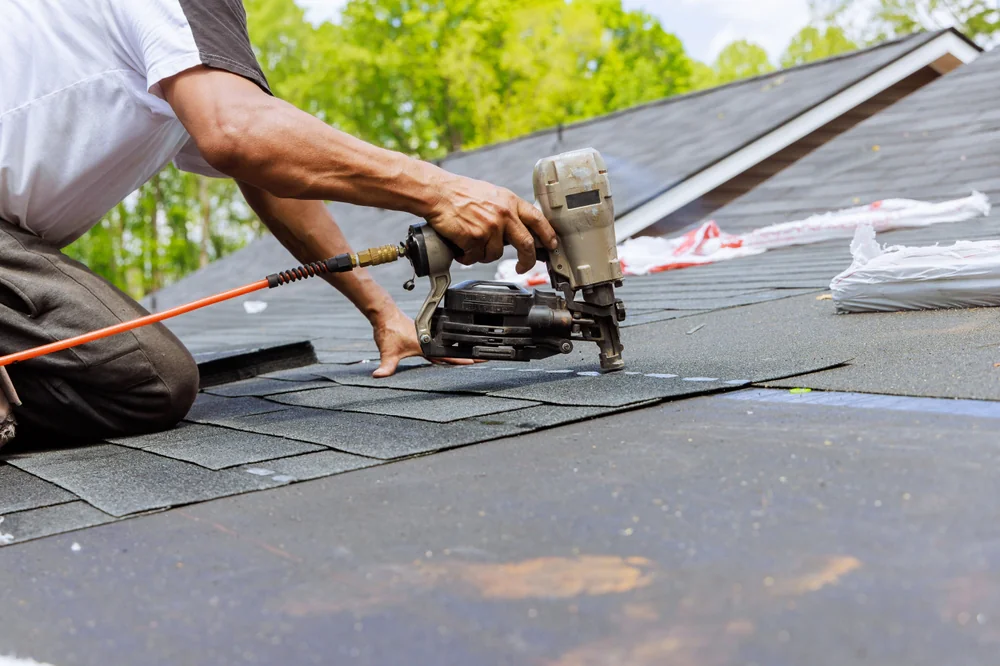
It starts with a thorough inspection not a five-minute visual scan from the driveway, but an actual assessment of your roof’s condition. That means checking the obvious damage, but also the flashing at your chimney and skylights, the condition of the underlayment, the soffits and fascia, and any low-slope sections that tend to be the first place water finds a way in. In Lindenhurst’s canal neighborhoods, that inspection also accounts for what salt air and moisture exposure have done to your metal components over time.
From there, you get a clear, upfront estimate. What the repair costs is what it costs no fees added mid-job for plywood, underlayment, or debris disposal. If the inspection turns up something unexpected, you hear about it before any additional work starts, not after.
The repair itself is done by our own crew, using materials appropriate for South Shore conditions. When the job is complete, you receive photo and video documentation of everything that was done. If your repair is the result of storm damage, the documentation is formatted to support an insurance claim. For work requiring a permit through the Village of Lindenhurst Building Department, we handle that process correctly the village has its own building department at 430 South Wellwood Avenue, separate from the Town of Babylon, and navigating that distinction is something not every contractor gets right.

Ready to get started?
Our roof repairs cover the full range of what Lindenhurst homes actually need leak diagnosis and repair, missing or damaged shingle replacement, flashing repair and replacement at chimneys, skylights, and roof edges, flat roof repair, soffit and fascia repair, ice dam damage remediation, and 24/7 emergency response for storm damage. If you’re dealing with a leak at 10 PM after a coastal storm, someone picks up.
The coastal exposure in Lindenhurst changes what good repair work looks like. Flashing on a bay-front home south of Montauk Highway needs to be specified differently than flashing on a home in a town that doesn’t deal with constant salt air. The materials used on low-slope sections of older Cape Cods need to account for the freeze-thaw cycles that come with nor’easter winters on the South Shore. These aren’t upsells they’re the difference between a repair that lasts and one that doesn’t.
Insurance claim support is included as a standard part of the process, not an add-on. If storm damage is involved, the photo and video documentation from your job is organized to give your adjuster exactly what they need. We hold a valid Suffolk County Home Improvement Contractor license a credential that requires passing a mandatory exam, and one you can verify in the county’s public database before you ever call.

It depends on the scope of the work. Minor repairs patching a small section, replacing a few shingles, resealing flashing typically don’t require a permit. But if the job involves replacing a significant portion of the roof deck, changing the roofing material, or any structural work, a permit is required.
What makes Lindenhurst different from most other Suffolk County towns is that it’s an incorporated village with its own Building Department at 430 South Wellwood Avenue, separate from the Town of Babylon’s building division. That means the permitting process runs through the village, not just the town and contractors who aren’t familiar with that distinction sometimes pull the wrong permits or skip the process entirely. Unpermitted work can create real problems when it’s time to sell your home or file an insurance claim. We navigate the Village of Lindenhurst’s requirements correctly and ensure every job that needs a permit gets one.
The honest answer is that you can’t always tell from the ground, and neither can we without actually getting up there and looking. What you’re evaluating is the overall condition of the roof system not just the shingles, but the decking underneath, the underlayment, and the flashing.
If the shingles are losing granules heavily, curling at the edges, or missing in multiple areas, and the roof is 20-plus years old, replacement is usually the more cost-effective path. But if the damage is localized a section of flashing that failed, a few shingles blown off in a storm, a single leak point repair is often the right call and can extend the life of your roof by several years. For Lindenhurst homeowners whose roofs were replaced or substantially repaired after Hurricane Sandy in 2012, those roofs are now 10-13 years old and worth a professional assessment to understand where they stand.
The most common culprits on South Shore homes are failed flashing, aging underlayment, and storm damage and in Lindenhurst specifically, salt air accelerates all three. Flashing is the metal that seals the joints around your chimney, skylights, vents, and roof edges. It’s the first thing to corrode in a coastal environment, and it’s the most common source of leaks that homeowners can’t explain because the shingles above it look fine.
Ice dams are another major source of winter leaks in this area. When snow accumulates on the roof and the attic is warm enough to melt the bottom layer, water runs down and refreezes at the cold eaves then backs up under the shingles. Older homes with inconsistent attic insulation, which describes a lot of Lindenhurst’s post-WWII housing stock, are especially prone to this. And after a nor’easter with wind-driven rain, even a roof in decent condition can develop leaks at any weak point that wouldn’t cause a problem under normal rainfall.
For emergency situations an active leak, storm damage that’s left your roof exposed we typically respond within hours. Our 24/7 emergency line exists specifically for the kind of weather events that Lindenhurst deals with regularly: nor’easters that come through overnight, tropical storm remnants that bring sustained wind and rain, and the occasional severe storm that sends debris across the bay-front neighborhoods south of Montauk Highway.
The first step after an emergency call is getting to your home to assess the damage and provide immediate weatherproofing tarping or temporary sealing to stop further water intrusion while permanent repairs are planned. That step matters because water damage compounds quickly once it’s inside the structure. The documentation from that initial visit is also useful if you’re filing a homeowner’s insurance claim, since it captures the condition of the damage before any work has been done.
For the homes in Lindenhurst’s canal neighborhoods and bay-front streets, material selection matters more than it does for inland properties. Standard builder-grade shingles and basic galvanized flashing work fine in areas without significant salt air exposure but in a coastal environment, you’re asking those materials to perform under conditions they weren’t fully designed for.
For shingles, architectural shingles with a higher wind rating are the right baseline for South Shore homes they’re more resistant to wind uplift and have better granule adhesion than three-tab shingles. For flashing, copper or high-quality aluminum outperforms standard galvanized steel in a salt-air environment because it doesn’t corrode at the same rate. The specific product recommendations depend on your roof’s configuration and exposure level, which is why a proper inspection matters before any repair or replacement work starts. We’ll tell you what makes sense for your specific home not just what’s cheapest or fastest to install.
Lindenhurst has lived through enough storm seasons including Hurricane Sandy in 2012, when more than half the village’s streets flooded to know that bad contractors show up fast after a major weather event. They go door to door, offer lowball estimates, take deposits, and either disappear or do work that fails within a season. It’s a well-documented pattern across Long Island’s South Shore communities after significant storms.
The most reliable protection is verification. Any contractor working on a home in Suffolk County needs a valid Home Improvement Contractor license and Suffolk County requires passing a mandatory written exam to get one, which filters out a lot of the fly-by-night operators. You can verify any contractor’s license in the county’s public database before you sign anything. Beyond that, look for a company with a verifiable local address, a track record of work in Lindenhurst specifically, and reviews that describe actual jobs not generic five-star ratings with no detail. A contractor who pulls permits through the Village of Lindenhurst Building Department correctly, documents their work with photos, and gives you a complete written estimate before starting is operating the way a legitimate business operates. That’s the standard worth holding to.
Other Services we provide in Lindenhurst