
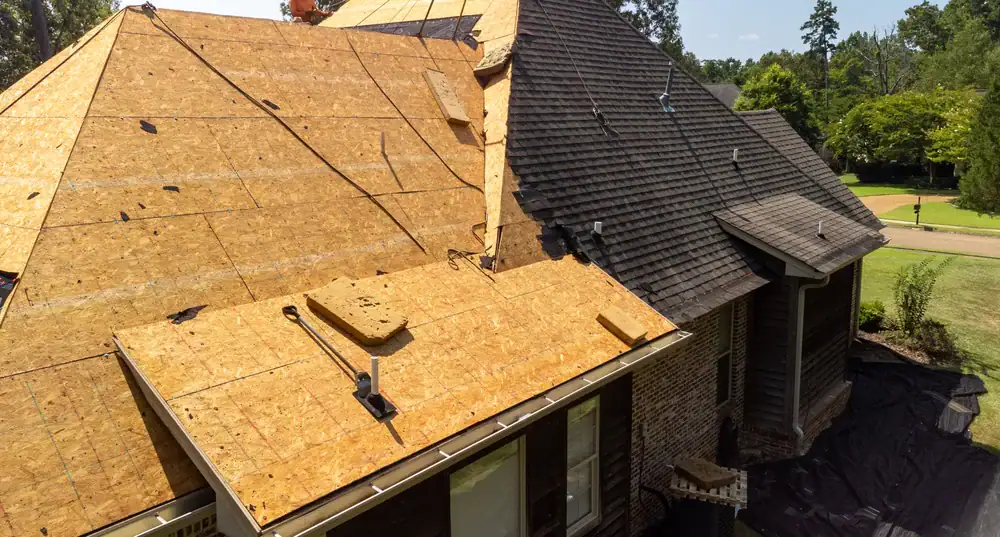
Summary
A missing shingle or small leak can feel like a manageable weekend fix — until it voids your homeowners insurance or wipes out your manufacturer warranty. This guide breaks down what DIY roof repair actually risks, what it costs compared to hiring a licensed contractor, and how to tell the difference between a minor maintenance task and a job that needs a professional.
For Suffolk County homeowners dealing with storm damage, salt air wear, and aging roofs, the stakes are higher than most. Read this before you get on that ladder.
After a nor'easter rolls through, it's tempting to grab a ladder and handle it yourself. You saw the shingle fly off. You know where the ceiling stain is. How hard could it be?
Harder than it looks — and more expensive when it goes wrong. In Suffolk County, where storm damage is routine and home insurance averages $2,840 a year, a DIY repair done incorrectly can give your insurer grounds to deny a claim, void your shingle warranty, or leave you with a bigger problem than the one you started with. This guide walks you through what's actually at stake, what the work really involves, and how to decide when it makes sense to call a professional.
Roof Repair Safety Risks and Insurance Implications for Suffolk County Homeowners
Most homeowners who attempt DIY roof repairs aren't reckless — they're just dealing with a problem that feels urgent and don't want to wait or overpay. That's completely understandable. But roofing is consistently ranked among the most dangerous types of work, and the risks don't disappear just because you're careful.
Falls account for three-quarters of all fatalities in the roofing industry — and that's among people who do this every day with proper equipment. The CDC reports that more than 97% of roofing and ladder accidents happen at home, not on professional job sites. OSHA requires fall protection at any height above six feet. Most homeowners working on their own roof have none of it.
Beyond the physical risk, there's a financial one that doesn't get talked about nearly enough: what a DIY repair can do to your insurance coverage.
Does DIY Roof Repair Void Your Homeowners Insurance?
It can — and in Suffolk County's insurance environment, that's not a risk worth taking lightly.
Here's how it typically plays out. A storm causes damage to your roof. You climb up, replace a few shingles, apply some roofing cement around a flashing seam, and figure you've handled it. Weeks later, water is getting in. You file a claim. The adjuster comes out, sees evidence of prior repair work, and determines that the damage was worsened — or caused — by improper maintenance. Claim denied, or significantly reduced.
Insurance companies aren't looking to pay out more than they have to. When they see DIY work that doesn't meet installation standards, they have legitimate grounds to question whether the damage was the storm's fault or the repair's fault. In many cases, they'll send an engineer to investigate. Intermittent leaks, improperly seated shingles, and misapplied sealants are all red flags that point to workmanship problems rather than storm events.
This matters even more in Suffolk County because the region has been hit by 45 named storms since 1930. Insurers operating here are well-acquainted with storm claims and they look closely at roof maintenance history. A paper trail that includes a licensed contractor's documentation is a much stronger position than a receipt from the hardware store.
There's also the warranty angle. Major shingle manufacturers — GAF, Owens Corning, CertainTeed — require certified contractor installation to maintain product warranties. A new roof is an $8,000 to $25,000 investment. If a DIY patch voids the system warranty and the roof fails two years later, that cost comes entirely out of your pocket. We can also offer extended manufacturer warranties — sometimes 25 years or more — that simply aren't available to homeowners who do the work themselves.
The short version: the money you save on a DIY repair can evaporate quickly if it leads to a denied claim or a voided warranty on a roof that still has years of life left in it.
What Roof Repairs Are Safe to DIY vs. What Needs a Professional?
To be fair, not every roofing task requires a licensed contractor. There's a meaningful difference between basic maintenance and actual repair work, and being honest about that distinction is more useful than telling every homeowner to call a pro for everything.
Clearing debris from gutters, removing leaves and branches from the roof surface, and visually inspecting your roof from the ground or through binoculars after a storm — these are reasonable things a homeowner can do without risk to their safety or their insurance coverage. If you notice granules accumulating in your gutters, that's useful information to pass along to a contractor. Spotting a lifted shingle from the ground and calling for an inspection is exactly the right move.
Where it gets complicated is the moment you start making repairs. Replacing a shingle sounds simple, but doing it correctly requires matching the existing material, using the right nail pattern per manufacturer specifications, and ensuring the surrounding shingles haven't been compromised. An incorrect nail placement — too high, too low, or at the wrong angle — is one of the most common reasons shingles blow off in high-wind events. It's also one of the most common reasons insurance adjusters determine that damage wasn't storm-related.
Flashing is where most DIY repairs fail entirely. The metal flashing around chimneys, skylights, vent pipes, and roof valleys is the most leak-prone area on any roof, and it's also the most technically demanding to repair correctly. Applying roofing cement over a flashing gap is a temporary measure at best. It degrades in UV exposure, traps moisture underneath, and rarely addresses the actual source of the leak. What looks like a fixed problem from the outside can be actively worsening behind the scenes.
In coastal Suffolk County, there's an added layer of complexity. Salt air accelerates the deterioration of metal components, and standard repair materials that hold up fine in inland markets don't perform the same way here. Standard asphalt shingles last 15 to 20 years in coastal areas versus 25 to 30 years inland. A repair done with the wrong materials in this environment will fail faster — sometimes within a single storm season.
If you're asking whether you need a professional, the honest answer is: if you're asking, you probably do.
Professional Roof Repair Benefits That DIY Simply Can't Match
There's a version of this conversation where the argument for professional repair is purely about safety or liability. But the more practical case is simpler than that: a licensed contractor gets you a better outcome, documented proof of what was done, and coverage that protects your investment.
In a market like Suffolk County — where storms are frequent, insurance scrutiny is real, and roofing materials need to meet coastal standards — the gap between a professional repair and a DIY one isn't just about skill. It's about what you're left with when the job is done.
Essential Roof Repair Tools and Why Most Homeowners Don't Have Them
One of the most common reasons people underestimate DIY roof repair is that they're picturing the visible part of the job — replacing a shingle, sealing a gap — without accounting for everything that goes into doing it correctly and safely.
The basic tool list for a proper shingle repair includes a roofing nail gun or hammer, a pry bar for removing damaged shingles without disturbing adjacent ones, roofing nails in the correct gauge and length for your shingle type, a utility knife, roofing adhesive, and replacement shingles that actually match your existing roof in both material and color. That last point matters more than people expect — mismatched shingles can affect how the roof performs as a system, not just how it looks.
For anything involving flashing, you're adding tin snips, a caulking gun with appropriate sealant, and in many cases, new flashing material that needs to be cut and bent to fit correctly. Getting flashing angles wrong is one of the most reliable ways to create a leak that didn't exist before.
Then there's the safety equipment, which is the part most homeowners skip entirely. OSHA requires fall protection at heights above six feet, which means a personal fall arrest system, roof anchors, and a harness rated for the work. A stable extension ladder with proper standoff distance is the starting point, not the whole answer. Without this equipment, you're taking on a risk that professionals manage carefully — and even they account for roughly 50 fatalities per year in the roofing industry.
The honest cost comparison here isn't just materials versus labor. It's the full picture: tools you don't own, safety equipment you'll use once, materials you're buying at retail versus what a contractor pays at wholesale, and the time it takes to do the job correctly versus the time it takes to do it quickly. When you add it up, the savings are often smaller than expected — and that's before accounting for any mistakes.
Why Suffolk County Roof Repairs Require More Than a Generic Fix
Long Island's coastal environment is genuinely different from most of the country, and roofing work here reflects that. It's not a marketing angle — it's a material reality that affects how long repairs last and what methods hold up over time.
Salt air from both the Long Island Sound on the north shore and the Atlantic Ocean on the south shore accelerates corrosion on metal flashing, fasteners, and gutters. Roofs in Setauket, Copiague, Babylon, and Montauk are dealing with conditions that inland markets simply don't face at the same intensity. Impact-resistant shingles, salt-air-resistant underlayment, and proper ventilation aren't optional upgrades here — they're what determines whether a repair lasts five years or fifteen.
Ventilation is one of the most overlooked factors in DIY repairs. Improper attic ventilation caused by work that disrupts the existing system can void shingle warranties, cause premature shingle failure, and create the conditions for ice dams in winter. Ice dams are a particular problem throughout Suffolk County — when heat escapes through the roof and melts snow that refreezes at the eaves, water gets forced under shingles in ways that are difficult to diagnose and expensive to fix. DIY attempts to address ice dams, especially in winter conditions, are among the more dangerous repair scenarios we see.
We've been doing this work in Suffolk County for over 10 years, and the pattern we see most often is a homeowner who did a reasonable-looking repair that failed within a season because the underlying issue wasn't addressed or the materials weren't right for the environment. A missing shingle is sometimes just a missing shingle. But it's also sometimes a sign that the adhesive strips across that section of roof have failed, or that the decking underneath has softened, or that the flashing at a nearby valley is letting water in. You can't see those things from the outside, and you can't assess them without getting into the system.
That's why we document everything with photos and videos — not as a formality, but because the work that matters most happens in places the homeowner can't see after the job is done. When we finish a repair, you know exactly what was found and what was done about it.
When to Call a Roofer Instead of Handling It Yourself in Suffolk County
The honest answer to "can I DIY this?" is usually: it depends on what you're actually dealing with. Basic maintenance is fine. Actual repair work — anything involving shingles, flashing, underlayment, or leak diagnosis — carries real risks to your safety, your insurance coverage, and your warranty protection that most homeowners don't fully account for until something goes wrong.
Suffolk County's storm history, coastal conditions, and insurance environment make those risks more consequential here than in most markets. A repair done incorrectly after a nor'easter isn't just a wasted afternoon — it can be the reason a claim gets denied or a warranty gets voided on a roof that still had years of life left.
If you're unsure what you're looking at, or if you've already attempted a repair and want to know whether it was done correctly, the best next step is a professional inspection. We've been serving Suffolk County homeowners for over a decade — no subcontractors, upfront pricing, and 24/7 availability when storms don't wait for business hours. Reach out and we'll take a look.
Article details