Summary
Suffolk County's weather doesn't forgive a poorly built roof. Between nor'easters, salt air, summer heat, and hard winters, your roof takes a beating that most standard installations aren't designed to handle.
This page breaks down what custom roofing actually means, why energy-efficient systems make financial sense on Long Island, and what separates a roof built to last from one that just looks good on day one. If you're weighing your options, this is worth the read.
Most homeowners don't think about their roof until something goes wrong. A leak after a storm, a spike in the electric bill every August, or ice backing up along the eaves in January. By then, the damage is already done — and the options get more expensive in a hurry.
If you're at the point where a replacement or major upgrade is on the table, the decision you make now will affect your home for the next 30 to 50 years. That's worth getting right. Here's what it actually means to build a custom roofing system that's designed for where you live — and why that distinction matters more in Suffolk County than almost anywhere else.
Energy-Efficient Roofing Systems Designed for Long Island's Climate
Energy-efficient roofing isn't a single product — it's a system. It's the combination of materials, ventilation, insulation, and roof installation method working together to manage heat, moisture, and airflow in a way that keeps your home more comfortable and your utility bills lower.
In Suffolk County, that matters for reasons that go beyond the obvious. PSEG Long Island's electricity rates are well above the national average, which means every degree of heat your roof lets into your attic costs you more than it would in most other parts of the country. A properly designed roofing system doesn't just protect your home from the outside — it actively reduces the load on your HVAC system from above.
Energy Star Rated Shingles: What They Actually Do for Suffolk County Homes
Energy Star rated shingles are manufactured with solar-reflective granules that bounce sunlight away from the roof surface instead of absorbing it. The practical result: roof surface temperatures drop by 20 to 30 degrees Fahrenheit compared to standard dark shingles. That cooler surface means less heat radiating into your attic, less strain on your air conditioning, and a more consistent indoor temperature on the kind of humid July days that are a fixture of Suffolk County summers.
For homeowners here, the savings are real and measurable. Typical cooling cost reductions run 10 to 15 percent annually — roughly $75 to $150 per year for most homes. The premium for Energy Star shingles over standard architectural shingles is usually in the $300 to $800 range for a full roof. At those numbers, you're looking at a payback period of five to seven years, and then pure savings after that. On Long Island's utility rates, that math is more favorable than in most markets.
Products like GAF Timberline Cool and Owens Corning Duration Cool both carry Energy Star certification and may qualify for rebates through PSEG Long Island — something most contractors never bring up, but that can meaningfully reduce your out-of-pocket cost on the project.
It's also worth knowing that modern Energy Star shingles don't look any different from standard architectural shingles. They come in the same profiles, the same color ranges, and the same styles. You're not making a visual trade-off. You're just getting a material that works harder for you.
How Energy Star Roof Shingles Help Prevent Ice Dams on Long Island
Most homeowners think of energy-efficient roofing as a summer solution. But one of its most important benefits in Suffolk County is what it does in winter — specifically, how it reduces the risk of ice dams.
Ice dams form when heat escapes through an under-ventilated attic and warms the roof deck unevenly. Snow melts at the warmer upper sections, runs down toward the eaves, and refreezes when it hits the cold overhang. That ice builds up, backs up under the shingles, and forces water into your home. It's a recurring problem across Suffolk County, from Setauket to Babylon, and it causes the kind of interior damage — soaked insulation, stained ceilings, rotted sheathing — that gets expensive fast.
A properly designed energy-efficient roofing system addresses this directly. Adequate attic ventilation keeps the roof deck at a more uniform temperature in cold weather, which disrupts the freeze-thaw cycle that creates ice dams in the first place. When we design a custom roofing system, we're not just picking shingles — we're evaluating your attic's airflow, the condition of your ridge and soffit vents, and whether your insulation is doing its job. Getting those elements right doesn't just save you money on cooling in August. It protects your ceilings, your walls, and your insulation every winter.
This is the part most standard installations skip. A contractor who shows up, tears off the old shingles, and installs new ones without ever looking at your ventilation situation is leaving a significant vulnerability in place. In Suffolk County, where winters are hard and attics in post-war homes are often under-ventilated, that's not a minor detail.
What Custom Roofing Actually Means for Your Home
"Custom roofing" gets used loosely in this industry. What it should mean is that your roof is designed around your specific home — its pitch, its exposure, its age, its location within Suffolk County, and the particular weather challenges it faces.
A home in Copiague on the South Shore deals with direct ocean exposure and salt air corrosion in a way that a home in Smithtown simply doesn't. A house in East Hampton faces different wind patterns than one in Brentwood. These differences aren't trivial. They affect which materials hold up, how long your roof lasts, and what your installation needs to account for.
Coastal Roofing Materials Built to Handle Salt Air and High Winds
Standard roofing materials weren't designed with Long Island in mind. Salt air accelerates corrosion in fasteners, flashing, and sealants. Wind-driven rain finds every gap a standard installation leaves behind. And the temperature swings between a Suffolk County summer and winter create expansion and contraction stress that shortens the lifespan of materials that aren't rated for it.
Coastal-grade materials — impact-resistant shingles, marine-grade sealants, corrosion-resistant flashing — exist specifically to address these conditions. When we install a roof on the South Shore or anywhere within a few miles of the water, material selection isn't a checkbox. It's a core part of what makes the installation worth the investment.
Wind resistance ratings matter here too. Products rated for 110 to 130 mph wind resistance are the standard for this market — not an upgrade. Hurricane Sandy changed how a lot of Long Island homeowners think about roofing, and rightly so. A roof that can't handle a serious nor'easter isn't doing its job. We spec materials that are appropriate for what this area actually throws at a house, not what works fine in a calmer climate.
For homeowners considering metal roofing, the case is even stronger. A properly installed metal roof system lasts 40 to 50 years, sheds snow and ice better than asphalt, and resists wind damage up to 140 mph. The upfront cost is higher — typically $10 to $16 per square foot compared to $5 to $9 for asphalt shingles — but the lifespan and performance in coastal conditions make it a legitimate long-term value for many Suffolk County homes.
Why No Subcontractors Matters More on a Custom Roofing Job
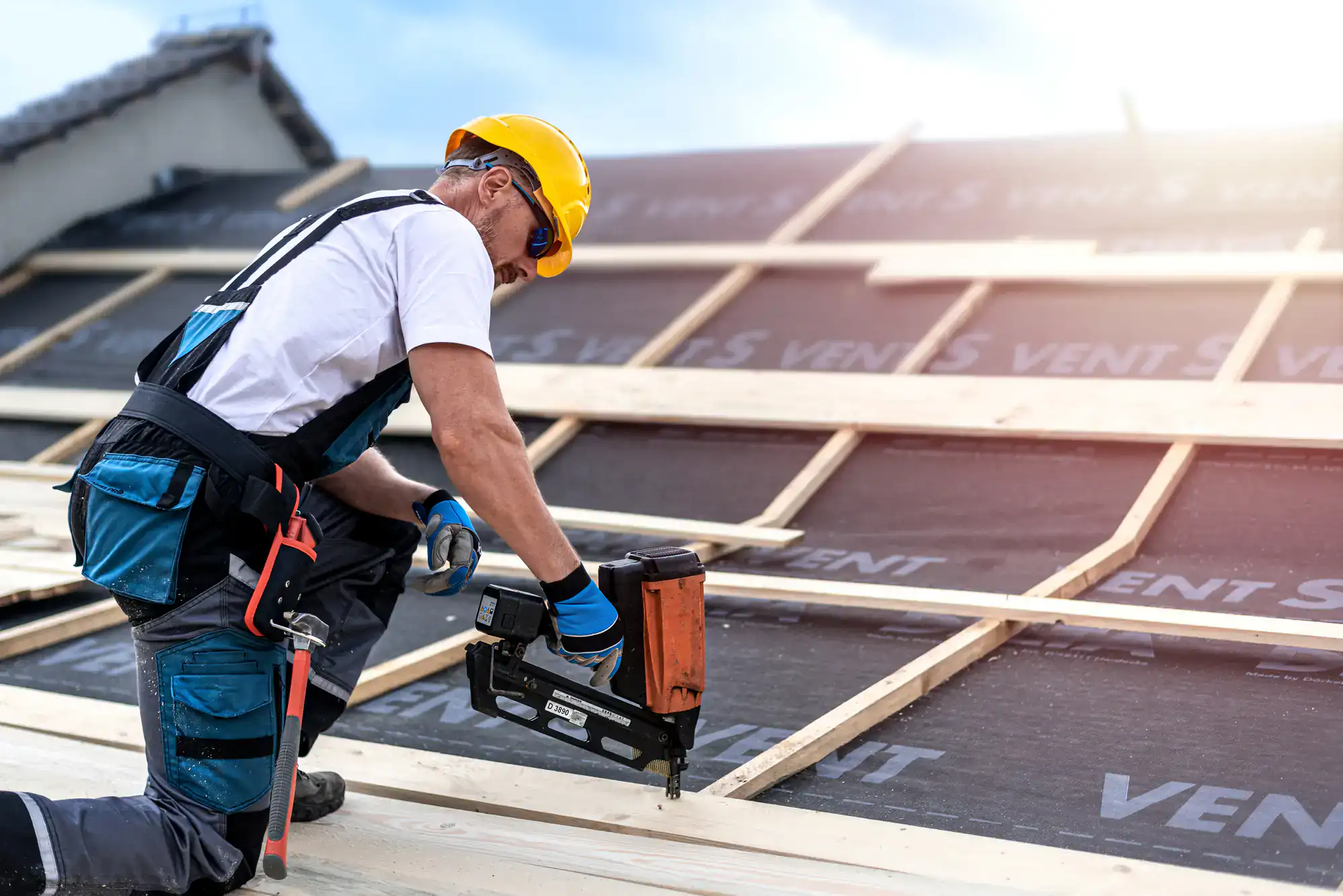
Custom roofing requires more judgment calls during installation than a standard replacement. When the old shingles come off and the deck is exposed, what gets found underneath — rotted sheathing, improperly installed flashing, inadequate ventilation, hidden water damage — determines what happens next. Those decisions need to be made by people who are accountable to you and to our company.
We don't use subcontractors. Every person working on your roof is a trained Home Team Construction employee. That's not a small thing. A significant portion of the complaints homeowners have about roofing contractors — unknown crews showing up, inconsistent workmanship, no one to call when something goes wrong — trace back directly to the subcontractor model. When the crew changes job to job, accountability disappears.
We also document every project with photos and videos during installation. Before the new shingles go on and everything is covered up, you see exactly what was found, what was repaired, and how the system was installed. That level of transparency isn't standard in this industry, but it should be. You're making a significant investment in your home — you deserve to know what you paid for.
We've been working in Suffolk County for over 10 years, with more than 400 reviews and a 4.9 out of 5 rating on HomeAdvisor. That track record exists because we're not a storm-chasing operation that moves on after a big weather event. We live and work here. Our reputation is local, and we protect it on every job.
Finding the Right Custom Roofing Contractor in Suffolk County, NY
If you're replacing a roof in Suffolk County, the decisions you make about materials, ventilation, and installation method will affect your home for decades. Getting a lower quote by cutting corners on those decisions isn't a savings — it's a deferred cost that usually shows up at the worst possible time.
A roof built for Suffolk County's specific conditions — coastal exposure, hard winters, humid summers, and the occasional major storm — performs differently than one built to a generic spec. Energy-efficient materials reduce your utility bills, proper ventilation prevents ice dams, and coastal-grade products hold up where standard materials fail.
If you want to talk through what your home actually needs, we're a call away. No pressure, no runaround — just a straight conversation about what makes sense for your house.
Article details